
If you’ve ever typed a sentence and paused, unsure whether to write accross or across, you’re not alone. This one small typo shows up in emails, social posts, and even published articles every single day. The Accross vs Across debate isn’t really a debate at all one spelling is correct, and the other simply isn’t a word. This guide clears up the Accross vs Across confusion for good, explains where the mix-up comes from, and shows you exactly how to use across the right way every time much like sorting out whether it’s goodmorning or good morning before you hit send.
The Correct Spelling Explained
Let’s settle the Accross vs Across question right away: across is correct, and accross is a misspelling. Standard English never doubles the c in this word. Every major dictionary Merriam-Webster, Cambridge, and Oxford included lists only one accepted spelling: a-c-r-o-s-s, with a single c and a double s.
The confusion likely comes from words like accompany, accord, or according, which do use a double c. Because those words feel similar, writers sometimes assume across follows the same pattern. It doesn’t. When you’re weighing Accross vs Across in your own writing, remember: only one version exists in standard English.
What Does Across Mean in English?
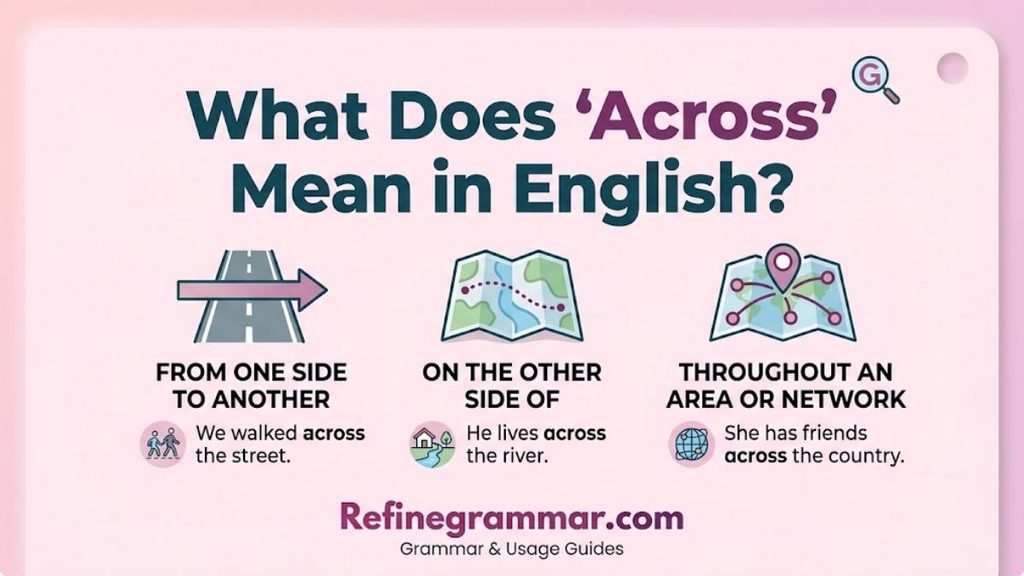
Across is a preposition and sometimes an adverb that describes movement or position from one side of something to the other. It shows up constantly in everyday English:
- She walked across the room to answer the door.
- The bridge stretches across the river.
- News of the merger spread across the industry.
In each example, across connects two sides, points, or areas. It can describe physical movement (walking across a street), spatial relationships (the store across from the bank), or a broader sense of coverage (a policy applied across the board).
Accross vs Across Meaning Explained
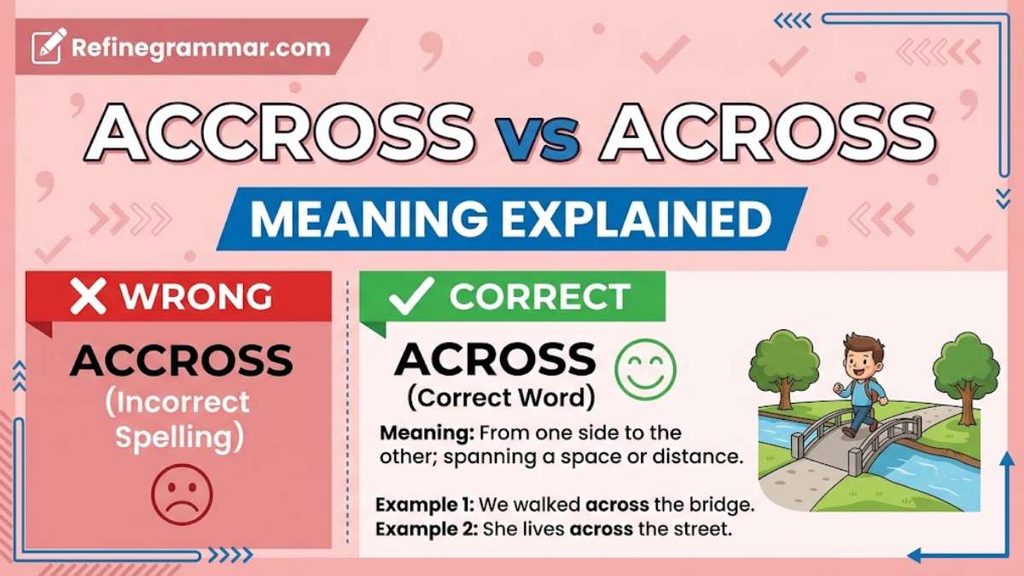
Since accross isn’t a real word, it has no independent meaning of its own it’s simply a misfire of the keyboard or a slip of memory. Whenever someone writes accross, what they mean, without exception, is across. There’s no shade of meaning or regional usage where the double-c version becomes acceptable. Anyone comparing Accross vs Across meaning will find the same answer every time: they’re not two variants of one word, just one correct word and one common mistake.
Why Is Across Spelled With One C?
English spelling often traces back to word origin, and across is no exception. It comes from the Middle English acros, formed from the prefix a- (meaning on or in) plus cross. Since cross itself only has one c, the compound word across kept that single c as it evolved. Doubling the consonant was never part of its history, which is exactly why accross never became standard, even informally.
Acrost vs Across: Is Acrost a Real Word?
You may have also heard people say acrost out loud, especially in casual or regional speech. Like accross, acrost is nonstandard. It’s a dialectal pronunciation that sometimes finds its way into writing, but no dictionary recognizes it as correct. Acrost vs Across follows the same rule as Accross vs Across: only across belongs in formal or professional writing. If you’ve heard acrost your whole life, that’s simply a spoken habit, not a spelling to bring into an email or essay.
Why Do People Spell Across Wrong?
A few patterns explain why accross is such a persistent typo:
- Pattern matching with other double-c words words like according or accurate train the eye to expect two c’s.
- Typing speed a fast typist’s fingers sometimes hit a key twice by accident.
- Regional pronunciation hearing acrost reinforces an incorrect mental spelling.
- Autocorrect gaps not every keyboard or app catches the error.
This kind of confusion isn’t unique to across. Plenty of English words trip people up for similar reasons, whether it’s mixing up tying vs tieing or debating of course or ofcourse. The Accross vs Across mix-up simply happens to be one of the most common.
Accross vs Across Grammar Rules Explained
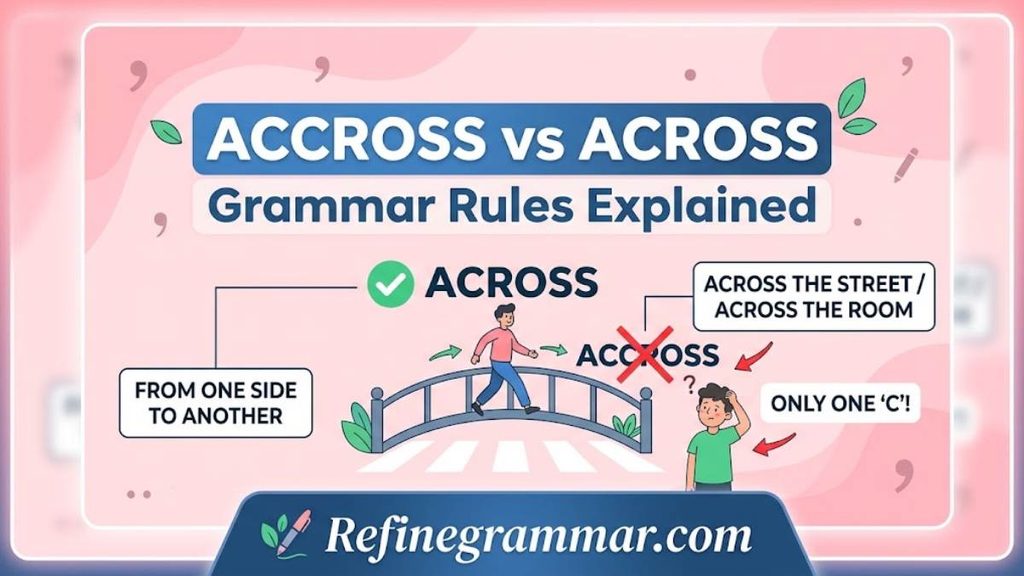
Grammatically, across functions as:
- A preposition, connecting a verb to a noun that shows position or direction (walk across the field).
- An adverb, modifying a verb without a following noun (she looked across).
There’s no grammatical rule that ever calls for a double c. Some learners assume that longer or more formal-sounding words need extra letters, similar to the confusion around beginning vs begining, where a doubled consonant actually is required. Across is the opposite case it stays lean, with just one c and two s’s, no matter how the sentence is structured.
How to Use Across in a Sentence Correctly
Here are a few natural examples to model your own writing after:
- We drove across the country in five days.
- The teacher placed the map across the whiteboard.
- Support for the proposal grew across the company.
- He glanced across the table and smiled.
Notice that across always links two points, sides, or areas. If your sentence describes that kind of relationship, across is almost certainly the word you need just remember it only ever takes one c.
Across vs Through vs Over: Key Differences
These three prepositions often get mixed up because they all describe movement, but each one implies a different path.
| Word | What It Implies | Example |
| Across | Movement over a flat surface, side to side | She swam across the lake. |
| Through | Movement inside or within something | He walked through the tunnel. |
| Over | Movement above or covering something | The plane flew over the mountains. |
Choosing correctly often comes down to visualizing the path. If you’re picturing a flat surface being crossed from one edge to another, across is your word similar to how getting take affect vs take effect right depends on picturing the right meaning before you write.
Across vs Cross: What’s the Difference?
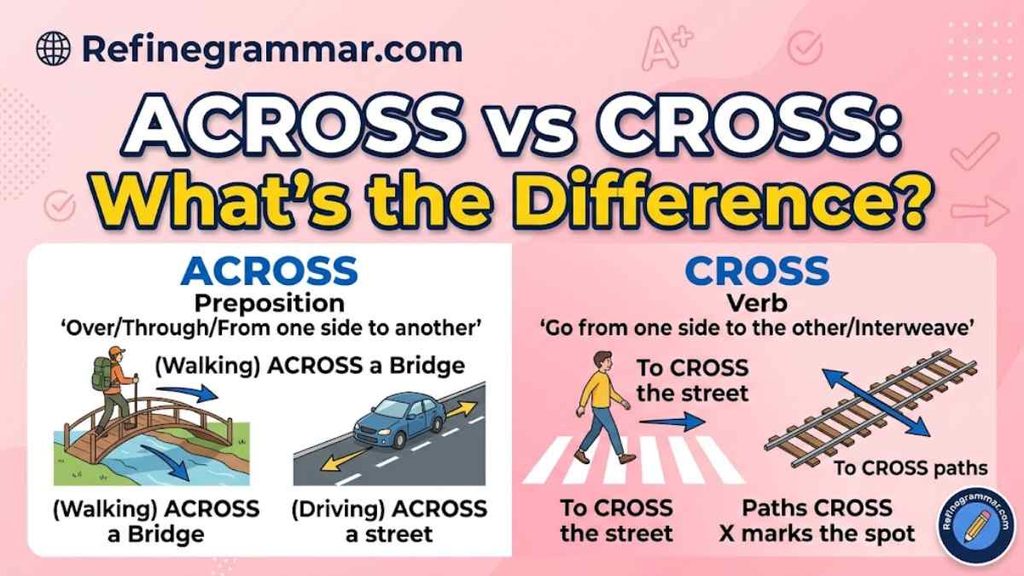
Across and cross are related but serve different grammatical roles. Across is a preposition or adverb, while cross is most often a verb or noun.
| Word | Part of Speech | Example |
| Across | Preposition/Adverb | The dog ran across the yard. |
| Cross | Verb | Cross the street carefully. |
| Cross | Noun | She wore a small cross necklace. |
A simple test: if you can replace the word with through or over and the sentence still makes sense, you likely need across. If the word is the main action in the sentence, cross is probably correct instead.
Across vs Around: What’s the Difference?
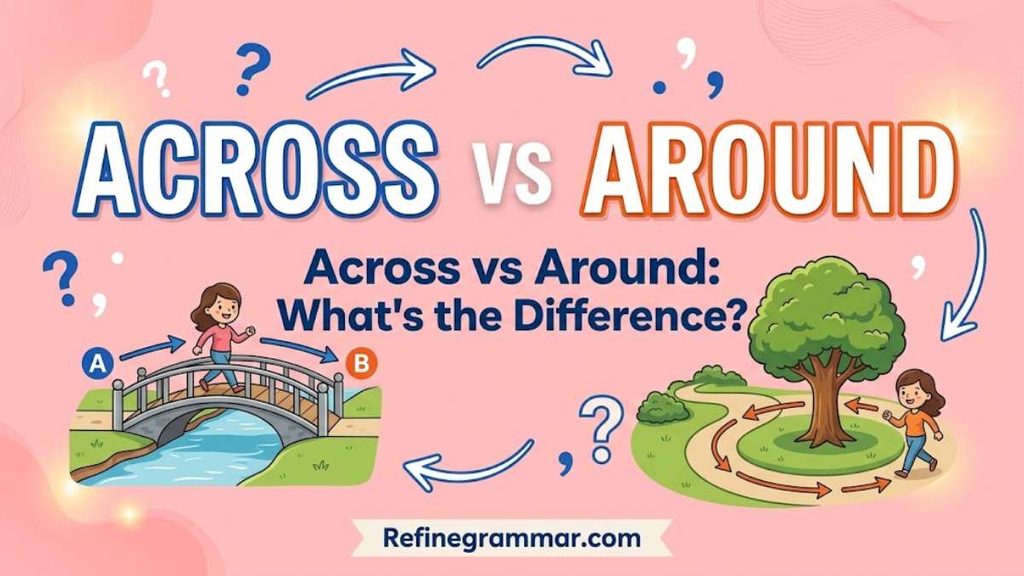
Across describes a direct path from one side to another, while around describes movement along the outer edge or in a circular path.
- She walked across the park. (straight through, side to side)
- She walked around the park. (along the perimeter)
Mixing these up doesn’t just sound awkward it can genuinely change the meaning of a sentence, since one implies a shortcut and the other implies going the long way.
Across vs Throughout: What’s the Difference?
Across usually refers to a spatial relationship, while throughout often adds a sense of time or completeness.
- The signal is strong across the building. (spatial coverage)
- The signal stayed strong throughout the day. (coverage over time)
They can overlap in some contexts news spread across the country and news spread throughout the country both work but throughout leans slightly more toward duration or thoroughness.
Synonyms and Similar Words to Across
Depending on context, you can sometimes substitute:
- Over
- Through
- Spanning
- Opposite
- From side to side
None of these are perfect one-to-one replacements, but they can help when you’re checking whether across truly fits your sentence. As with most Accross vs Across questions, the safest move is to default to the single-c spelling and only swap in a synonym when the meaning genuinely calls for it.
Across Spelling UK vs US: Any Difference?
Good news for anyone worried about regional spelling traps like defence or defense: across is spelled identically in both American and British English. There’s no UK variant with an extra letter and no US shortcut. Whether you’re writing for a US or UK audience, across one c, two s’s is the only accepted form.
Is Accross Ever Correct to Use?
No. When it comes to Accross vs Across, there is no context, dialect, or formal exception where accross is the accepted spelling. It doesn’t appear correctly in British English, American English, Australian English, or any recognized style guide. If you see it in published writing, it’s simply an error that slipped past editing not a valid alternative.
The Impact of Spelling Errors on Writing
A single typo like accross might seem minor, but repeated spelling mistakes can quietly damage how your writing is perceived. Readers may question your attention to detail, and in professional contexts resumes, emails, articles errors like this can undercut otherwise strong content. It’s the same reason getting beginning vs begining right matters on a job application. The good news is that the Accross vs Across mistake is easy to fix once you know the rule: just one c, always.
Practice Session
Test what you’ve learned about Accross vs Across with the quick exercises below.
Learn More: Beginning vs Begining: Quick Guide to the Correct Spelling
Fill in the Blanks
- She walked ______ the street to get her mail.
- The news spread quickly ______ the office.
- He looked ______ the room and waved.
- The bridge stretches ______ the entire valley.
Multiple Choice Questions
1. Which spelling is correct?
- a) Accross
- b) Across
- c) Acrost
- d) Accros
2. What part of speech is across in she ran across the field?
- a) Noun
- b) Preposition
- c) Conjunction
- d) Pronoun
3. Which sentence uses across correctly?
- a) He walked accross the bridge.
- b) He walked across the bridge.
- c) He walked acrost the bridge.
- d) He walked accros the bridge.
(Answers: 1-b, 2-b, 3-b)
FAQs
Is accross a correct way to spell across?
No. Accross is a common misspelling; the only correct spelling is across.
Why do people commonly misspell across as accross?
It usually happens because other words like according use a double c, which leads writers to assume across does too.
Is acrost a real word or just a variant of across?
Acrost is not a real word. It’s a nonstandard, dialectal pronunciation of across.
What does across mean in a sentence?
It describes movement or position from one side of something to the other, such as walking across a street.
What is the difference between across and cross?
Across is a preposition or adverb, while cross is usually a verb or noun describing an action or object.
What is the difference between across and through?
Across implies movement over a flat surface, while through implies movement within an enclosed space.
What is the difference between across and over?
Across suggests side-to-side movement, while over suggests movement above or covering something.
What is the difference between across and around?
Across means a direct path from one side to another, while around means moving along the outer edge.
What is the difference between across and throughout?
Across typically describes spatial coverage, while throughout often adds a sense of time or completeness.
Is there a difference between American and British spelling of across?
No. Across is spelled the same way in both American and British English.
Final Thought
The Accross vs Across question really comes down to one simple rule: across is always correct, and accross never is. Once that rule sticks, you’ll never second-guess this word again whether you’re writing a quick text or a polished, professional page. And if other tricky pairs still trip you up, brushing up on mix-ups like tying vs tieing is a great next step toward cleaner, more confident writing.
