
If you’ve ever paused mid-sentence wondering whether to write “amount” or “ammount,” you’re not alone. This is one of the most commonly searched spelling questions in English, and the confusion makes sense — the word is pronounced in a way that makes a double “m” feel almost natural. It isn’t, though. This guide settles the amount or ammount question for good, covering the meaning, grammar rules, origin, and real-world examples so you never second-guess the spelling again.
Amount or Ammount – Quick Answer
Amount is the only correct spelling. Ammount is a misspelling that doesn’t appear in any recognized English dictionary — not Oxford, not Merriam-Webster, not Cambridge. Whenever you’re debating amount or ammount, the rule is simple: one “m,” always.
Ammount or Amount Meaning
“Amount” refers to a total, sum, or quantity of something — money, time, effort, or any measurable resource. “Ammount” has no meaning of its own; it’s simply an incorrectly spelled version of “amount,” similar to how “recieve” is a common misspelling of “receive.”
Is It Ammount or Amount? Which Spelling Is Correct?
The correct spelling is amount. This holds true across formal writing, casual messaging, business documents, and academic papers. There’s no context — regional, stylistic, or otherwise — where “ammount” becomes acceptable. If you’re still typing “ammount” out of habit, it’s worth unlearning now, since spelling errors like this can quietly undermine your credibility, especially in professional or financial writing where precision matters most.
What Is the Correct Spelling of Amount?
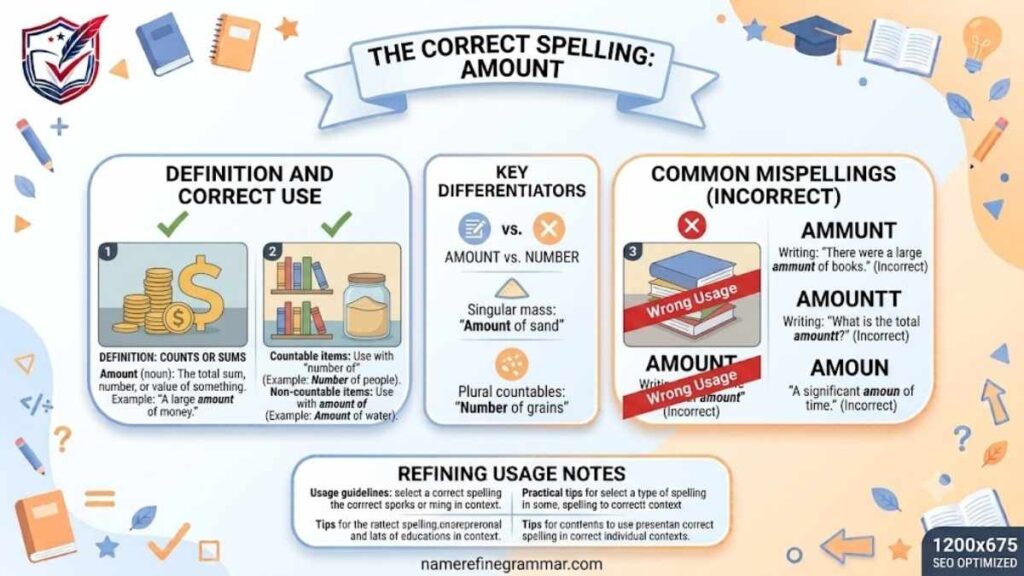
The correct spelling has a single “m” positioned between “a” and “ount”: a-m-o-u-n-t. A quick way to remember it is to think of the word “mount” (as in a mountain) with an “a” added to the front. Just as a mountain has one peak, “amount” has just one “m.”
This mistake is similar to other frequently confused word pairs, like ballon vs balloon, where an extra or missing letter changes a word from correct to incorrect. Understanding the pattern behind these errors makes it easier to catch them before you hit publish or send.
The Meaning of Amount (Oxford Dictionary)
According to standard dictionary definitions, “amount” means the total quantity or number of something, especially when it’s measured or estimated rather than counted individually. It can refer to:
- A quantity of money (“a large amount of savings”)
- A quantity of a substance (“a small amount of sugar”)
- An extent or degree (“a certain amount of patience”)
The word can also function as a verb, meaning “to add up to” or “to be equivalent to in effect,” which we’ll cover in more detail shortly.
Amount or Ammount Grammar Rules
Here’s the simple grammar rule behind the amount or ammount debate:
- Amount is always spelled with one “m.”
- It is used with uncountable nouns (“the amount of water,” “the amount of information”).
- Its verb forms — amounts, amounted, amounting — never double the “m” either.
- “Ammount” is never correct, in any tense, form, or context.
A helpful comparison is the confusion around quieter vs more quiet, where writers aren’t sure which grammatical form fits — except here, there’s no ambiguity at all. Only one spelling is ever right.
The Origin of Amount or Ammount
The word “amount” traces back to the Old French word amonter, meaning “to go up” or “to ascend,” which itself came from the Latin phrase ad montem (“to the mountain”). Over centuries, it evolved through Middle English as amounten before settling into the modern spelling we use today. At no point in this history did the word ever carry a double “m.” The “ammount” version is purely a modern typing and memory error, not a forgotten historical variant.
British English vs American English Spelling
Unlike words such as “colour/color” or “organise/organize,” amount doesn’t change between British and American English. Both varieties of English spell it exactly the same way.
Comparison Table
| Spelling Variant | British English | American English | Correct? |
| Amount | ✅ Used | ✅ Used | Yes |
| Ammount | ❌ Not used | ❌ Not used | No |
| Amounts (plural) | ✅ Used | ✅ Used | Yes |
| Ammounts | ❌ Not used | ❌ Not used | No |
Which Spelling Should You Use?
Always use amount. There’s no situation — business writing, casual texting, academic essays, or social media captions — where “ammount” is the right choice. If you’re prone to typos like this one, it’s worth reviewing other frequently mixed-up terms, such as swap vs swop, so you build a habit of double-checking spelling before publishing.
Can Amount Be Used as a Verb?
Yes. “Amount” works as a verb when it means “to add up to” or “to be equal to in importance or effect.” For example:
- “The total expenses amount to $1,200.”
- “His apology didn’t amount to much.”
- “Their efforts eventually amounted to success.”
Note that even in its verb forms — amounts, amounted, amounting — the spelling never gains a second “m.”
What Does “Amount” Mean?
In simple terms, “amount” describes how much of something there is. It’s typically used with things that are measured rather than counted individually, such as liquids, money, time, or abstract qualities like effort or patience. If something can be counted item by item (like apples or people), English usually prefers “number” instead of “amount,” which brings us to a common follow-up question people search alongside amount or ammount.
Amount of Money – Correct Usage
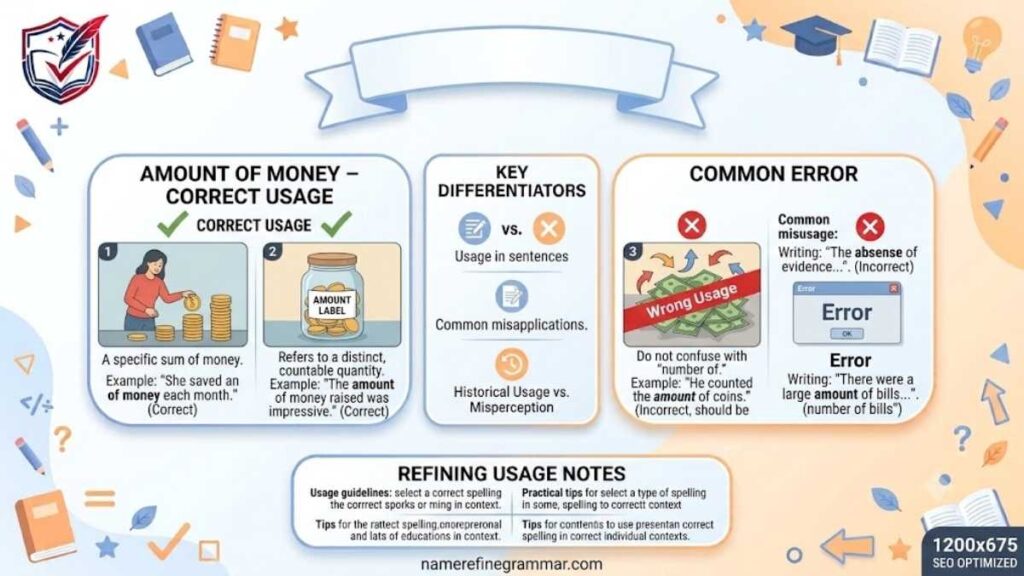
One of the most common contexts for this word is finance. You’ll frequently see phrases like:
- “The amount due is $450.”
- “Please transfer the correct amount by Friday.”
- “The invoice amount was updated after the discount.”
Getting this spelling right matters especially in financial and business communication, where a misspelled word like “ammount” can make an otherwise professional document look careless. This is much like getting details right elsewhere in formal writing — for instance, correctly using terms like due to or do to, which also trips up even experienced writers.
All Amount or All Amounts – Which Is Correct?
This depends on context:
- Use “the total amount” when referring to a single combined sum (“the total amount of the invoice”).
- Use “amounts” (plural) when referring to multiple separate sums or quantities (“various amounts were donated by different sponsors”).
So, “all amounts” is correct when discussing several individual sums, while “all amount” is grammatically incomplete unless followed by “to” as a verb phrase (e.g., “all amount to the same result”).
Amount or Ammount in Everyday Examples
| Incorrect | Correct |
| The ammount of homework was overwhelming. | The amount of homework was overwhelming. |
| Please confirm the ammount before checkout. | Please confirm the amount before checkout. |
| A large ammount of rain fell overnight. | A large amount of rain fell overnight. |
| The ammount of support she received was surprising. | The amount of support she received was surprising. |
Common Mistakes with Amount or Ammount
- Doubling the “m” out of habit, influenced by words like “common” or “summit.”
- Using “amount” with countable nouns instead of “number” (e.g., “amount of people” should be “number of people”).
- Assuming British and American spellings differ — they don’t, for this word.
- Auto-correct fatigue, where writers stop trusting spell-check and revert to muscle memory, which sometimes favors the wrong version.
Much like the recurring uncertainty around inter vs intra, these amount or ammount mistakes usually come down to pattern-matching against similar-looking words rather than genuine confusion about meaning.
Amount or Ammount Comparison Table
| Feature | Amount | Ammount |
| Dictionary recognized | Yes | No |
| Correct spelling | Yes | No |
| Used in formal writing | Yes | Never |
| Regional variant | No | N/A |
| Number of “m”s | 1 | 2 (incorrect) |
Amount or Ammount – Google Trends & Usage Data
Search interest in “amount or ammount” spikes consistently, reflecting how often people type the word quickly and second-guess themselves afterward. This pattern is common with words that sound like they should have double letters — similar to how people search for clarification on numeric formatting questions like 22th or 22nd. The underlying cause in both cases is the same: English spelling doesn’t always match intuition, so writers turn to search engines for a quick confidence check.
Amount or Ammount on Reddit – What Do People Say?
Across grammar and writing communities online, the consensus is unanimous: “amount” is correct, and “ammount” is simply a typo that spreads through repetition rather than any real grammatical debate. Many commenters note that once they learned the “a + mount” trick, they stopped making the mistake entirely. Writers also frequently link this error to broader proofreading habits, similar to catching repeated issues like swap vs swop in their own writing before publishing.
Conclusion
The amount or ammount debate has a clear, permanent answer: amount is correct, and ammount is not a recognized English word. The mistake happens because of how the word sounds when spoken aloud, not because of any real spelling ambiguity. Once you remember the simple “a + mount, one m” trick, you’ll never second-guess this word again. Whether you’re writing an email, a report, or a casual text, using the correct spelling consistently helps your writing look polished, accurate, and trustworthy.
FAQs About Amount or Ammount
Is it ammount or amount?
It’s always amount. “Ammount” is a common misspelling and isn’t found in any standard dictionary.
What is the correct spelling of amount?
The correct spelling is a-m-o-u-n-t, with a single “m.”
How do you spell amount correctly?
Spell it with one “m”: amount. Think “a + mount,” like a single mountain peak.
What does “amount” mean?
It means the total, sum, or quantity of something, such as money, time, or effort.
What is the meaning of amount in simple words?
It simply means “how much” of something there is.
Can amount be used as a verb?
Yes, as in “the costs amount to $500,” meaning they add up to that total.
When do you use amount vs number?
Use “amount” for uncountable things (water, money) and “number” for countable things (people, apples).
How do you use amount correctly in a sentence?
Place it before “of” plus an uncountable noun, like “the amount of time we have left.”
Is amount a real word?
Yes, it’s a standard English word recognized by every major dictionary.
Is there a plural form of amount?
Yes — “amounts” — used when referring to multiple separate sums or quantities.
