
If you’ve ever paused mid-sentence and wondered whether it’s “comment” or “coment,” you’re not alone. This mix-up shows up everywhere: in emails, social posts, code, and school assignments. The short answer is simple “comment” is correct, and “coment” is a misspelling. But there’s more to the comment vs coment question than just picking the right letters. This guide walks through the meaning, the grammar, the tech usage, and the small habits that make the spelling stick for good.
Comment vs Coment Meaning and Spelling
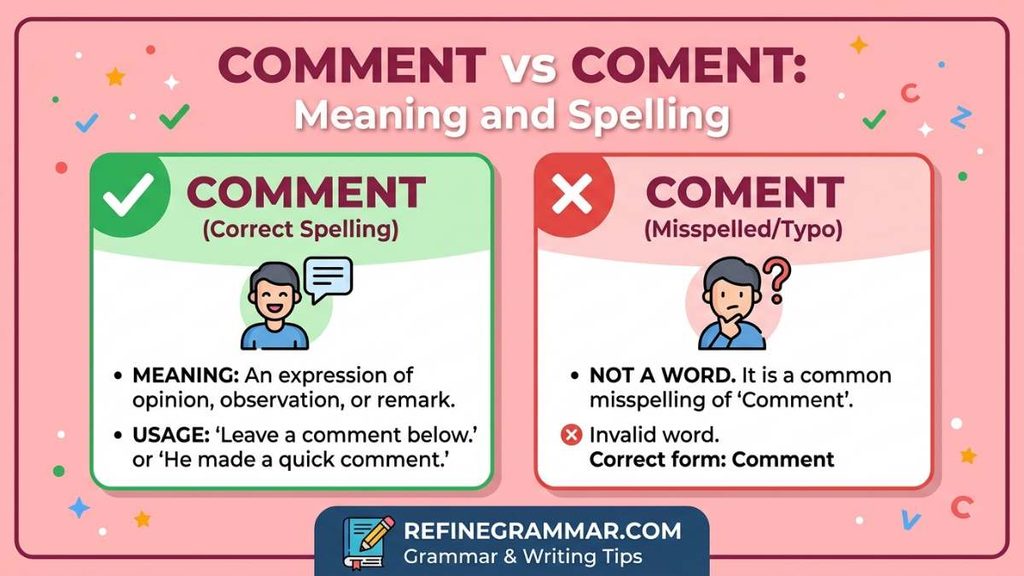
Let’s settle this once and for all: “comment” is the only correct spelling in English. “Coment” doesn’t appear in any standard dictionary, and it isn’t a regional variant or an accepted shorthand. It’s simply a typo that happens because people drop one of the two m’s while typing fast.
The comment vs coment confusion usually comes from one of three habits:
- Typing quickly and skipping a letter
- Hearing the word spoken and guessing at the spelling
- Mixing it up with similar words in another language
Once you know the pattern, the comment vs coment mistake becomes easy to catch and easy to avoid.
What Is Comment in English? A Definition That Actually Helps

Before diving into the comment vs coment rule further, it helps to nail down what the word itself means. A comment is a spoken or written remark that shares an opinion, an observation, or a piece of feedback. You’ll hear it in phrases like “no comment” or “leave a comment below.” As a verb, “to comment” means to make that remark, usually about something specific an article, a decision, or someone’s work.
The word traces back to the Old French “coment” and the Latin “commentum,” meaning an interpretation or explanation. Ironically, the very spelling people mistakenly use today (“coment”) is close to where the English word started centuries ago but modern English settled on the double-m version, and that’s the one you need for correct, professional writing.
Why Small Details Carry Big Weight
A single dropped letter might feel trivial, but spelling errors shape how readers judge your writing. A resume with “coment” instead of “comment” can cost you an interview. A comment vs coment slip in a business email can make a polished message look careless. Search engines and grammar checkers flag it too, which means the error can quietly hurt your content’s credibility and its ranking.
Getting small details right builds trust. Readers assume that if you handled the little things spelling, punctuation, formatting you probably handled the big things too, like facts and structure.
How Do You Spell Comment Correctly? Make It Automatic

Here’s a simple trick: break the word into two familiar parts “com” and “ment.” Both are common syllables you already spell correctly in other words (community, moment). Put them together, keep both m’s, and you’ve got it: c-o-m-m-e-n-t.
A few more ways to lock in the correct spelling:
- Say the word slowly, stressing each syllable: COM-MENT.
- Write it five times by hand muscle memory helps more than you’d think.
- Use a browser spell-checker or a grammar tool while drafting.
- Read it in context a few times so your eyes learn the shape of the word.
Once you’ve practiced the comment vs coment distinction a handful of times, your brain stops needing to think about it at all.
Learn More: Thier or Their? I Analyzed Which Is Correct
Comment Usage in Sentences Writing That Feels Human
Seeing the word in real sentences helps more than memorizing a rule. Here are a few natural examples:
- “She left a thoughtful comment on my blog post.”
- “The coach declined to comment on the trade rumors.”
- “His comment about the budget sparked a long discussion.”
- “Feel free to comment if you have questions.”
Notice how “comment” works as both a noun (a comment) and a verb (to comment). That flexibility is part of why the word shows up so often and why getting the comment vs coment spelling right matters across so many contexts, from casual chats to formal reports.
One Letter and Different Meaning

It’s worth noting that “coment” isn’t just a misspelling of “comment” it isn’t an actual English word at all, so it doesn’t carry an alternate meaning. That’s different from cases like “complement” and “compliment,” which are both real words with distinct definitions. With comment vs coment, there’s only one correct option, which actually makes this easier than many other spelling mix-ups in English.
Comment Section Meaning on Social Media More Than Just Replies
On platforms like Instagram, YouTube, and Facebook, the “comment section” is where a post’s real conversation happens. It’s more than a reply box it’s a space for reactions, questions, debates, and community building. Brands watch their comment sections closely because they reveal what audiences actually think, often more honestly than a like or a share does.
A healthy comment section can include:
| Type of Comment | Purpose |
| Reaction comment | Expresses emotion or agreement |
| Question comment | Asks for clarification or more detail |
| Critical comment | Offers pushback or disagreement |
| Spam comment | Unwanted promotional content |
Understanding comment vs coment spelling matters here too a caption or pinned comment with the wrong spelling looks unpolished, even on a casual platform.
Comment Meaning in Programming
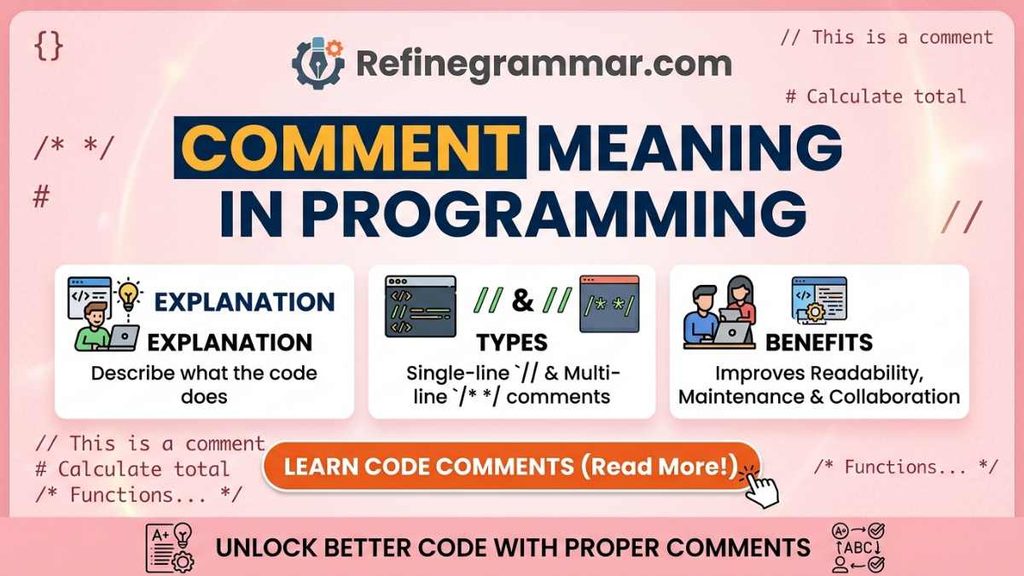
The comment vs coment rule doesn’t stop at everyday English it carries straight into code, too. In coding, a comment is a line (or block) of text that the compiler or interpreter ignores. Comments exist purely for humans to explain what the code does, why a decision was made, or what to fix later. They don’t affect how the program runs, but they make code far easier to read, debug, and maintain, especially when multiple people work on the same project.
Comment in C Language: Structure and Practical Use
C was one of the earlier languages to formalize commenting, and its rules still influence many modern languages. In C, you write a comment using /* to open and */ to close:
/* This function calculates the total price */
int total = price * quantity;
Later versions of C also support single-line comments using //, borrowed from C++. Developers use comments in C to document function purposes, mark unfinished sections, or temporarily disable a line of code without deleting it.
Single Line, Multiline, and Inline Comment Examples Explained
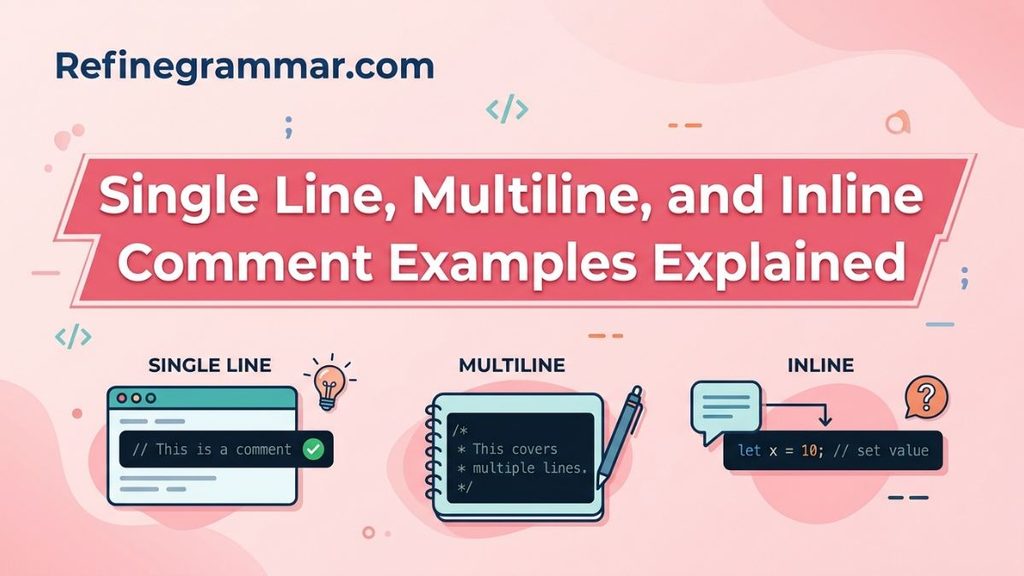
Most programming languages support a few comment styles:
- Single-line comment: Covers just one line, often starting with // or #. Example: // Initialize the counter
- Multiline comment: Spans several lines, useful for longer explanations. Example: /* This section handles user authentication and session tracking */
- Inline comment: Sits on the same line as actual code, right after the statement it explains. Example: int age = 25; // user’s age in years
Each style serves a different purpose, but all of them share the same goal helping the next person (often a future version of yourself) understand the logic faster.
Comment Out vs Uncomment A Tool Every Developer Uses
“Commenting out” means turning working code into a comment so it stops running, without deleting it. Developers do this to test alternatives, isolate bugs, or temporarily disable a feature. “Uncommenting” reverses that restoring the line so it runs again.
For example, commenting out a line in Python looks like this: adding a # before it turns active code into inert text. Removing the # uncomments it. This simple habit saves time, because you don’t have to retype code you might need again in a few minutes.
Types of Comments in Programming Languages A Structured Approach
Different languages format comments differently, though the underlying idea stays the same:
| Language | Single-Line | Multiline |
| C / C++ | // | /* */ |
| Python | # | ”’ ”’ or “”” “”” |
| JavaScript | // | /* */ |
| HTML | <!– –> | |
| SQL | — | /* */ |
Knowing these formats matters if you work across multiple languages, since mixing up the syntax will cause errors instead of silent, harmless comments.
Comment Formatting Rules and Best Practices That Actually Work

Good commenting is a skill, not just a habit. A few widely followed best practices:
- Explain the “why,” not just the “what” code already shows what it does.
- Keep comments short and current; outdated comments mislead more than they help.
- Avoid over-commenting obvious lines, which clutters the code.
- Use consistent formatting across a project so comments are easy to scan.
- Remove leftover debugging comments before shipping code.
Following these rules keeps a codebase readable for the whole team, not just the person who wrote it.
What Are Comments Used for in Coding?
Comments serve several practical purposes beyond just explanation. Developers use them to document how a function works, to leave notes for teammates, to mark TODO items, and to temporarily disable code during testing. In larger teams, comments also support onboarding new developers often lean on comments to understand unfamiliar parts of a codebase faster than reading raw logic alone.
Practice Exercises: Comment vs Coment
Fill in the Blank
- Please leave a ______ (comment/coment) below the video.
- The teacher asked us to ______ (comment/coment) on the poem’s tone.
- His ______ (comment/coment) surprised everyone in the meeting.
Guidance
Remember: “coment” is never correct. If you’re unsure, default to the double-m spelling every time.
Identify Correct and Incorrect Usage
- “I have no coment on that.” Incorrect
- “I have no comment on that.” Correct
- “She commented on the article.” Correct
Sentence Correction (Rewrite Accurately)
Original: “He didn’t coment on the results.”
Corrected: “He didn’t comment on the results.”
Improving Sentence Quality
Instruction
Rewrite each sentence below so it reads naturally and uses the correct spelling of “comment.”
Meaning Based Selection
Choose the word that fits: “The professor’s (comment / commend) on my essay was encouraging.”
Programming Concepts
Fill in: In Python, a single-line ______ starts with a hash symbol.
Answer Key
- comment
- comment
- comment
Identify Correct Usage
“Comment” is always correct; “coment” is always incorrect.
Sentence Correction
“He didn’t comment on the results.”
Comment vs Commend
These two words look similar but mean different things. “Comment” means to remark or give an opinion. “Commend” means to praise or officially recognize someone. So “The professor’s comment was encouraging” and “The professor commended my essay” are both correct, but they carry different meanings.
Programming Concepts (Answer)
“Comment” that’s the term used in Python for this kind of line.
Key Insight
The comment vs coment debate really comes down to one rule: always use the double m. There’s no alternate spelling, no exception, and no shortcut just one consistent, correct form.
FAQs
What does coment mean?
“Coment” has no meaning in English it’s simply a misspelling of “comment.”
What is the correct spelling of comment?
The correct spelling is “comment,” with two m’s.
Which is correct: “commentate” or “comment”?
Both are real words, but they differ in use “commentate” refers to narrating an event live, while “comment” means to remark generally.
Which is correct, comment or comment out?
Both are correct; “comment out” is a specific programming phrase meaning to disable a line of code by turning it into a comment.
What is the difference between comment and comments?
“Comment” is singular, referring to one remark, while “comments” is plural, referring to multiple remarks.
How do you pronounce “comment” correctly?
It’s pronounced KOM-ent, with stress on the first syllable.
What is the difference between “comment” and “commentary”?
A “comment” is usually a short remark, while “commentary” refers to a longer, more detailed set of observations or analysis.
What’s the difference between “comment out” and “uncomment” in code?
“Comment out” disables a line of code by turning it into a comment; “uncomment” restores that line so it runs again.
What is a comment in the C programming language?
It’s text enclosed in /* */ or preceded by // that the compiler ignores, used to explain code.
What is a comment section on social media?
It’s the space beneath a post where users leave reactions, questions, or feedback.
Final Thought
The comment vs coment question has one clear answer: always spell it with two m’s.
Once you practice it a few times, in writing and in code, it becomes second nature.
Get this small detail right, and your writing online or in a script will read as careful and credible.
