
You’ve probably typed one of these phrases and paused, wondering if you picked the right one. In process vs in progress trips up even careful writers because the two phrases look alike and often show up in similar sentences.
But they don’t mean the same thing, and swapping one for the other can confuse readers especially in job applications, business updates, or technical writing. This guide breaks the difference down clearly, with examples, a comparison table, and rules you can apply today.
What “In Process” vs “In Progress” Really Means
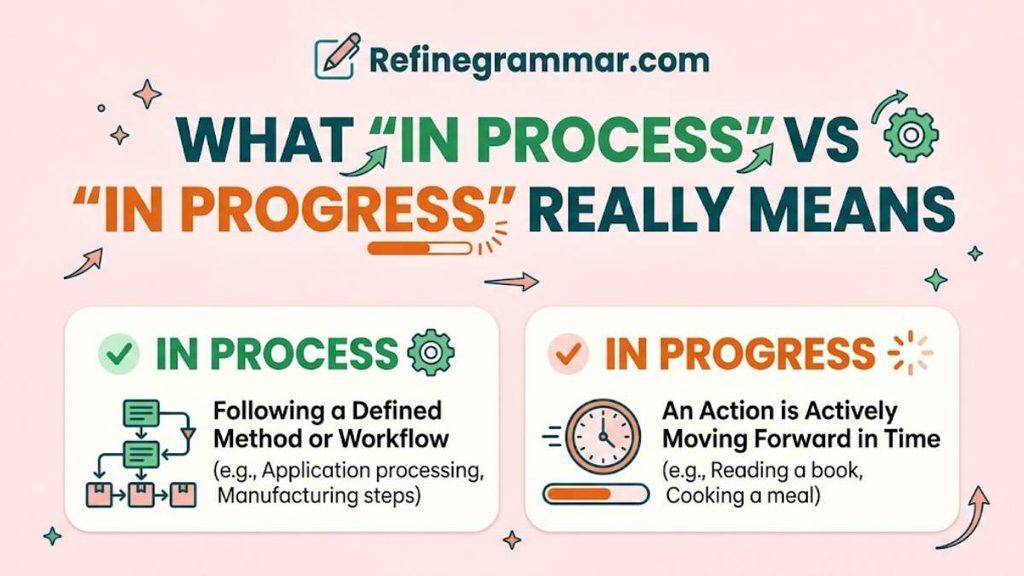
At its core, in process vs in progress is a contest between two prepositional phrases that both describe unfinished work. In progress refers to a task actively being done right now. In process refers to something moving through a defined system, workflow, or set of steps. The difference is subtle, but it matters in formal writing, status updates, and industries like manufacturing and HR.
Meaning of “In Process”
Core definition
In process describes an item, request, or task that’s moving through a defined sequence of steps. It emphasizes the system or procedure behind the scenes, not the person doing the work.
Key characteristics
- Focuses on a workflow or pipeline, not a single action
- Common in manufacturing, legal, and administrative contexts
- Often describes something happening behind the scenes
- Implies multiple stages rather than one continuous task
Examples of “in process”
- “Your refund is in process and should post within five business days.”
- “The visa application is in process at the embassy.”
- “Quality checks are in process before the batch ships.”
Meaning of “In Progress”
Core definition
In progress describes work that has started and is actively continuing. It puts the focus on the action itself, not the surrounding system.
Key characteristics
- Describes active, ongoing effort
- Common in project management, writing, and everyday speech
- Implies a person or team is currently doing the work
- Suggests a single continuous task rather than several stages
Examples of “in progress”
- “The report is in progress and will be ready by Friday.”
- “Construction on the new office is in progress.”
- “Her novel is still in progress after three years.”
Key Differences Between “In Process” and “In Progress”
Understanding in process vs in progress starts with recognizing what each phrase emphasizes: a system, or a person actively at work.
Side-by-side comparison
| Feature | In Process | In Progress |
| Focus | The system or workflow | The active task itself |
| Best used for | Applications, orders, procedures | Projects, reports, active work |
| Implies | Multiple steps or stages | Continuous, ongoing action |
| Common in | Manufacturing, HR, legal, government | Business, creative work, everyday speech |
| Example sentence | “The claim is in process.” | “The claim review is in progress.” |
Simple rule
If you can swap in the phrase “moving through the system,” use in process. If you can swap in “currently being worked on,” use in progress. That one test settles most of the in process vs in progress debate on the spot.
Synonyms and Alternatives to “In Progress” and “In Process”
Once you’re confident with in process vs in progress, you might want fresher ways to say either phrase in your writing.
Professional alternatives to “in progress”
- Underway
- Ongoing
- Currently being handled
- Actively in development
- Being worked on
Stronger words for “progress”
- Advancement
- Momentum
- Headway
- Traction
- Development
Why “In Progress” Is More Common Today
Reasons for popularity
In progress shows up more often in everyday English because it’s shorter, sounds more active, and fits both casual and professional writing. Project management tools and status trackers default to “in progress” as a label, which has trained most readers to expect it.
Fact
Search trends show people type “in progress” far more often than “in process,” partly because popular task-tracking apps use it as a default status which keeps the in process vs in progress question coming up online.
When to Use “In Progress” vs “In Process”
Use “In Progress” When Work Is Active
Choose in progress whenever someone is actively doing something right now writing, building, reviewing, or creating.
Use “In Process” for Systems or Procedures
Choose in process when the subject is moving through a formal system: an application, a legal filing, a manufacturing line, or a government process.
Side-by-Side Example Scenarios
Workplace example
“The proposal is in progress” tells your manager someone is actively writing it. “The proposal is in process” suggests it’s moving through an approval chain.
Customer support
“Your ticket is in progress” means an agent is working on it directly. “Your ticket is in process” means it’s queued inside a support system.
Hiring example
“Your application is in progress” suggests a recruiter is actively reviewing it. “Your application is in process” suggests it’s moving through automated screening steps.
How Different Industries Use “In Process” vs “In Progress”
Different industries settle the in process vs in progress question in their own way, depending on how their workflows are structured.
Technology and software development
Tech teams almost always say “in progress,” since agile boards track single, active tasks assigned to one person.
Business operations
Operations teams favor “in process” for orders, invoices, and approvals that pass through several departments before completion.
Manufacturing
Manufacturing relies on “in process” inventory and the term “work in process” (WIP) to describe goods that are mid-production.
Education
Schools use “in progress” for grades and assignments still being completed, and “in process” for enrollment or transcript requests.
Creative industries
Writers, designers, and artists almost always describe a project as “in progress,” since the work is personal and ongoing rather than routed through a system.
“In Process” vs “In Progress” in Job Applications and Workday
Nowhere does in process vs in progress cause more confusion than in job applications, where the wording can feel like a signal that isn’t really there.
What “in process” means on a job application
When a job application shows “in process,” it means the application has entered the employer’s review pipeline but it doesn’t confirm that a person has actually read the resume yet.
What “in process” means on Workday
In Workday specifically, “in process” and “in progress” are functionally the same status. Some companies configure the platform to display one label instead of the other, but both simply mean the application is still active and hasn’t been rejected, withdrawn, or closed out.
Grammar Rules for “In Process” vs “In Progress”
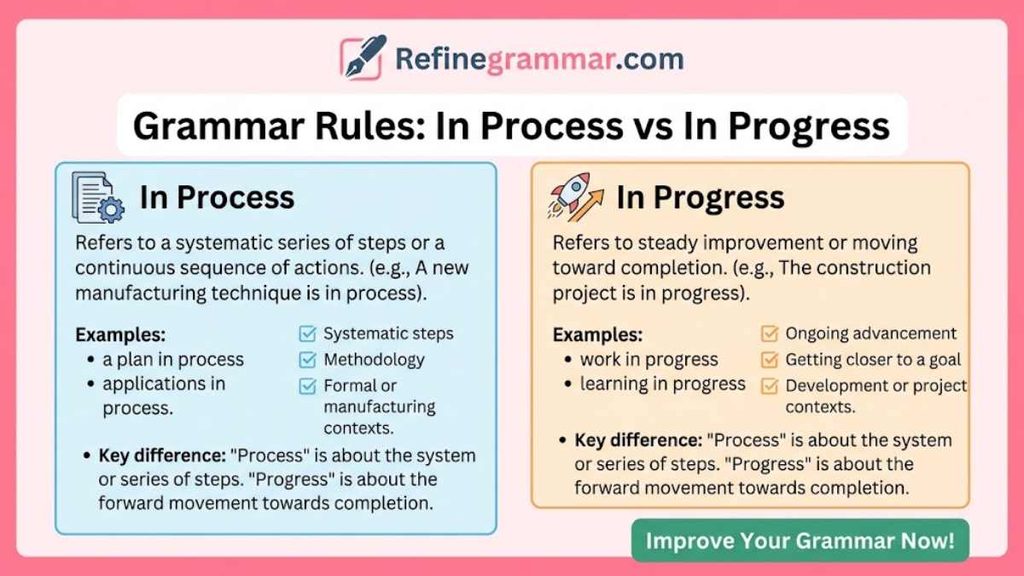
Now that the meaning of in process vs in progress is clear, here’s how to use each phrase correctly in a sentence.
Sentence structure
Both phrases function as prepositional phrases and typically follow a linking verb: “The order is in process” or “The order is in progress.”
Correct placements
Place either phrase after the subject and a form of “to be,” or use it to modify a noun directly, as in “work in progress” or “goods in process.”
Verb combinations
Common pairings include “currently in process,” “still in progress,” “remains in process,” and “is now in progress.”
Capitalization
Neither phrase is capitalized mid-sentence unless it starts a sentence or appears as a formal status label, such as “In Progress” on a dashboard.
Common Mistakes to Avoid
Most in process vs in progress mistakes come down to misjudging whether a system or a person is actually doing the work.
Mistake: Using “in process” for active work
Saying “I am in process of writing the report” sounds stiff. Use “in progress” or “in the process of” instead.
Mistake: Using “in progress” for systems
Calling a shipment “in progress” instead of “in process” misses the point it’s moving through a supply chain, not being worked on by one person.
Mistake: Mixing both
Avoid combining the two, as in “in process of progress.” Pick one phrase based on what you’re actually describing.
Mistake: Over-formal writing
Don’t force “in process” into casual writing just because it sounds official. Simpler is usually clearer.
Real Case Study: Project Team Miscommunication
A marketing team once labeled a campaign “in process” on their shared tracker, meaning it was awaiting legal approval. A new hire read it as “in progress” and assumed creative work was still underway, delaying the launch by two days. The mix-up came down to one small phrase proof that in process vs in progress isn’t just a grammar nitpick, it affects real deadlines.
Case Study: Manufacturing Confusion
A factory floor supervisor reported units as “in progress” instead of the standard “in process” inventory term. Accounting flagged the report because “in progress” wasn’t a recognized category in their work-in-process (WIP) system, causing a reconciliation delay until the report was corrected.
Case Study: Customer Support Issue
A support agent told a customer their refund was “in progress,” implying someone was actively handling it. In reality, the refund was queued in an automated system more accurately described as “in process.” The customer’s frustration grew when no visible action followed, showing exactly why word choice shapes expectations.
Quick Memory Tricks
These tricks make in process vs in progress easy to remember for good.
Memory trick
Progress has “go” hidden inside it think “go-ing,” as in actively moving forward. Process sounds like “procedure,” and both start with “pro,” pointing to steps and structure.
One-line test
Ask yourself: is someone doing it right now, or is it moving through steps? Right now means in progress. Moving through steps means in process.
Confusing in process and in progress isn’t the only pair that trips up writers. Common slip-ups include across vs. accross, suing or sueing, totalling vs. totaling, lable or label, parent’s vs. parents‘, emaculate vs. immaculate, simile vs. metaphor, and thier or their each one follows its own simple rule once you see it clearly.
Quotes to Remember
- “Progress is action. Process is a path.”
- “If it’s active, it’s in progress. If it’s automated, it’s in process.”
- “In process moves through a system; in progress moves through time.”
FAQs
Is “in process” grammatically correct?
Yes. It’s a standard phrase used to describe something moving through a system or workflow.
What does “in process” mean on a job application?
It means the application has entered the employer’s review pipeline, though that doesn’t guarantee anyone has reviewed it yet.
Is “in progress” the same as “in process” on Workday?
Functionally, yes. Both mean the application is active; the exact wording depends on the employer’s configuration.
Can “in process” and “in progress” be used interchangeably?
Not ideally. Use “in progress” for active tasks and “in process” for items moving through a formal system.
What’s a professional alternative to “in progress”?
Try “underway,” “ongoing,” or “currently being handled” for a more polished tone.
Is “work in process” the same as “work in progress”?
They’re related but distinct: “work in process” is a manufacturing and accounting term for goods mid-production, while “work in progress” describes any ongoing task.
Conclusion
Choosing between in process vs in progress comes down to one question: is something actively being worked on, or moving through a system? Use in progress for active tasks and personal work, and in process for applications, orders, and formal workflows. Once that distinction sticks, you’ll never second-guess the choice again.
