
If you’ve ever paused mid-sentence wondering whether to type 31st or 31th, you’re in good company. This is one of the most frequently searched grammar questions in English, and it catches out native speakers, students, and professional writers alike. Whether you’re finishing an invitation, writing “October 31st” in an email, or double-checking a birthday message, getting this ordinal number right matters for clarity and credibility.
This guide settles the 31st or 31th question for good. You’ll learn the grammar rule behind ordinal numbers, see real examples across dates, birthdays, floors, and formal writing, and pick up simple tricks so you never hesitate over this spelling again.
31st or 31th: Quick Answer
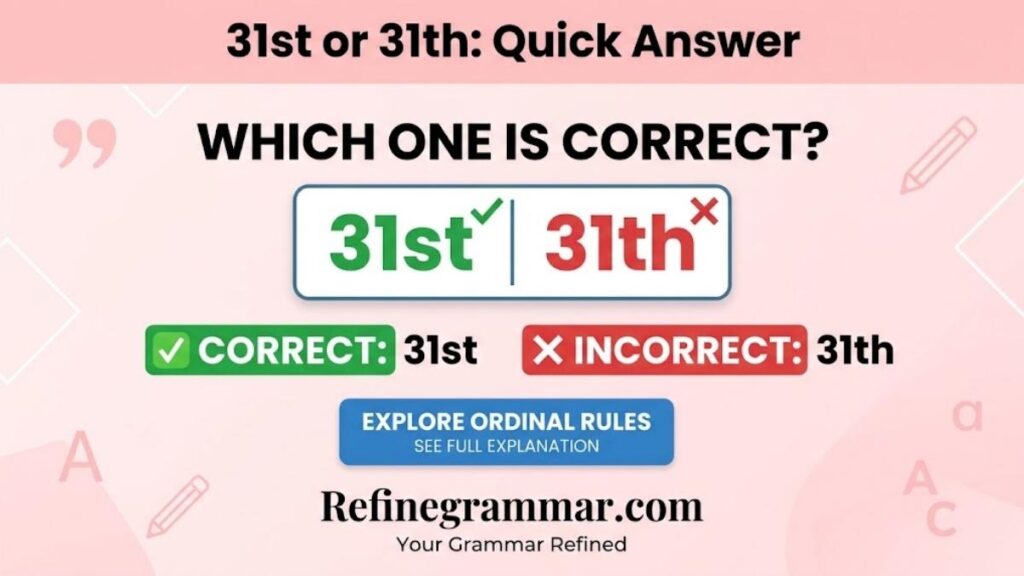
Do we say 31st or 31th? The correct, standard English form is always 31st. The number 31 is spoken as “thirty-first,” and because it ends in “first,” it takes the “-st” suffix, just like the numbers 1, 21, and 41. “31th” is a spelling mistake and should never appear in professional, academic, or everyday writing. No dictionary, style guide, or grammar authority recognizes 31th as a valid alternative.
Ordinal numbers indicate position or order rather than quantity, and English assigns different endings based on how the number is pronounced, not simply the digit it ends with. Since 31 becomes “thirty-first” when spoken aloud, the written form follows the same logic as “first,” producing 31st rather than 31th.
31st or 31th in Dates: Correct Usage Examples
Dates are where the 31st or 31th confusion shows up most often, especially in months that actually have a 31st day: January, March, May, July, August, October, and December. The table below covers each of these months with correctly formatted examples.
| Month | Example Sentence | Correct Ordinal |
| January | Submit the form by January 31st. | 31st |
| March | The quarter ends March 31st. | 31st |
| May | Her flight departs May 31st. | 31st |
| July | The invoice is due July 31st. | 31st |
| August | School resumes after August 31st. | 31st |
| October | Halloween falls on October 31st. | 31st |
| December | The year ends on December 31st. | 31st |
Notice that regardless of the month, the ordinal ending never changes. Whether it’s January, March, or December, the correct form remains 31st, because the ending depends on the number itself, not the month attached to it.
The Origin of 31st or 31th
The confusion between these two spellings traces back to how English ordinal numbers developed. Old English and early Germanic number systems used irregular endings for numbers like first, second, and third, while most other ordinals eventually settled into a predictable “-th” pattern. Because 31 is built from “thirty” plus “one,” it inherited the irregular ending of “one” rather than adopting the regular “-th” suffix used by numbers like 4th, 5th, or 30th.
This is the same underlying pattern that governs other easily confused word pairs in English. Just as writers sometimes mix up plural forms, like whether to use dwarfs or dwarves, ordinal numbers have their own quirks that don’t always follow the “obvious” rule.
British English vs American English Spelling
Some writers assume British and American English might handle the 31st or 31th question differently, the way the two dialects differ on spellings like “colour” versus “color.” Fortunately, ordinal numbers are one area where both dialects fully agree.
Comparison Table
| Aspect | British English | American English |
| Correct ordinal | 31st | 31st |
| Date format | 31st July 2026 | July 31st, 2026 |
| Spoken form | “the thirty-first of July” | “July thirty-first” |
| Regional variation | None | None |
As the table shows, there’s no regional variation to worry about. Whether you’re writing for a British audience, an American audience, or anywhere else, 31st is the only acceptable spelling.
Which Form Should You Use?
Given the consistent rule across dialects, the answer to “which form should you use” is straightforward: always choose 31st. Reserve “thirty-first” for extremely formal contexts such as legal documents, wedding invitations, or certificates, where writing numbers out in full is customary. In virtually every other context, from emails to text messages, 31st is the correct and expected choice.
Common Mistakes with 31st or 31th
Even once the rule is clear, mistakes still creep into everyday writing. The most common error is writing “31th” outright, usually because a writer defaults to the regular “-th” pattern used by numbers like 20th or 30th without pausing to check the exception. Another frequent mistake is the malformed “31sth,” which awkwardly combines both suffixes and should always be avoided.
Mixed writing errors are also common in fast-typed messages, where autocorrect or muscle memory produces inconsistent ordinals within the same document, such as writing “31st” in one sentence and “31th” a few lines later. Careful proofreading, or reading text aloud before sending it, catches most of these slips. Interestingly, these kinds of small, repeated mix-ups are common across English more broadly. For example, many people also struggle with whether a word should be nosey or nosy, or whether to write bear with me vs bare with me, showing that irregular and commonly confused spellings are simply part of learning English well.
The same pattern shows up in other frequently confused word pairs. Borrowed terms like sempai or senpai raise similar spelling questions once English speakers adapt words from other languages. Plural noun choices, such as protestors or protesters, generate ongoing debate, and closely related discussions around protestors and protesters show how style guides sometimes differ on preference. Verb-form errors are common too, as in maintained or maintenanced, where only one of the two is an actual, dictionary-recognized word. Number spellings trip people up in the same way, as seen in fourteen or forteen, where the second option is simply incorrect despite how often it appears in casual writing. Recognizing these patterns makes it easier to remember that 31st, not 31th, is the standard form.
31st or 31th: Common Search Questions Answered
People searching for help with this topic tend to phrase their questions in similar ways. “Do we say 31st or 31th” is one of the most common phrasings, closely followed by “what is right, 31st or 31th” and “which is correct here.” All of these questions have the same answer: 31st is correct in every standard context, and 31th should be avoided entirely, whether you’re writing casually or formally.
31st or 31th in Everyday Examples
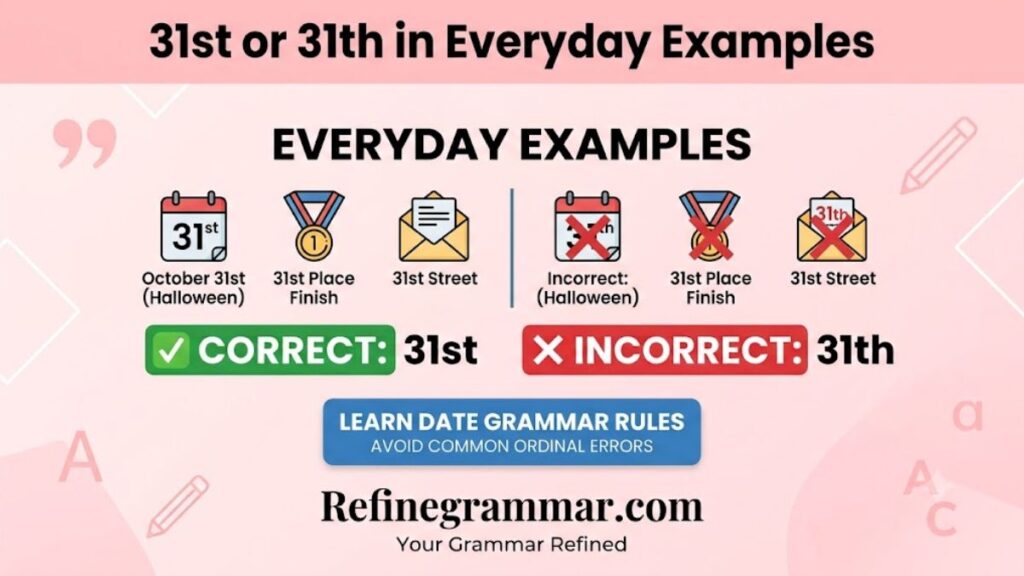
Seeing this ordinal spelled correctly across different formats can help cement the rule. Here’s how it typically appears in real-world writing.
Emails
In emails, ordinal dates usually appear in scheduling and confirmation messages, such as “Please confirm your attendance by July 31st” or “Our office will be closed on December 31st.” Getting this right adds a small but noticeable layer of professionalism.
News Writing
News writing tends to favor concise date formats, often dropping the ordinal suffix entirely in favor of numerals like “31” alone, as in “The policy takes effect March 31.” However, when publications do use ordinals, especially in feature writing or direct quotes, 31st remains the only accepted form.
Social Media
Social media posts are more relaxed in tone, but the 31st or 31th distinction still matters for readability. A caption like “Halloween countdown: October 31st is almost here” reads naturally, while “October 31th” looks like a typo and can undermine an otherwise polished post.
Formal Writing
Formal writing, including legal contracts, academic papers, and official correspondence, holds the highest standard. Here, writers often spell out “thirty-first” entirely, but when the numeral form is used, it must be 31st, never 31th, to maintain accuracy and professionalism.
Birthdays & Anniversaries
Birthdays and anniversaries are another place where 31st or 31th comes up constantly. A “31st birthday” or “31st anniversary” is the only correct phrasing; “31th birthday” is a common but avoidable mistake. The same rule applies to related terms like a “monthsary,” where writers might reference a “31st monthsary” to mark thirty-one months together.
Floors & Building Levels
Floors and building levels follow the identical rule. Whether you’re describing an elevator button, a hotel reservation, or an office address, it’s always the “31st floor,” never the “31th floor.” Building signage, directories, and official documents consistently use the correct ordinal form.
31st or 31th: Google Trends & Usage Data
Search interest in 31st or 31th spikes predictably around the end of months that contain a 31st day, particularly late October, ahead of Halloween, and late December, around New Year’s Eve. Search data consistently shows far higher volume for “31st” than “31th,” reflecting how rarely the incorrect form appears in edited, professional writing, even though it remains a common typing mistake. This pattern mirrors other ordinal-number searches, where people briefly hesitate before typing dates correctly.
| Search Term | Relative Search Interest | Typical Context |
| “31st” | High, steady year-round | Dates, birthdays, floors, anniversaries |
| “31th” | Low, occasional spikes | Common typo, mostly corrected on review |
| “31st or 31th” | Moderate, seasonal spikes | Direct comparison searches near month-end |
Comparison Table: Ordinal Number Endings
| Number | Ordinal Form | Suffix Rule |
| 1 | 1st | -st |
| 2 | 2nd | -nd |
| 3 | 3rd | -rd |
| 4 | 4th | -th (regular) |
| 11 | 11th | -th (irregular exception) |
| 21 | 21st | -st |
| 30 | 30th | -th (regular) |
| 31 | 31st | -st (correct, not “31th”) |
| 32 | 32nd | -nd |
FAQs: 31st or 31th
Do we say “31st” or “31th”?
We say and write “31st.” “31th” is a spelling mistake and is never correct in standard English.
Is it “31st or 31th” on a date, like October 31st?
It’s always 31st on a date, so “October 31st” is correct. “October 31th” is incorrect.
Is it correct to write “31st birthday” or “31th birthday”?
“31st birthday” is correct. “31th birthday” is a common but incorrect variation.
Is it “31st July” or “31th July”?
“31st July” is correct. The ordinal ending never changes based on which month it’s paired with.
What is the correct spelling for the 31st of the month?
The correct spelling is “31st,” used consistently for the last day of any month that has 31 days.
Is it “31st anniversary” or “31th anniversary”?
“31st anniversary” is correct. “31th anniversary” should be avoided in all writing.
Is “31st” correct for a monthsary, or should it be written differently?
Yes, “31st” is correct for a monthsary, as in a “31st monthsary,” following the same ordinal rule.
Is it “31st floor” or “31th floor” in a building?
It’s “31st floor.” Building directories, elevators, and signage all use this correct form.
How do you write someone’s age “31st years old” or “31 years old”?
Neither ordinal form applies here; the correct phrasing is simply “31 years old,” with no suffix at all.
Is “32nd” or “31th” the correct next ordinal after 31st?
“32nd” is the correct next ordinal. “31th” is not a valid ordinal number at all.
Conclusion
The 31st or 31th debate ultimately comes down to one simple rule: numbers ending in one take the “-st” suffix, and 31 is no exception. Whether you’re writing a date, a birthday message, a floor number, or a formal document, 31st is always correct, and 31th should never appear in polished writing. Keep this guide handy, bookmark it if needed, and you’ll never second-guess this spelling question again.
