
After digging through dictionaries, style guides, and real usage data, my answer to the puting vs putting debate is simple: putting is the only correct spelling. Puting is a common misspelling that drops one of the two required t’s, and no major dictionary not Merriam-Webster, not Cambridge, not Oxford lists it as a valid alternative.
Whether you’re talking about putting a book on a shelf, putting money into savings, or putting a golf ball toward the hole, the word always keeps its double t. In this guide, I break down exactly why putting wins the puting vs putting spelling contest, walk through the spelling rule that explains it, cover the special golf usage, and answer every related question people search for. By the end, you won’t second-guess this word again.
Why I Found It’s Spelled “Putting”
When I first researched this, I expected a complicated explanation. Instead, I found a simple spelling rule that English has used for centuries. “Put” is a one-syllable verb ending in a single vowel followed by a single consonant.
To keep the short vowel sound intact when adding “-ing,” English doubles the final consonant. That’s the entire mechanism behind putting, and it’s exactly why the puting vs putting comparison keeps popping up in search results and grammar forums.
You can see the same pattern in other short verbs: run becomes running, sit becomes sitting, and stop becomes stopping. Puting looks like it should work the same way “hope” becomes “hoping,” but put doesn’t end in a silent e, so that rule doesn’t apply here.
The CVC Rule I Follow
The rule I rely on is called the CVC rule consonant, vowel, consonant. Look at “put”: p (consonant), u (vowel), t (consonant). That’s a textbook CVC pattern in a one-syllable word.
When a word like this takes a suffix that starts with a vowel, such as “-ing” or “-ed,” the final consonant doubles. That single rule is the real reason behind the puting vs putting confusion, because it isn’t obvious unless you were taught it explicitly.
This same doubling logic decides other tricky spelling pairs I’ve analyzed, including transferred vs transfered, where the identical CVC pattern applies. It’s also worth comparing to number-based mix-ups like nineth or ninth, which trips people up for a different reason but shows just how often English spelling rules get misapplied.
How Do You Spell Putting as in Golf?
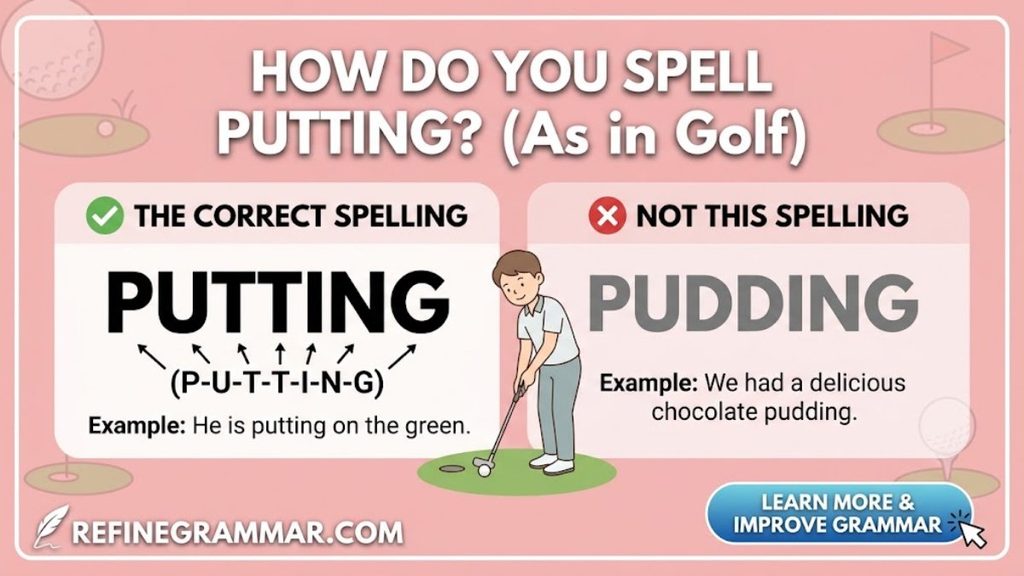
Quick answer: it’s spelled exactly the same way p-u-t-t-i-n-g. The puting vs putting rule doesn’t change once you step onto the golf course. Golfers talk about “working on their putting” or having a “putting stroke,” and the spelling never drops a letter, no matter how casual the context.
The Golf Connection: A Special Case
Here’s the twist I found interesting: golf’s “putting” doesn’t actually come from the everyday verb “put.” It comes from a separate verb, “putt,” meaning to strike a golf ball gently toward the hole. “Putt” traces back to a Scottish word from the 1500s meaning to push or shove. This golf twist adds another layer to the puting vs putting story, because two different root words end up looking identical once “-ing” is added.
Why are they spelled the same?
“Putt” already ends in a double t, so you simply add “-ing” without doubling anything further: putt + ing = putting. Meanwhile “put” needs the consonant doubled to become putting. Two different spelling paths land on the exact same word, which is why grammarians classify “putting” as a heteronym in this context same spelling, different origin, and in careful speech, a slightly different feel. Either way, it explains one more piece of the puting vs putting puzzle: the correct spelling is always consistent, even when the meaning shifts.
What Does “Putting” Mean?
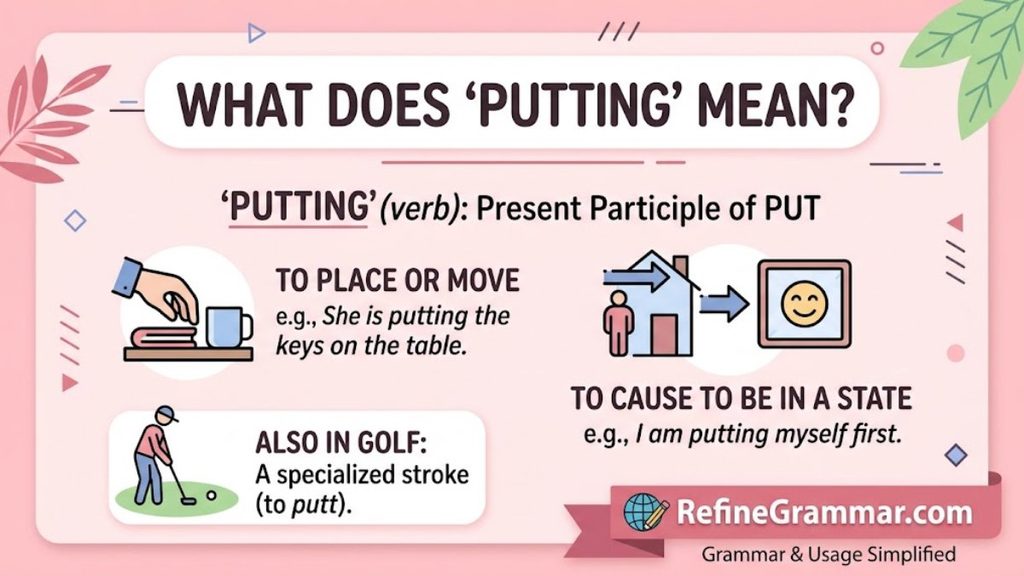
“Putting” is the present participle or gerund form of the verb “put,” meaning to place, move, or position something. In golf, it refers specifically to the light stroke used to roll the ball into the hole on the green. Understanding both meanings also settles the puting vs putting question for good, since neither definition ever calls for a single t.
My Definition and Meaning Analysis
Here’s my breakdown of the two core meanings behind putting, based on how the word actually shows up in everyday and specialized writing.
1. Placing or Moving
This is the most common use. It describes the act of moving an object into a specific position or location.
- Example: She is putting the groceries on the counter.
- Example: He keeps putting off his dentist appointment.
2. In Golf
This use is specific to the sport and describes the short, controlled stroke used near the hole.
- Example: Her putting improved dramatically after the lesson.
- Example: Consistent putting is what separates amateur golfers from pros.
How Do You Spell Putting as in Putting Something Away?
The puting vs putting answer stays the same here too it’s putting, with two t’s, whether you’re putting away laundry, putting away leftovers, or putting away toys. There’s no separate spelling rule for phrasal verbs like “put away”; the base verb still follows the standard CVC doubling pattern.
- Correct: I’m putting away the dishes before guests arrive.
- Incorrect: I’m puting away the dishes before guests arrive.
Is Putting Grammatically Correct?
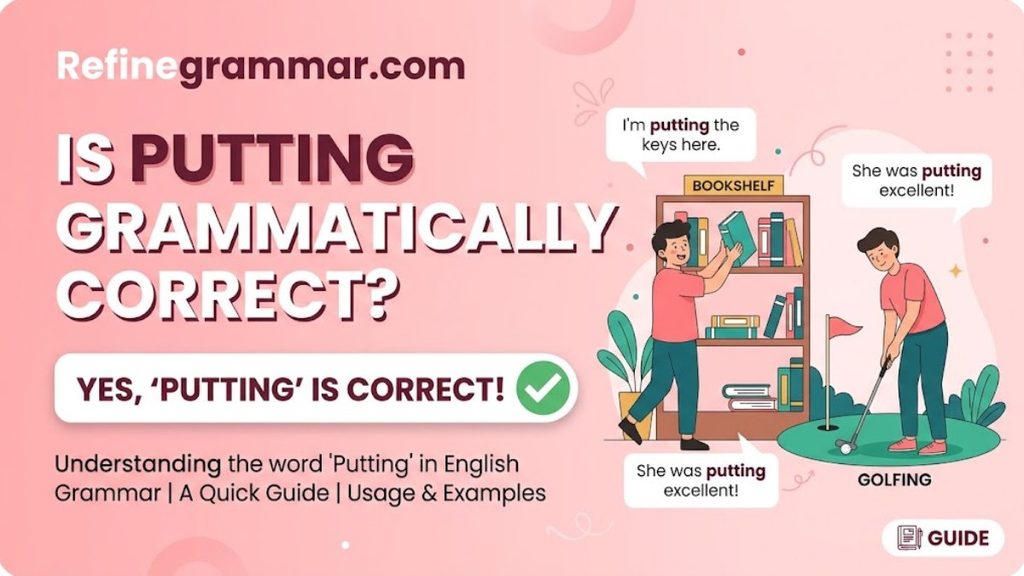
Yes “putting” is grammatically correct when it functions as a gerund (acting as a noun, such as “Putting is my weakest golf skill”) or as a present participle in a progressive tense (such as “She is putting her shoes on”). Once you settle the puting vs putting spelling question, using the word correctly mostly comes down to sentence structure rather than spelling.
One grammar trap worth knowing: if you start a sentence with a participial phrase like “Putting the baby to sleep,” the subject right after the comma must be the one doing the putting, or you create a dangling modifier.
This kind of small structural slip is common across English, similar to the confusion people run into with tried or tryed or the everyday mix-up between to bad vs too bad. None of these errors are about intelligence they’re about rules that were never taught clearly.
Examples I Use
These puting vs putting examples show the correct spelling in action across different contexts:
- She is putting the final touches on her presentation.
- They spent the afternoon putting up holiday decorations.
- His putting on the back nine cost him the tournament.
- We’re putting together a proposal for the client.
- Stop putting off your homework until the last minute.
- Incorrect: She is puting the final touches on her presentation.
Putting vs Puting: My Summary Table
Here’s a quick-reference table I put together summarizing everything above.
| Spelling | Correct? | Part of Speech | Example |
| Putting | Yes | Gerund / present participle of “put” (or “putt” in golf) | She is putting the vase on the table. |
| Puting | No | Common misspelling missing double t | She is puting the vase on the table. (incorrect) |
Did you know?
The verb “put” traces back to the Old English word “putian.” It has kept the same core meaning to place something for over a thousand years, while the spelling rule that doubles its final consonant has stayed remarkably stable. One more puting vs putting fact worth remembering: dictionaries have never recorded “puting” as a historical or regional variant it’s simply a modern typing slip.
Explore More Grammar Guides
If the puting vs putting rule interested you, these related word mix-ups are worth a look:
Frequently Asked Questions
Is it puting or putting?
It’s putting. Puting or putting only one is correct, and that’s putting, with two t’s, in every context.
Why is putting spelled with two ts?
Because “put” is a one-syllable word ending in a single vowel and consonant (CVC), English doubles the final consonant before adding “-ing.”
What is the past tense of put?
The past tense of “put” is also “put.” It’s an irregular verb that doesn’t change form in the past tense.
Is it putt or putt in golf?
In golf, the verb is “putt” (to strike the ball gently), and its “-ing” form is spelled “putting,” identical to the everyday word.
Can we use the word “putting”?
Yes, “putting” is a standard English word used as a gerund or present participle in everyday and golf-related sentences.
What are the types of putting?
In golf, common putting styles include the straight-back-and-through stroke, the arc stroke, and variations using different putter grips and stances.
Is it correct to say “putting”?
Yes, “putting” is grammatically correct when used as a gerund or in a progressive verb tense, such as “I am putting.”
Is putting a valid word?
Yes, putting is a valid, dictionary-recognized English word; puting is not.
What does “putting” in a word mean?
It generally means placing, positioning, or moving something, or, in golf, executing a short stroke toward the hole.
How do you spell putt as in golf?
The golf verb is spelled “putt,” and its noun and “-ing” forms are “putt” and “putting.”
Final Thoughts
That wraps up my full puting vs putting analysis for 2026. The rule is short enough to remember for good: put follows the CVC doubling pattern, so it becomes putting, never puting, no matter the context everyday tasks, golf, or anything in between. Keep the CVC rule in mind, and you’ll never misspell this word again.
