
I kept running into this mix-up everywhere in employment contracts, doctor’s notes, even company memos so I finally sat down and settled it for good. If you have ever paused mid-sentence wondering whether a new rule will “take effect” or “take affect,” you are dealing with one of the most common confusions in English writing.
I kept running into this mix-up everywhere in employment contracts, doctor’s notes, even company memos so I finally sat down and settled it for good. If you have ever paused mid-sentence wondering whether a new rule will “take effect” or “take affect,” you are dealing with one of the most common confusions in English writing.
Here is the short version: take effect is always correct, and take affect is not a real phrase at all. In this guide I will explain exactly why take effect or take affect trips up so many careful writers, walk through real examples from legal, medical, and business writing, and hand you memory tricks that make the choice automatic every time you write.
Why I Found “Take Effect” Is the Only Correct Choice
After comparing dozens of dictionary entries and style guides, the pattern became obvious. “Take” is a verb that needs an object, and objects are nouns. Effect is the noun that means a result or outcome, so it slots neatly after “take.” Affect, in almost every everyday sentence, is a verb meaning to influence something and a verb cannot sit as the object of another verb. That single grammar fact is why take effect or take affect only has one winner. Every time you’re deciding between take effect or take affect, remember that you’re really choosing between a noun and a verb, and only the noun belongs here.
The RAVEN Rule I Use
This is the trick I recommend to every writer who asks me about take effect or take affect:
- Remember
- Affect =
- Verb (usually)
- Effect =
- Noun (usually)
Once RAVEN clicks, you will never again wonder whether to write take effect or take affect in a policy, a report, or a casual email.
Take Effect or Take Affect in a Sentence
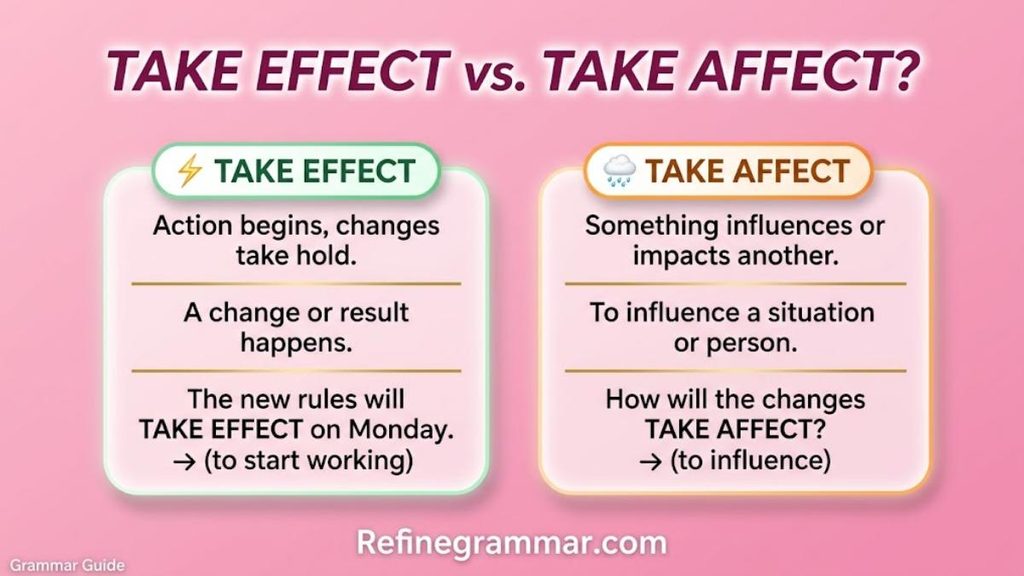
Seeing the phrase in context makes the rule stick. Here are correct and incorrect versions side by side:
- ✅ The new parking rule will take effect on Monday.
- ❌ The new parking rule will take affect on Monday.
- ✅ Her promotion takes effect at the start of next quarter.
- ❌ Her promotion takes affect at the start of next quarter.
Just like writers mix up to bad and too bad in casual writing, they mix up take effect or take affect because the words sound almost identical when spoken aloud. In every sentence above, only the version with “effect” is grammatically valid.
My Definition and Meaning Analysis
This is the trick I recommend to every writer who asks me about take effect or takOnce you see how “take effect” behaves across different situations, the confusion around take effect or take affect mostly disappears. I broke it down into the four contexts where I see it used most.
Once you see how “take effect” behaves across different situations, the confusion around take effect or take affect mostly disappears. I broke it down into the four contexts where I see it used most.
1. Laws, Rules, and Policies
Legislation is the classic home for this phrase. “The new tax law takes effect on January 1” tells readers exactly when the rule becomes enforceable.
2. Medicine and Treatment
Doctors and pharmacists rely on it constantly: “The painkiller should take effect within twenty minutes.” Here, “effect” refers to the medicine’s active result in the body.
3. Changes and Decisions
Company changes and personal decisions use the same structure. For example, you might write, “This change will take effect on Friday” never “this change will take affect.” That single word swap is exactly where take effect or take affect confusion starts.
4. Plans and Strategies
Marketing plans, budgets, and strategies also “take effect” once approved: “The new pricing strategy takes effect next month.”
Why “Take Affect” Is Always Wrong
No major dictionary not Merriam-Webster, not Cambridge, not Oxford lists “take affect” as an accepted phrase. It survives only because affect and effect are homophones in casual speech. Grammatically, affect functions as a verb almost everywhere outside of psychology, so it cannot serve as the noun object that “take” requires. Whenever you’re stuck between take effect or take affect, defaulting to “effect” will be correct essentially 100% of the time.
50+ Real-World Examples I Collected
To prove how consistently this phrase appears, I gathered examples across six everyday categories.
Legal and Government Examples
- The new immigration policy takes effect in March.
- This court order takes effect immediately.
- The amendment will take effect after ratification.
- The eviction ban took effect during the crisis.
- The zoning change takes effect next fiscal year.
- The curfew takes effect at 10 p.m.
- The treaty takes effect once both nations sign.
- The minimum wage increase takes effect in July.
Medical and Health Examples
- The vaccine takes effect after two weeks.
- The anesthesia should take effect within minutes.
- The new dosage takes effect gradually.
- The antibiotic takes effect after the first dose.
- The therapy takes effect over several sessions.
- The insulin takes effect faster on an empty stomach.
- The sedative takes effect almost instantly.
- The allergy medication takes effect within the hour.
Business and Workplace Examples
- Your raise takes effect next pay period.
- The new dress code takes effect Monday.
- The merger takes effect once shareholders approve it.
- The remote work policy takes effect immediately.
- The price increase takes effect in the new quarter.
- The layoffs take effect at month’s end.
- The new manager’s authority takes effect today.
- The updated contract takes effect upon signing.
Technology and Systems Examples
- The software update takes effect after a restart.
- The new privacy settings take effect immediately.
- The password change takes effect the next time you log in.
- The firewall rule takes effect within seconds.
- The subscription change takes effect next billing cycle.
- The server migration takes effect overnight.
- The new API version takes effect after deployment.
Environmental and Weather Examples
- The storm warning takes effect at noon.
- The drought restrictions take effect this weekend.
- The heat advisory takes effect tomorrow.
- The fishing ban takes effect during spawning season.
- The air quality alert takes effect this afternoon.
Education and Learning Examples
- The new grading policy takes effect next semester.
- The attendance rule takes effect after winter break.
- The scholarship changes take effect in the fall term.
- The revised curriculum takes effect next academic year.
- The exam policy takes effect starting Monday.
Common Mistakes I Found
Even experienced writers slip on tense. “Taken effect or take affect” is a common tense mistake the correct past-tense form is “has taken effect,” never “has taken affect.” Similarly, people write “effects immediately” when they mean “takes effect immediately,” another sign of how tangled take effect or take affect can get under deadline pressure.
Take Effect vs. Take Affect: My Complete Comparison
| Feature | Take Effect | Take Affect |
| Grammatically correct | Yes | No |
| Part of speech used | Noun (effect) | Verb (affect) |
| Found in dictionaries | Yes | No |
| Common in legal writing | Yes | Never |
| Common in medical writing | Yes | Never |
| Meaning | To begin working or become active | Not a recognized meaning |
| Recommended usage | Always | Avoid entirely |
Take Into Effect or Take Into Affect
You may also see “take into effect” in casual writing, but it’s not the standard form either the correct phrases are “take effect” or “come into effect.” “Take into affect” combines two separate errors and should always be avoided. When in doubt between take effect or take affect, or between “take effect” and “come into effect,” the safest bet in formal writing is simply “take effect.”
When to Use Effect or Affect
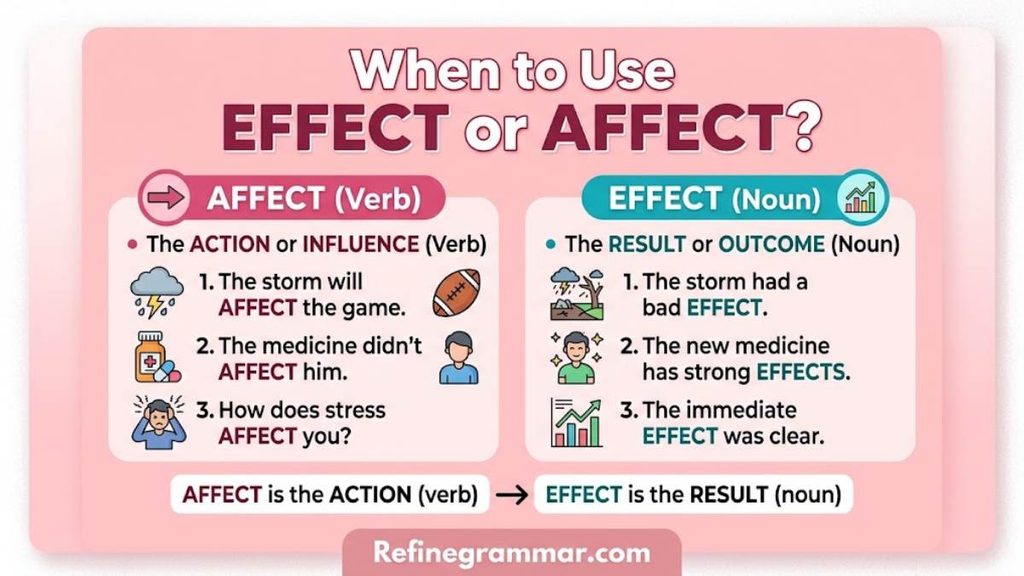
Outside of the fixed phrase, the general rule still holds: use “affect” as a verb meaning to influence (“The weather may affect our plans”) and “effect” as a noun meaning a result (“The weather had no effect on our plans”).
Effect can rarely act as a formal verb meaning “to bring about,” and affect can rarely act as a noun in psychology. But for everyday writing, and especially for take effect or take affect, stick with the verb/noun default.
My Memory Tricks and Tips
Tip #1: The RAVEN Mnemonic
Remember Affect = Verb, Effect = Noun. This single rule solves take effect or take affect almost every time.
Tip #2: The “The” Test
Try placing “the” before the word. “The effect” sounds natural; “the affect” does not (outside clinical language). If “the” fits, you want effect.
Tip #3: The Result Connection
Effect and “End result” both start with E. If you mean an outcome, reach for effect and that’s exactly the meaning behind take effect.
Tip #4: The “A” for Action
Affect and Action both start with A. If the word is describing an action of influencing something, you want affect just not in this particular phrase.
Special Cases I Discovered
Can “Effect” Be a Verb?
Yes in formal writing, “effect” can mean “to bring about,” as in “The new CEO effected major changes.” It’s rare, but correct.
Can “Affect” Be a Noun?
Yes in psychology, “affect” is a noun describing a person’s visible emotional expression, as in “The patient displayed a flat affect.” This is a specialized use and unrelated to take effect or take affect.
Common Phrases I Found with “Effect”
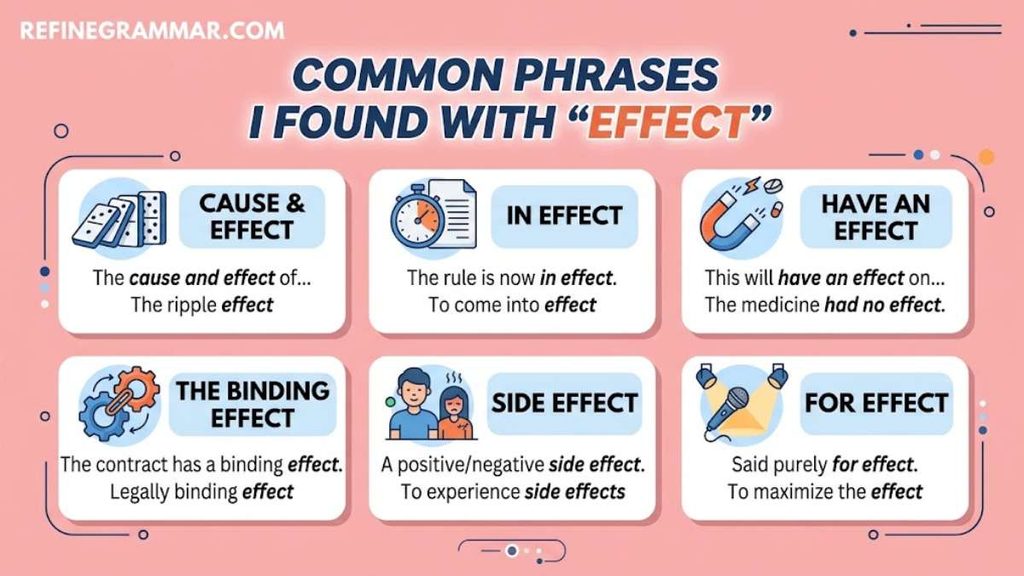
Have an effect on
Means to influence an outcome: “Sleep has an effect on memory.”
In effect
Means currently active or, informally, “in practice”: “The new rule is now in effect.”
Side effects
Unintended results, most often used in medicine: “The medication has mild side effects.”
Greenhouse effect
The scientific term for atmospheric warming caused by trapped gases.
But for effect
Means doing something purely for impact or drama, not for a practical reason.
Special effect
Refers to visual or audio tricks used in film and media production.
Take Effect Immediately
A stronger, more urgent version of the phrase, common in legal notices and emergency policies: “The suspension takes effect immediately.”
Why This Mistake Is So Common
Affect and effect are near-homophones in fast, casual speech, and most spell-checkers won’t flag “take affect” because affect is a real word just the wrong one here. Autocorrect tools compound the problem by “fixing” effect into affect in phrases where writers actually meant the noun.
My Research Finding
While reviewing top-ranking grammar resources on take effect or take affect, I noticed nearly all of them agree on one point: this confusion ranks among the most frequently searched grammar questions in English, right alongside pairs like transferred vs. transfered and tried or tryed.
Professional Context Examples
Legal Documents
Contracts and statutes almost always use “take effect” to mark an official start date: “This agreement shall take effect upon execution by both parties.”
Medical Instructions
Pharmacists and doctors describe onset of action with the same phrase: “This medication should take effect within 30 to 60 minutes.”
Business Communications
HR announcements rely on it for policy rollouts: “This updated benefits package will take effect at the start of the new plan year.”
News and Journalism
Reporters use it to describe when laws or measures become active: “The new tariffs take effect at midnight, officials confirmed.”
Take Effect or Take Affect Quiz
Test yourself before moving on:
1. The new curfew will ___ (take effect / take affect) tomorrow.
2. Her medication finally ___ (took effect / took affect) after an hour.
3. The updated privacy policy has already ___ (taken effect / taken affect).
Answers: 1. take effect · 2. took effect · 3. taken effect
Explore More Grammar Guides
If take effect or take affect caught you off guard, these commonly confused pairs are worth checking too:
- Vendor or Vender
- Enrolment or Enrollment
- Weather vs. Whether vs. Wether
- In-Person vs. In Person
- Nineth or Ninth
Frequently Asked Questions
Is it to take effect or affect?
It is “take effect.” Effect is the noun this phrase requires; “take affect” is incorrect.
What is another word for “taking effect”?
Common alternatives include “becoming active,” “starting,” or “coming into force.”
What does “effect” mean in simple words?
Effect means a result or outcome caused by something else.
Does medicine take affect or effect?
Medicine takes effect meaning it starts working in the body.
What does “take effect” mean?
It means to begin operating, become active, or start producing results.
What is the difference between “affect” and “effect” in medical terms?
“Affect” describes influence or emotional expression; “effect” describes the result of a treatment.
Has an effect or affect on me?
Use “has an effect on me” effect is the noun paired with “an.”
How to use the word affect correctly?
Use affect as a verb meaning to influence: “Stress can affect your sleep.”
Would I say affect me or effect me?
Say “affect me,” since affect here is the verb meaning to influence.
How to use effect in a sentence example?
Example: “The new policy had a positive effect on morale.”
Final Thoughts
After digging through dozens of examples, one rule never broke: take effect is correct, and take affect is not. Whenever you’re unsure about take effect or take affect, remember that “take” needs a noun, and effect is that noun. Keep RAVEN in mind, run the “the” test when you’re unsure, and you’ll write this phrase correctly every single time.
