
If you’ve ever paused mid-sentence wondering whether to write “suing” or “sueing,” you’re not alone. This mix-up shows up in emails, legal forums, and social media threads every single day. The confusion makes sense once you see why: English spelling rules don’t always feel obvious, and this particular word breaks the pattern people expect. This guide settles the suing or sueing debate for good, explains where the confusion comes from, and walks through how to use the word correctly in real sentences.
By the end, you’ll know the correct spelling, the reasoning behind it, and how to answer every common question people ask about this term from its legal meaning to whether “I will sue you” counts as an actual threat.
Suing or Sueing: Which Spelling Is Correct?
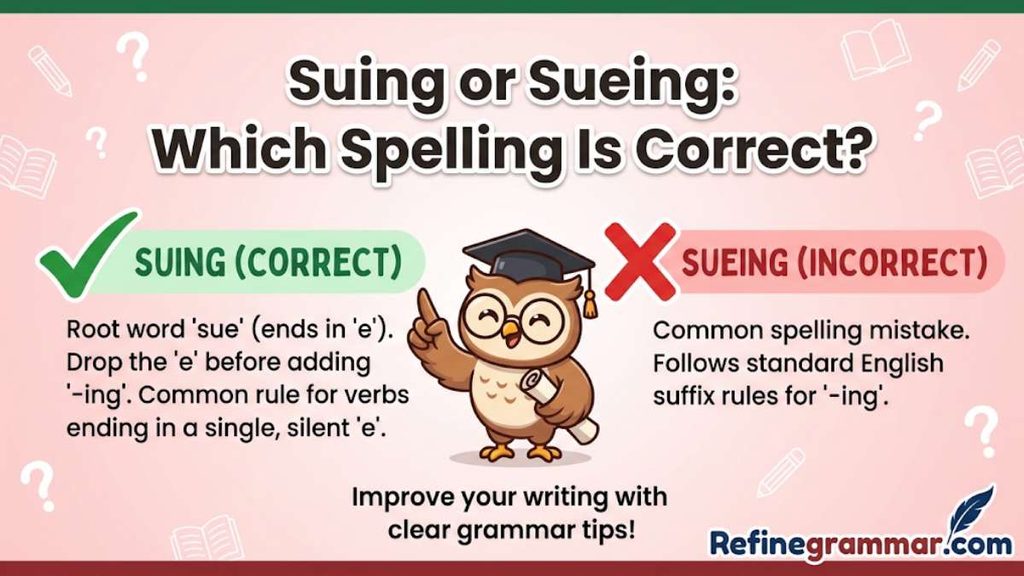
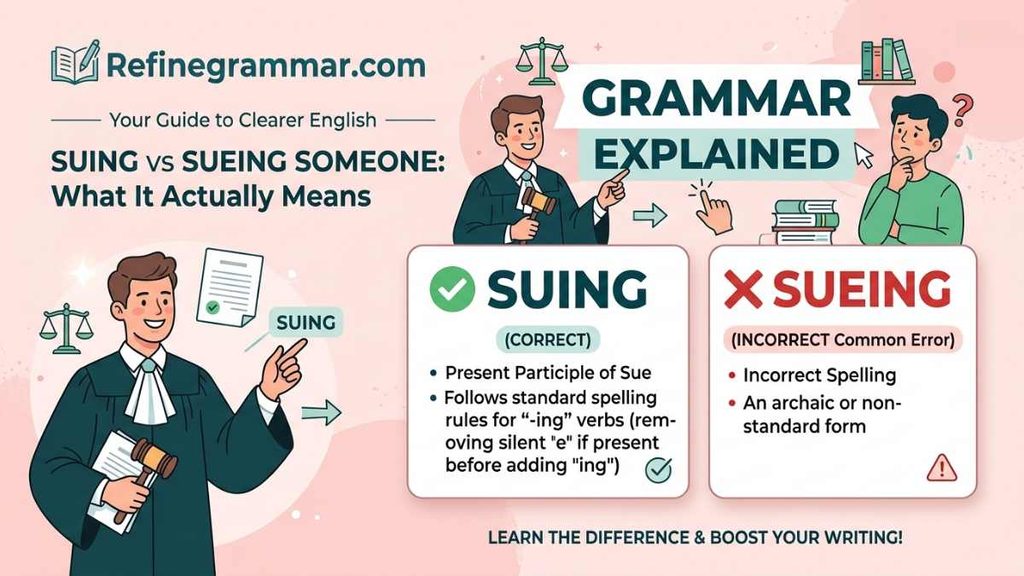
The correct spelling is suing. “Sueing” is a common misspelling, not an accepted variant, and you won’t find it in Merriam-Webster, Cambridge Dictionary, or any other major reference.
Here’s the rule that explains it. The base verb is “sue,” and it ends in a silent “e.” When you add “-ing” to a verb that ends in a silent “e,” standard English spelling convention drops that “e” before attaching the suffix. That’s why “write” becomes “writing,” “use” becomes “using,” and “sue” becomes “suing.” Keeping the “e” and writing “sueing” breaks this pattern, which is exactly why it looks off to a trained eye but still trips up plenty of writers.
So whenever you’re debating suing or sueing in a document, message, or legal filing, default to “suing.” It’s the only form accepted in professional, academic, and legal writing.
Why Do People Misspell It as “Sueing”?
A few things drive the suing or sueing confusion:
- Pronunciation instinct: the word is spoken as “soo-ing,” and some writers add the extra “e” thinking it preserves that long vowel sound, the way “seeing” or “agreeing” keep a double vowel.
- Autocorrect gaps: not every spellchecker flags “sueing” instantly, especially in casual typing apps or fast-paced messaging.
- Visual unfamiliarity: “suing” looks shorter and less “complete” than other -ing verbs, so some people feel compelled to pad it.
- Rare exposure: most people don’t use this word often, so the correct spelling never becomes automatic the way common verbs do.
None of these reasons make “sueing” acceptable. They just explain why the mistake keeps happening.
Suing or Sueing Meaning
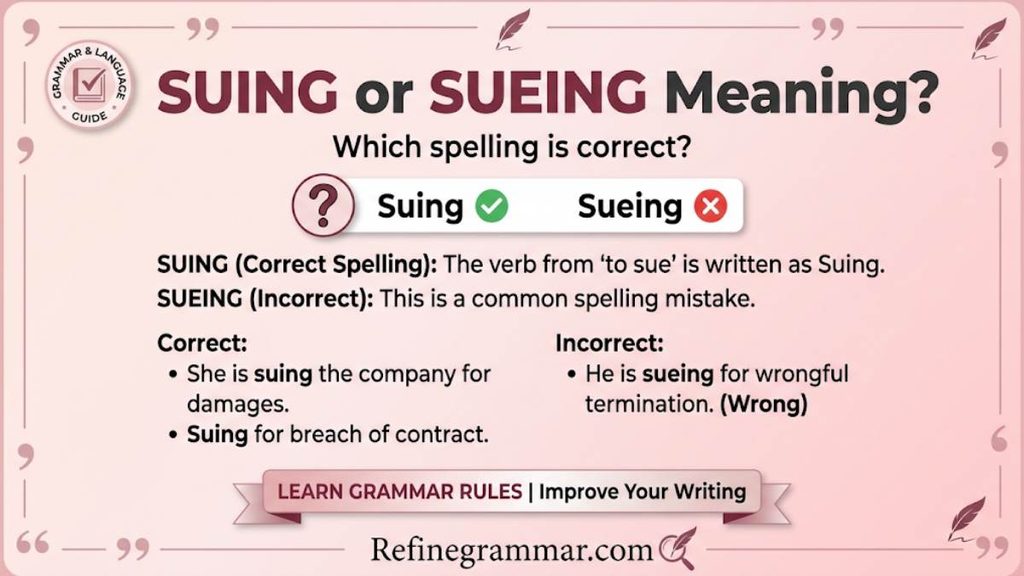
Once you’ve settled on the spelling, it helps to nail down the meaning too. “Suing” is the present participle (or gerund) of the verb “sue,” which means to bring a legal action against someone in court. When someone says they’re “suing” a company or a person, they mean they’re pursuing a formal legal claim, usually seeking money, damages, or a specific court order.
The table below breaks down the correct form against the common error, so you can see the distinction at a glance.
| Form | Status | Example Sentence |
| Suing | Correct | She is suing her landlord over unsafe living conditions. |
| Sueing | Incorrect | She is sueing her landlord over unsafe living conditions. |
| Sue | Base verb (correct) | He plans to sue the manufacturer. |
| Sued | Past tense (correct) | They sued the company last year. |
This meaning matters because it clears up why the suing or sueing spelling question keeps popping up in legal and everyday writing alike. People typing quickly about a dispute, a claim, or a court date are often stressed or rushed, and that’s exactly when small spelling slips like “sueing” tend to creep in. Slowing down for one extra second, remembering the silent “e” rule, and checking your sentence before you send it will save you from that error every time.
How to Use “Suing” in a Sentence
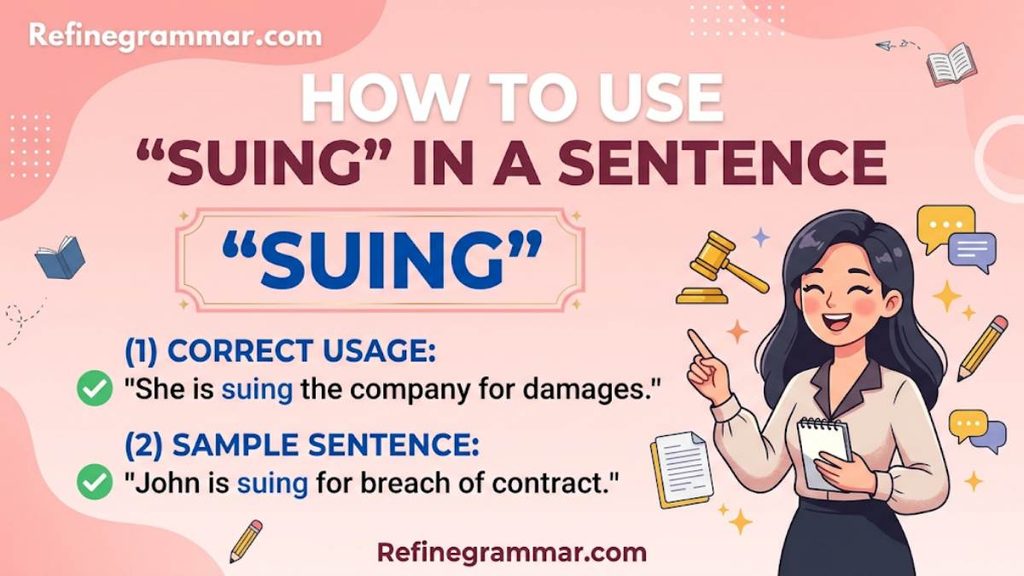
Seeing the word in context makes the suing or sueing rule stick. Here are a few natural examples:
- “The tenant is suing the property manager for failing to fix the heating system.”
- “After months of back-and-forth, the family decided they had no choice but to start suing the contractor.”
- “He’s not actually suing anyone; he’s just threatening it to force a settlement.”
- “The company is being sued by three former employees over unpaid overtime.”
Notice that “suing” always pairs with a form of “to be” (is, was, are) when describing an ongoing action, which is standard for present participles in English.
Learn More: Defence or Defense: Correct Spelling Explained (US vs UK)
Suing or Sueing Someone: What It Actually Means
When you’re “suing someone,” you’re formally asking a court to resolve a dispute in your favor. This usually starts with filing a complaint, which lays out your claims and what you want the court to do about them. From there, the other party called the defendant gets a chance to respond, and the case moves through discovery, negotiation, and possibly trial.
People often say “suing” casually, as in “I’m going to sue you,” without meaning to start a real court case. But in a formal sense, suing someone is a structured legal process with deadlines, filings, and rules that vary by jurisdiction. If you’re seriously considering it, talking to a licensed attorney is the safest first step, since court procedures and statutes of limitations differ from place to place.
Is Suing the Same as Filing a Lawsuit?
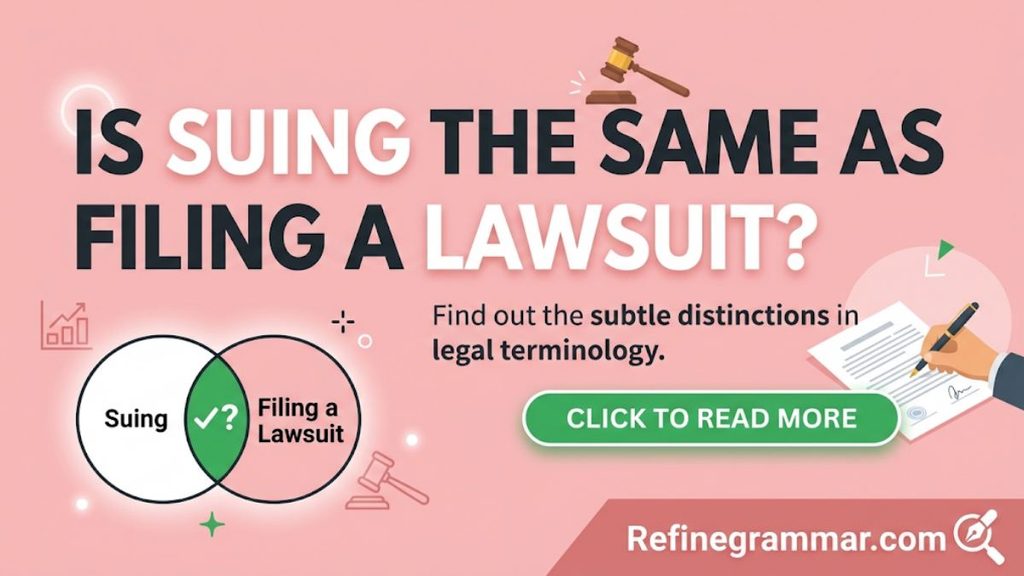
Not exactly, though the two are closely related. “Suing” describes the ongoing act of pursuing legal action, while “filing a lawsuit” refers to the specific, formal step of submitting your complaint to a court. Filing a lawsuit is essentially the starting gun for the process of suing someone.
Think of it this way: suing is the broader journey, and filing the lawsuit is the first official mile marker on that journey. You can threaten to sue without ever filing anything, but you can’t be actively suing someone in the legal sense until a lawsuit has actually been filed.
Legal professionals rarely debate suing or sueing as a spelling matter, since law school and legal writing courses drill the correct form early on. But for everyday readers who only encounter the word occasionally, the mix-up is understandable, and it’s worth double-checking any document before you send it to a court, a lawyer, or the other party involved.
Learn More: To Bad vs Too Bad: The Correct Answer (Grammar Guide)
Can You Sue Someone Who Sues You?
Yes. This is called a countersuit or counterclaim, and it’s a common feature of civil litigation. If someone sues you and you believe you have your own valid legal claim against them arising from the same dispute or a related one you can file a counterclaim within the same case, or in some situations, a separate lawsuit.
For example, imagine a landlord sues a tenant for unpaid rent, and the tenant responds by countersuing for the landlord’s failure to make required repairs. Both claims can proceed together in the same court proceeding, which often saves time and legal costs compared to two separate cases.
People Also Search For
Here’s a quick-reference table answering the related questions people commonly search alongside “suing or sueing.”
| Search Query | Short Answer |
| Suing or sueing | “Suing” is correct; “sueing” is a misspelling. |
| Suing or sueing meaning | It means bringing or pursuing a legal case against someone. |
| I’m suing or sueing | Write “I’m suing,” never “I’m sueing.” |
| Is it spelled suing or suing | The only correct spelling is “suing.” |
| Suing or sueing someone | Taking legal action against a specific person or entity. |
| Is suing a lawsuit | Suing is the act; a lawsuit is the formal case itself. |
| Can you sue someone who sues you | Yes, through a countersuit or counterclaim. |
| Is suing the same as filing a lawsuit | Related but not identical; filing starts the suing process. |
| What is suing | Legal action seeking a court remedy, like damages. |
| Can I sue someone for suing me | Only if their lawsuit was frivolous, malicious, or abusive. |
Frequently Asked Questions
Is it spelled sueing or suing?
It’s spelled “suing.” Drop the silent “e” from “sue” before adding “-ing.”
What does “I’m suing you” mean?
It means the speaker intends to bring, or has already brought, a legal claim against you in court.
What does suing mean?
Suing means pursuing a formal legal action against a person, business, or organization.
What is another word for suing someone?
Common alternatives include litigating, prosecuting (in a civil sense), or taking legal action against someone.
What is the difference between “suing” and “lawsuit”?
“Suing” is the verb describing the action; “lawsuit” is the noun for the actual court case itself.
What does “sue me” mean?
It’s often used informally to mean “do your worst” or “I don’t care about the consequences,” rather than a literal legal invitation.
What does it mean to sue someone?
It means formally asking a court to grant relief, such as money or a specific action, because that person wronged you legally.
What does “I will sue you” mean?
It’s a statement of intent to pursue legal action, though it doesn’t guarantee a lawsuit will actually be filed.
Is saying “I will sue you” a threat?
It can be seen as a threat of legal action, but it’s generally legal to say unless it’s paired with extortion or coercion.
What does “sue” mean in simple words?
In simple words, “sue” means to ask a court to make someone pay for or fix a wrong they caused you.
Final Thought
The suing or sueing question has one clean answer: always write “suing.” Once that spelling clicks, the rest of the confusion around lawsuits, countersuits, and legal threats gets a lot easier to untangle. Keep this guide handy the next time doubt creeps back in.
