
Should you write Friendlier vs More Friendly? Both forms show up in everyday writing, and English speakers use them almost interchangeably but one usually fits better than the other.This guide breaks down exactly when to reach for friendlier and when more friendly is the smarter pick, so your writing sounds natural every time.
By the end, you’ll know the simple rule that settles the more friendly vs friendlier debate for good, along with real examples you can copy straight into your own sentences.
Understanding Comparative Adjectives in English
Comparative adjectives let us measure one thing against another bigger, smarter, more useful. English gives writers two tools for building these forms, and knowing which tool fits which word is the real key to sounding fluent when comparing friendlier and more friendly options in a sentence.
Two Ways to Form Comparatives
You can either add a suffix to the base adjective or place a separate word in front of it. Short, simple adjectives usually take the suffix. Longer or more complex adjectives usually take the separate word instead.
When English Adds “-er”
One-syllable adjectives like fast, tall, and small almost always take “-er”: faster, taller, smaller. Many two-syllable adjectives ending in “-y” follow the same pattern, swapping the “y” for an “i” first: happy becomes happier, easy becomes easier.
When English Uses “More”
Adjectives with three or more syllables, plus most two-syllable adjectives that don’t end in “-y,” pair with more instead: more beautiful, more careful, more modern. Adding “-er” to these words would sound clumsy or simply wrong.
Where “Friendly” Fits
Friendly sits right at the boundary. It has two syllables and ends in “-y,” which puts it in the “-er” camp alongside happy and easy. That’s why friendlier is the textbook-correct comparative. Still, more friendly isn’t wrong it’s just the less common of the two, which is exactly where the confusion starts.
Why “Friendly” Creates Confusion
Most two-syllable “-y” adjectives comfortably take “-er,” so friendlier should feel automatic. But friendly doesn’t look or sound like a typical adjective it’s built from the noun “friend” plus the suffix “-ly,” the same ending adverbs like quickly or slowly use. That resemblance tricks writers into reaching for more, the pattern usually reserved for longer, adverb-like words. Spelling look-alikes cause the same kind of trap elsewhere, the way emaculate vs immaculate confuses writers who go by sound instead of spelling. Add in compound phrases like user-friendly, and the rules seem to shift again. The result is a word that technically follows one pattern but visually suggests another a small mismatch that has confused writers in the more friendly vs friendlier debate for generations.
When “Friendlier” Is the Better Choice
In most everyday writing, friendlier is the natural, grammatically preferred choice between more friendly and friendlier.
Typical Situations
Use friendlier when:
- Comparing two people directly (“She’s friendlier than her coworker.”)
- Writing casual or conversational content
- Describing places, pets, or brands in marketing copy
- Keeping a sentence short and punchy
Why “Friendlier” Often Wins
Friendlier is shorter, reads more naturally, and matches how native speakers actually talk. Style guides generally recommend the “-er” form whenever an adjective allows it, since suffixed comparatives tend to sound less formal and more fluid than their more counterparts.
When “More Friendly” Works Better
More friendly isn’t incorrect it has its own legitimate uses, especially in formal or structured writing.
Situations Where “More Friendly” Makes Sense
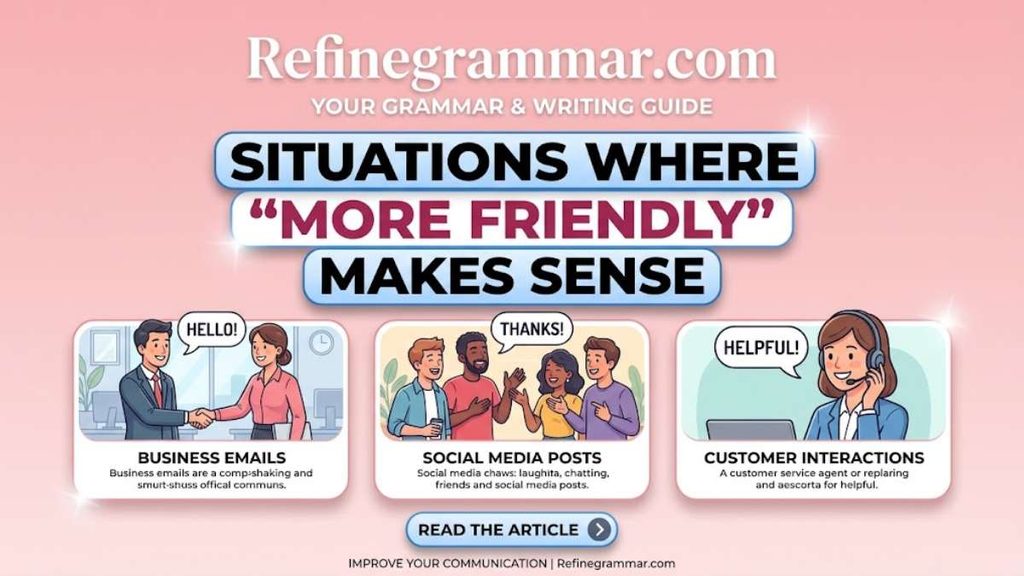
Reach for more friendly when:
- Pairing it with another adjective (“more friendly and professional”)
- Writing formal or academic content
- Emphasizing the comparison itself (“far more friendly than expected”)
- Following a word like far, much, or somewhat for emphasis
Sentence Rhythm Matters
Sometimes the choice comes down to how a sentence sounds out loud. “The new manager is more friendly, approachable, and easygoing than the last one” flows better than forcing friendlier into a list of longer adjectives. Rhythm, not just rule, often decides the final call in the more friendly vs friendlier comparison.
Compound Adjectives and the “Friendly” Exception
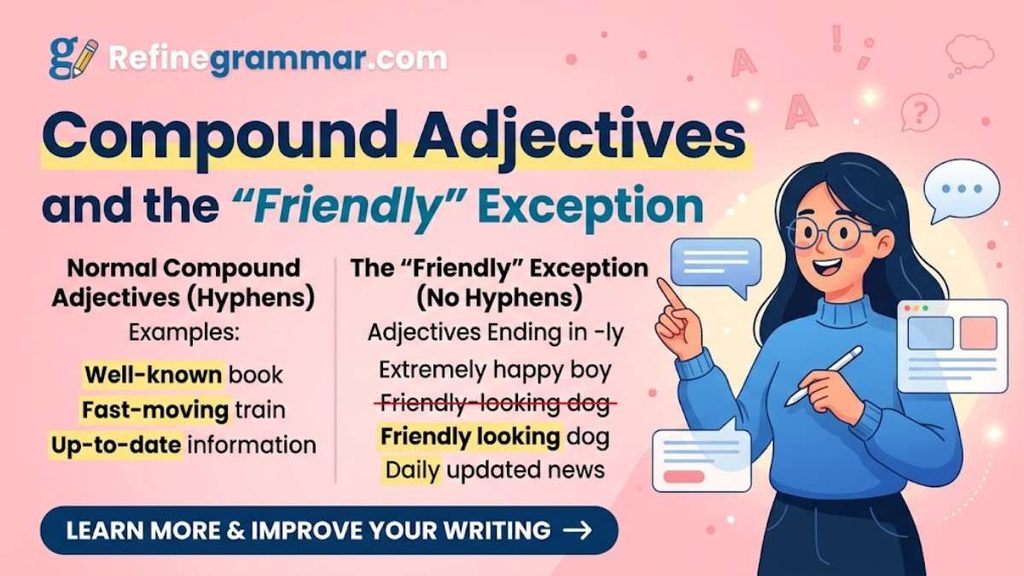
Compound adjectives change the rule entirely. When friendly attaches to another word eco-friendly, user-friendly, budget-friendly more becomes the only correct option, no exceptions.
Examples of Compound Comparatives
- more eco-friendly packaging
- more user-friendly interface
- more budget-friendly option
- more family-friendly neighborhood
Real-World Example
A product description that reads “this app is friendlier for beginners” sounds off, while “this app is more user-friendly for beginners” reads naturally. The compound form locks the sentence into the more pattern. Writers sorting out fixed-pattern exceptions like label or lable run into the same kind of rule, where one small structural detail changes everything.
“More Friendly” vs “Friendlier” in Context
The table below sums up how the more friendly vs friendlier choice plays out across common writing situations:
| Context | Preferred Form | Example |
| Casual writing | Friendlier | “He’s friendlier than I expected.” |
| Formal or academic writing | Either (context-dependent) | “The policy is more friendly to small businesses.” |
| Compound adjectives | More friendly | “A more eco-friendly solution.” |
| Direct one-to-one comparison | Friendlier | “This café is friendlier than that one.” |
| Lists with longer adjectives | More friendly | “More friendly, open, and welcoming.” |
Formal vs Informal Usage
In informal speech and casual blog content, friendlier dominates because it mirrors natural conversation. Formal writing legal documents, academic papers, corporate reports leans slightly more toward more friendly, particularly when the writer wants to sound measured or is matching a “more + adjective” pattern already used elsewhere in the text. The same formal-versus-informal split shows up in debates like label or lable, where one spelling reads casual and the other reads deliberate.
Observing Modern Usage
Corpus data from published English books and articles consistently shows friendlier appearing far more often than more friendly, confirming that native speakers overwhelmingly favor the shorter form outside of compound adjectives and stylistic exceptions.
Common Mistakes Writers Should Avoid
Double Comparatives
Never combine both forms: “more friendlier” is a double comparative and is always incorrect. Choose one method, not both the same way you wouldn’t write “more taller” or “more faster.”
Misplaced Comparisons
Avoid comparing friendly to an unrelated noun. “This city is friendlier than New York’s weather” compares two different categories. Keep the comparison parallel: people to people, places to places. Mismatched categories cause the same kind of confusion as possessive slip-ups like parents vs parent’s, where one small word choice changes what’s actually being compared.
Overusing “More”
Defaulting to more for every adjective, even short, simple ones, makes writing feel stiff. If “-er” is available and natural, as it is with friendlier, use it instead of automatically reaching for more.
A Simple Rule You Can Remember
If friendly stands alone, use friendlier. If friendly is attached to another word (eco-friendly, user-friendly) or paired with a list of longer adjectives, use more friendly. That one distinction resolves almost every real-world case of the more friendly vs friendlier question.
Practical Writing Tips
Read the Sentence Aloud
If a sentence sounds awkward with friendlier, your ear is usually right switch to more friendly and see if it flows better.
Favor Simplicity
When both forms are grammatically fine, choose the shorter one. Readers process friendlier faster than more friendly, which helps with clarity in web content.
Watch for Compound Phrases
Always check whether friendly is part of a hyphenated compound before choosing a comparative. Compounds almost always require more.
Focus on Clarity
Grammatical correctness matters less than clear communication. Pick whichever form of more friendly vs friendlier makes the sentence easiest to understand at a glance.
Real-World Language Examples
Customer Service Example
“Our support team is friendlier than most call centers we’ve dealt with.” Here, friendlier captures a direct, personal comparison that fits customer-facing copy.
Software Design Example
“The updated dashboard is more user-friendly than the previous version.” Because user-friendly is a compound, more is the only correct choice, even though the base word is still friendly.
Environmental Product Example
“This packaging is more eco-friendly than plastic alternatives.” The same compound rule applies friendlier would sound wrong here despite being grammatically valid for plain friendly.
Linguistic Insight: Why Both Forms Survive
English rarely enforces a single “correct” comparative when a word sits on the edge between short and long adjectives. Friendly survives in both forms because its “-y” ending invites “-er,” while its noun-plus-suffix structure invites more. Similar overlaps show up elsewhere in English usage debates like simile vs metaphor or thier or their persist for related reasons, where two forms compete until everyday usage, not a grammar textbook, settles the outcome.
Frequently Asked Questions
Is it correct to say “more friendly” or “friendlier”?
Both are grammatically correct, but friendlier is the more common and natural choice in most contexts.
What is the comparative form of “friendly”?
The standard comparative form is friendlier.
Which is correct, “friendliest” or “most friendly”?
Friendliest is the standard superlative; most friendly appears mainly with compound adjectives like most user-friendly.
Is there a word “friendlier”?
Yes, friendlier is a real, widely used comparative adjective found in every major dictionary.
What is the superlative form of “friendly”?
The superlative form is friendliest.
Is “friendliest” a real word?
Yes, it’s the standard superlative of friendly.
What does “friendlier” mean?
It means showing more warmth, kindness, or approachability than whatever it’s being compared to.
What is another word for “friendlier”?
Synonyms include warmer, more approachable, and more amiable.
How do you use “friendlier” in a sentence?
Example: “The new café feels friendlier than the old one.”
What is the comparative word for “friendly”?
Friendlier is the comparative word for friendly.
Conclusion
The more friendly vs friendlier debate comes down to one simple distinction: use friendlier when the word stands alone, and switch to more friendly for compound adjectives or lists of longer comparatives. Once you spot that pattern, you’ll never second-guess the choice again. For more spelling and usage comparisons like this one from comment vs coment to in process vs in progress keep exploring guides that clear up the small details that make writing sound polished and professional.
