
If you’ve ever paused mid-sentence wondering whether to type Manuel or manual, you’re not alone. This one-letter swap trips up writers, students, and professionals every day, especially once autocorrect gets involved. The Manuel vs Manual mix-up looks small on the page, but it can change the entire meaning of a sentence. This guide breaks down exactly when to use each word, why the confusion happens, and how to avoid it for good.
Manuel vs Manual
At the core, Manuel vs Manual comes down to one simple distinction: Manuel is a person’s name, while manual is a common English word describing instructions, hand-operated tasks, or physical processes. The two share nearly identical spelling, but they belong in completely different parts of a sentence. Understanding this difference is the first step toward writing with confidence.
Quick Comparison
Here’s a side-by-side look at how these two words differ.
| Feature | Manuel | Manual |
| Word type | Proper noun (name) | Common noun / adjective |
| Meaning | A person’s first name | Instructions, a guidebook, or done by hand |
| Capitalization | Always capitalized | Lowercase unless starting a sentence |
| Origin | Spanish, Portuguese, Hebrew | Latin “manus” (hand) |
| Example | “Manuel arrived early.” | “Read the manual first.” |
Simple Rule to Remember
- If you’re naming a person, write Manuel.
- If you’re describing instructions, a guide, or something done by hand, write manual.
- When in doubt, ask yourself: am I talking about a person or a process?
What Does Manual Mean?
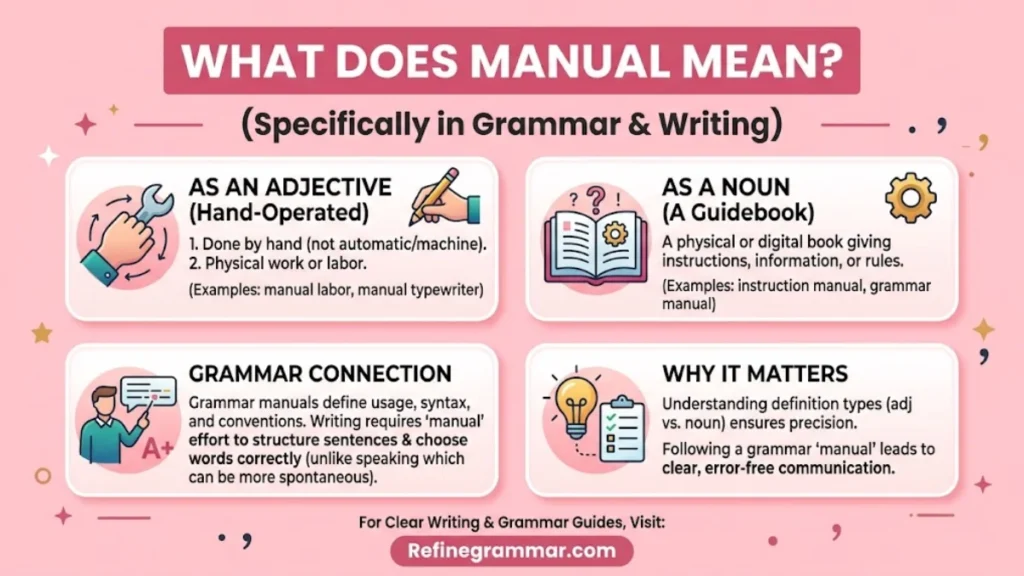
Manual is a versatile English word that functions as both a noun and an adjective. As a noun, it refers to an instruction book or guide. As an adjective, it describes something operated by hand rather than automatically. Because it appears constantly in technology, automotive, and workplace writing, understanding what manual means is essential for clear communication.
Manual Definition in English
According to standard English dictionaries, manual traces back to the Latin word manus, meaning hand. Over time, the word expanded to describe anything done by hand or any document created to guide human action. This root explains why manual so often appears alongside words like handbook, guide, and instructions.
Manual Document Meaning
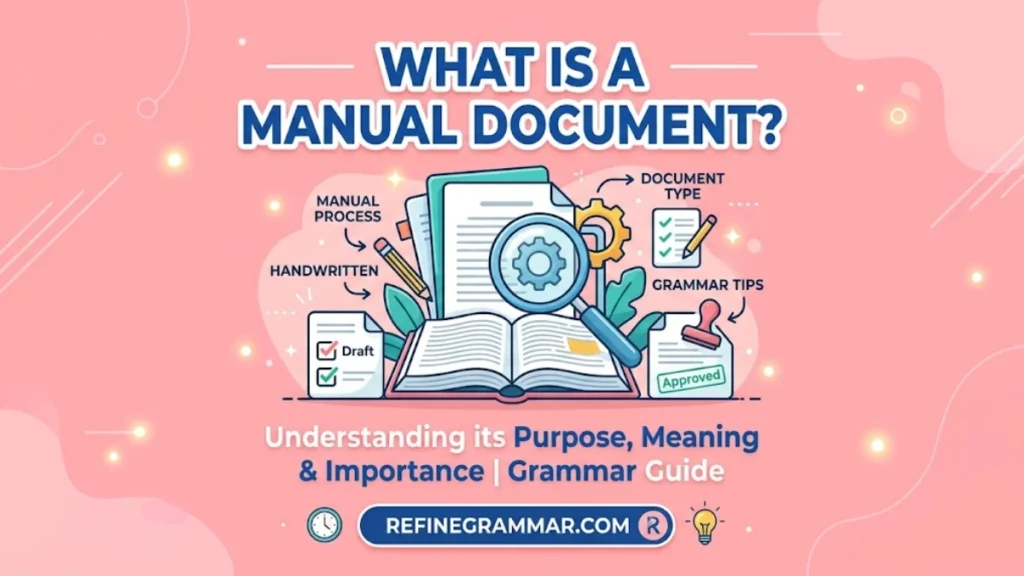
When people search for manual document meaning, they’re usually asking about instruction booklets — the kind that come packaged with appliances, software, or machinery. A well-organized manual explains setup, use, and troubleshooting in a logical sequence, and how a manual’s content is laid out can determine whether readers actually use it.
Manual Meaning as a Noun
As a noun, manual meaning centers on a written guide. A car owner’s manual, a software user manual, and an employee handbook are all examples of this noun form. Each one exists to walk a reader through a process step by step.
Common Examples
- User manuals for electronics
- Training manuals introduced early in a person’s career at a new job
- Repair manuals for vehicles
- Instruction manuals for furniture assembly
- Safety manuals in workplaces
Examples of Manual in a Sentence
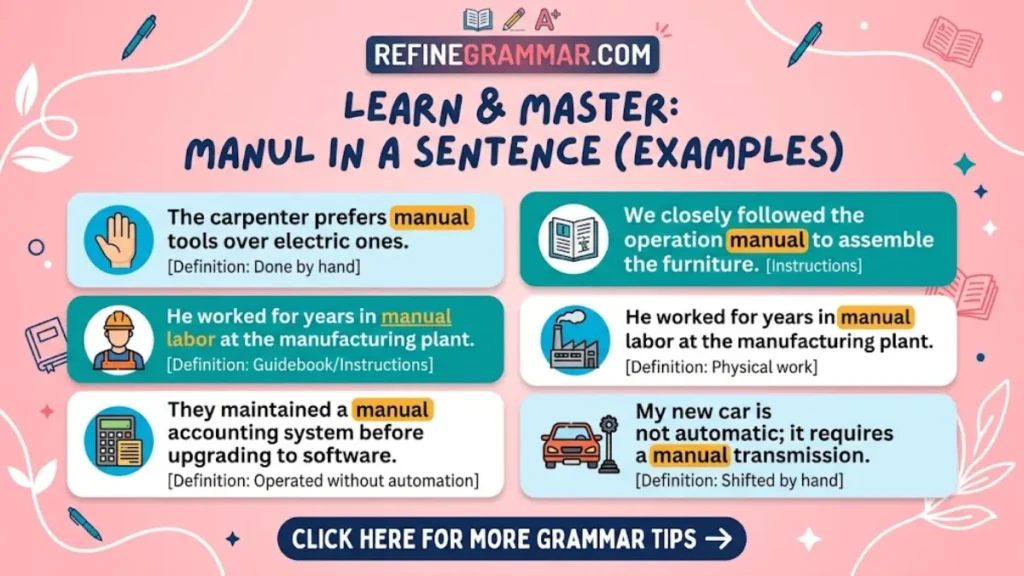
- She kept the manual in the glovebox for reference.
- Please consult the manual before assembling the desk.
- The manual explained each button on the dashboard.
What Does “Manual Book” Mean?
“Manual book” is a phrase some non-native English speakers use, but it’s technically redundant in standard English. Since manual already functions as a noun meaning “instruction book,” adding “book” repeats the meaning. Native English writing typically uses simply manual or instruction manual instead.
Manual Meaning as an Adjective
As an adjective, manual describes anything done by hand or without automation. A manual task requires physical effort or direct human control rather than a machine handling it automatically.
Common Uses
- Manual labor
- Manual transmission
- Manual override
- Manual data entry
- Manual settings on a camera
Even having at least a basic grasp of these terms helps readers follow technical writing without confusion.
Example Sentences
- The job required manual labor in the warehouse.
- He prefers a manual transmission over an automatic one.
- She switched the camera to manual settings for better light.
Is “Manual” Used as a Verb?
No. Manual is not used as a verb in standard English. It functions only as a noun or an adjective. Writers sometimes reach for “manually,” the adverb form, to describe an action instead, as in “she manually adjusted the settings.”
What Does Manuel Mean?
Manuel is a given name with deep roots in Spanish, Portuguese, and Hebrew traditions. It is not a common noun, and it never describes an object, a guide, or a process.
Manuel Meaning
Manuel is considered a variant of Emmanuel, a name derived from the Hebrew phrase meaning “God is with us.” It remains a popular first name across Spain, Portugal, Latin America, and Portuguese-speaking communities worldwide.
Is Manuel a Word in English?
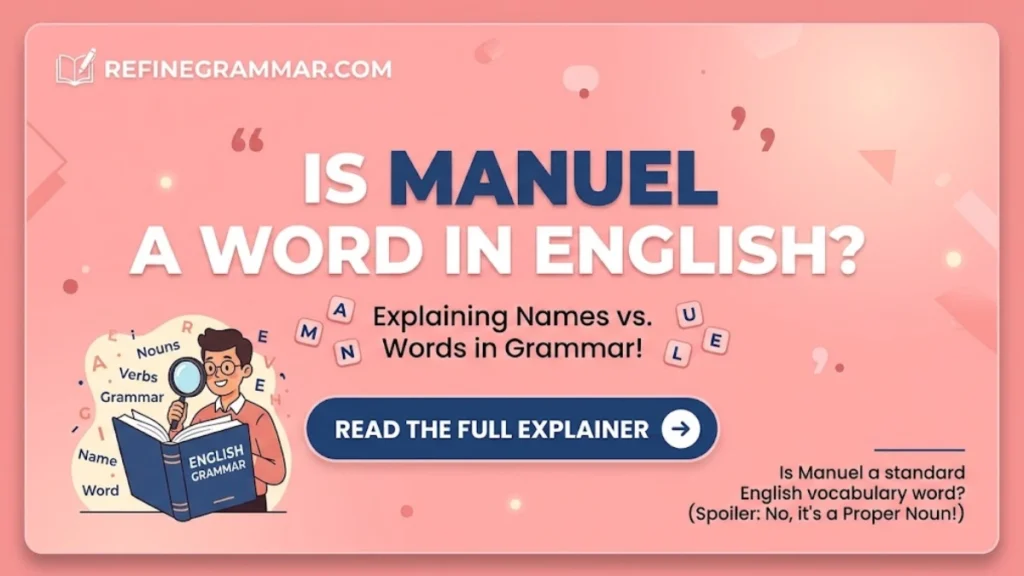
Manuel is not a standard English vocabulary word. It doesn’t appear in English dictionaries as a common noun or adjective. It exists only as a proper name, which means it should always be capitalized in writing.
Example Sentences
Manuel called before lunch to confirm the meeting.
I met Manuel at last year’s conference.
Manuel fixed the car in under an hour.
Why Writers Confuse Manuel vs Manual
The Manuel vs Manual mix-up happens for a few predictable reasons. The words differ by a single letter, sound nearly identical in casual speech, and autocorrect tools sometimes swap one for the other based on saved contacts or regional language settings.
Main Reasons for the Mistake
- Autocorrect substituting a saved contact’s name
- Only one letter separates the two spellings
- Similar pronunciation in fast or accented speech
- Unfamiliarity with Manuel as a common name in English-speaking regions
Why Manuel Is Incorrect Spelling in Most Writing
Outside of referring to an actual person named Manuel, using “Manuel” in place of manual is a spelling mistake. Since Manuel is a proper noun tied to an individual, dropping it into a sentence about instructions or hand-operated tasks creates confusion and looks unprofessional.
Incorrect Example
Incorrect: “Please read the Manuel before turning on the machine.”
Correct Version
Correct: “Please read the manual before turning on the machine.”
Situations Where Manual Is Used
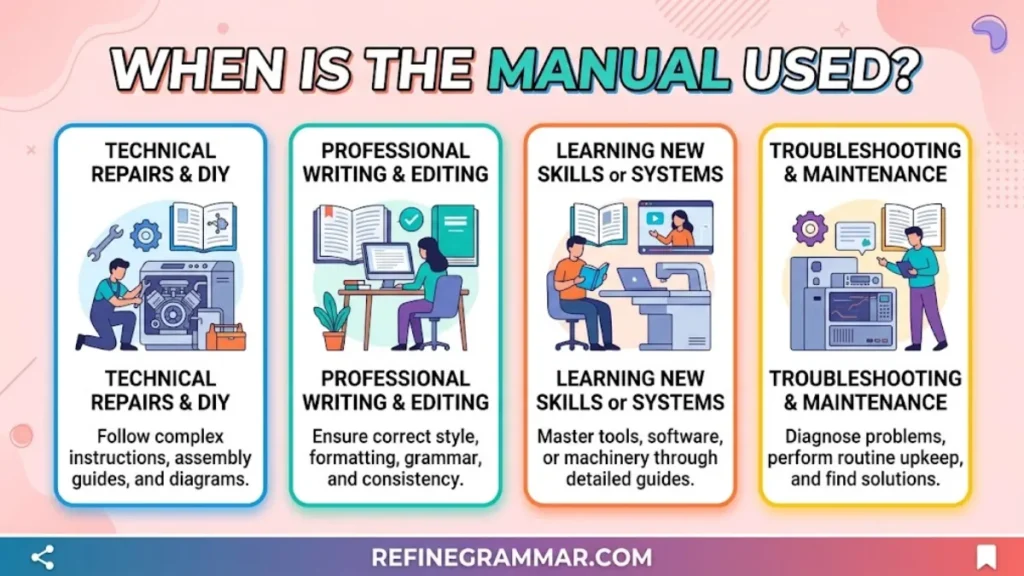
Manual shows up across nearly every industry, from technology to transportation to workplace training. Below are the most common contexts where writers need this word.
Technology and Software
Every piece of software or hardware typically ships with a manual explaining installation, features, and troubleshooting steps. Some updates even require certain manual steps to be completed within a specific window to avoid errors or lockouts.
Automotive Industry
In cars, manual usually refers to the transmission system, where the driver controls gear shifts instead of relying on automation.
Manual Car Meaning
A manual car is a vehicle equipped with a manual transmission, requiring the driver to operate a clutch pedal and shift gears by hand using a gear stick.
Workplace Training and Documentation
Businesses rely heavily on manuals for onboarding, safety compliance, and skill-building. A training manual, often provided by an employer or program sponsor, outlines expectations and procedures new employees must follow.
Manual vs Automatic Meaning
Manual and automatic describe opposite approaches to control.
| Aspect | Manual | Automatic |
| Control | Operated by hand | Operated by a machine or system |
| Speed | Often slower | Often faster |
| Example | Manual transmission | Automatic transmission |
| Effort | Requires active input | Requires minimal input |
Manuel vs Manual Examples in Sentences
Seeing both words used correctly side by side makes the Manuel vs Manual distinction easier to remember.
Sentences Using Manuel
- Manuel works as a mechanic downtown.
- I haven’t spoken to Manuel since college.
- Manuel’s presentation impressed the entire team.
Sentences Using Manual
- The manual is available as a PDF download.
- Manual data entry takes longer than automated syncing.
- Always keep the manual in a safe place.
Manuel vs Manual Meme
Online, the Manuel vs Manual confusion has become a lighthearted running joke. Posts poke fun at people who type “read the Manuel” instead of “read the manual,” often imagining a person named Manuel awkwardly standing in for an instruction booklet. These memes highlight just how easy the mix-up is, even for confident writers.
What People Say About Manuel vs Manual on Reddit
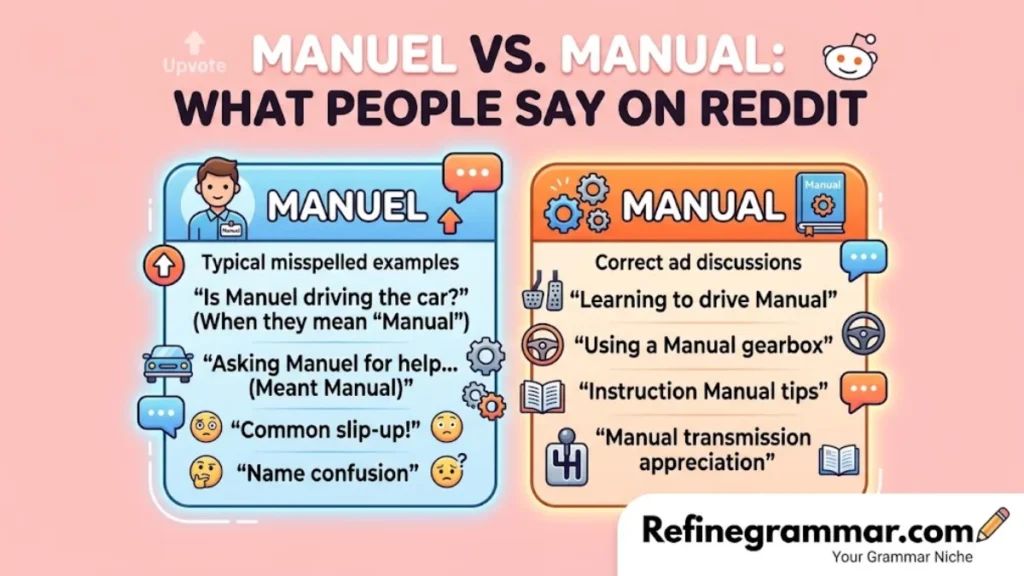
Across grammar and language forums, including threads on Reddit, users frequently share their own Manuel vs Manual autocorrect mishaps. Many commenters note that the mistake usually comes from a phone contact named Manuel overriding the intended word, reinforcing that this is a widespread, relatable error rather than a sign of poor writing skills.
A Small Spelling Error With Big Consequences
A single swapped letter might seem too small to matter, but in professional writing, it can undermine credibility. A resume, business email, or technical document containing “Manuel” instead of manual signals carelessness to readers, even when the rest of the writing is strong.
Easy Tricks to Remember the Correct Spelling
A few simple memory tricks make the Manuel vs Manual choice automatic.
Trick One
Manuel has an “e” like “he” — reserve it for a person.
Trick Two
Manual relates to “manus,” the Latin word for hand — use it for anything hand-related.
Trick Three
If you can replace the word with “guide” or “instructions” and the sentence still makes sense, you need manual, not Manuel.
Why Correct Spelling Matters in Writing
Spelling accuracy affects how readers perceive trustworthiness and attention to detail. Getting Manuel vs Manual right, along with other commonly confused word pairs, strengthens the overall professionalism of any document.
Effects of Spelling Errors
- Reduced credibility with readers
- Miscommunication of the intended meaning
- Lower rankings in search engines for published content
- A negative impression in professional or academic settings
Quick Manuel vs Manual Comparison
| Manuel | Manual | |
| Category | Name | Word / instruction |
| Capitalization | Always capitalized | Lowercase, usually |
| Refers to | A person | A guide or hand-operated action |
Other Common English Spelling Confusions
Manuel vs Manual isn’t the only pair of words that trips writers up. English is full of similar traps, including debates over favs or faves, uncertainty around how to write out the number 25 or 26, and spelling slips such as encorporate vs incorporate. Reviewing these common confusions alongside Manuel vs Manual can sharpen overall writing accuracy.
Reference Cambridge Dictionary Definitions
Cambridge Dictionary defines manual as a book of instructions, or as something done by hand rather than by machine. This definition confirms that manual is grounded in physical action and guidance — a distinction worth remembering whenever the Manuel vs Manual question comes up.
FAQs
What is the difference between “Manuel” and “Manual”?
Manuel is a person’s name, while manual refers to instructions or something done by hand.
Is it spelled manuel or manual?
It depends on context: Manuel for a name, manual for instructions or hand-operated tasks.
What does “manual” mean?
Manual means a guidebook of instructions, or something operated by hand rather than automatically.
What is the full meaning of Manuel?
Manuel is a variant of Emmanuel, a Hebrew-origin name meaning “God is with us.”
What are the three types of manuals?
Common types include user manuals, training manuals, and repair or service manuals.
What is a manual example?
A car owner’s manual explaining maintenance and dashboard controls is a classic example.
What is the main purpose of a manual?
A manual’s main purpose is to guide users clearly through a process, product, or task.
What are instruction manuals called?
Instruction manuals are also known as user guides, handbooks, or owner’s manuals.
Is it better to drive in manual mode?
It depends on preference: manual mode offers more control, while automatic offers more convenience.
Final Thoughts
Choosing correctly between Manuel vs Manual comes down to one question: are you naming a person or describing instructions? Manuel belongs to people, always capitalized and never interchangeable with a guidebook. Manual belongs to processes, products, and instructions, covering everything from car transmissions to employee handbooks. Keep this distinction in mind, apply the simple tricks above, and the Manuel vs Manual mix-up will disappear from your writing for good.
