
If you’ve ever paused mid-sentence wondering whether to write tying or tieing, you’re dealing with one of English’s sneakiest spelling traps. The Tying vs Tieing question trips up native speakers and learners alike because “tie” looks like it should simply add “-ing” at the end. This guide breaks down the Tying vs Tieing debate with a clear answer, the grammar rule behind it, real examples, and a quick way to remember it for good.
Tying vs Tieing Quick Answer
The short answer: tying is correct, and tieing is not a standard English word. When “tie” takes the “-ing” ending, the “ie” changes to “y,” giving you “tying.” Tieing is a common misspelling that shows up in casual writing, texts, and even social captions, but it never appears in dictionaries or style guides.
Simple Examples
- She is tying her shoelaces before the race.
- He was tying knots for the sailing club.
- We’re tying up loose ends before the deadline.
- The teams are tying the score in the final minute.
Tying or Tieing Meaning
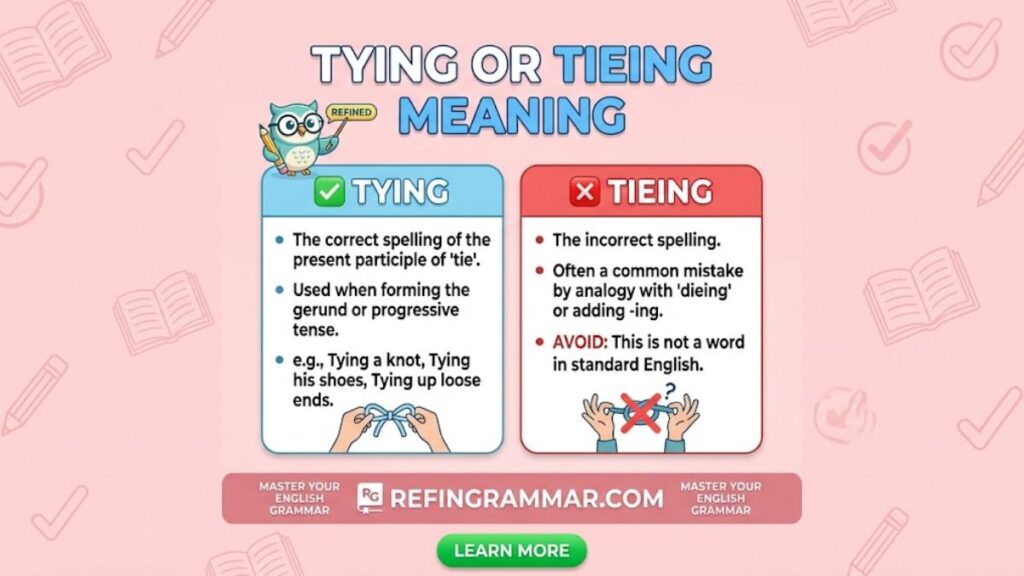
Meaning-wise, Tying vs Tieing isn’t really a contest both are meant to describe the same action. Tying is the present participle and gerund form of the verb “tie,” meaning to fasten, secure, bind, or connect something using a knot, cord, or similar method. It describes someone in the process of fastening or connecting an object. Tieing carries that exact same intended meaning, but it isn’t recognized as correct spelling anywhere.
Tying or Tieing Synonym
Since tying describes the act of fastening, several words can stand in for it depending on context.
- Binding
- Fastening
- Knotting
- Securing
- Lacing
- Linking
- Attaching
- Tethering
Grammar Rule Explained Clearly
The Tying vs Tieing question comes down to one dependable spelling rule. English handles verbs ending in “-ie” differently from other verbs: when adding “-ing,” the “ie” changes to “y.” This keeps two vowels from colliding awkwardly and matches how the word is actually pronounced. It’s a similar hesitation to what trips writers up over puting vs putting, where a doubled consonant not a vowel swap decides the correct spelling.
Core Rule / Formula / Example
| Base Verb | Rule Applied | Correct -ing Form |
| tie | ie → y | tying |
| die | ie → y | dying |
| lie | ie → y | lying |
| vie | ie → y | vying |
Why Does English Change ie to y
Understanding why English handles Tying vs Tieing the way it does starts with pronunciation. If “tie” simply added “-ing,” it would become “tieing” three vowels bunched together (i-e-i), which is awkward to read and say smoothly. Swapping “ie” for “y” removes that vowel cluster and keeps the word easy to pronounce. The same principle explains why “die” becomes “dying” and “lie” becomes “lying” instead of “dieing” and “lieing.”
Understanding Present Participles and Gerunds
The “-ing” form of a verb serves two grammatical roles, and Tying vs Tieing confusion often surfaces in both uses. As a present participle, it shows continuous action, as in “She is tying her shoes.” As a gerund, it functions as a noun, as in “Tying knots takes practice.”
Present Participle / Gerund
- Present participle: “He is tying his shoes.” (describes an ongoing action)
- Gerund: “Tying is a useful camping skill.” (acts as a noun)
Why People Write Tieing
Despite being incorrect, tieing is a frequent search term and typo. A few reasons explain why.
- Logical Assumption: Writers assume every verb just adds “-ing” to its base spelling.
- Lack of Awareness of the ie Rule: Many people were never taught the ie-to-y spelling pattern.
- Autocorrect Confusion: Some keyboards and apps fail to flag “tieing,” especially in casual typing.
- Rare Exposure to the Rule: Words like tie, die, and lie appear far less often than regular “-ing” verbs, so the rule never really sticks.
Tying or Tieing Quiz
Test yourself quickly before moving on.
1. She is ___ her shoes. (tying / tieing)
2. The players are ___ up loose ends. (tying / tieing)
3. He spent all afternoon ___ the boat. (tying / tieing)
Answer: tying is correct in every case.
Tying vs Tieing in Real World Usage
Tying vs Tieing decisions show up constantly in everyday communication, not just grammar books.
- Daily Life: “I’m tying my apron before starting dinner.”
- Academic Writing: “The essay discusses tying historical events to modern policy.”
- Professional Emails: “I’m tying up the final report today.”
- Sports: “The home team is tying the match with a last-minute goal.” (a common way tying or tieing in sports gets searched)
Tying or Tieing a Game
In sports writing, tying the game means matching an opponent’s score rather than winning or losing outright. You’ll see “tying” used constantly in match recaps: “The forward’s goal ended up tying the game in stoppage time.” Tieing never appears in credible sports journalism.
Tying the Knot
“Tying the knot” is a well-known idiom meaning to get married. Wedding invitations, toasts, and articles consistently use “tying” never “tieing” in this expression, reinforcing how firmly the correct spelling is established across formal and celebratory writing.
Tying or Tieing Shoes
Whether you’re teaching a child or writing instructions, it’s always tying shoes, not tieing shoes. This is one of the most common everyday phrases where the misspelling appears, especially in casual text messages.
Tieing or Tying Shoelaces
The same rule applies to shoelaces. Correct: “She practiced tying shoelaces for weeks.” Incorrect: “She practiced tieing shoelaces.” Plenty of people type “tieing shoelaces” into search bars, but it never reflects standard spelling.
Tying as Part of Phrasal Verbs
Phrasal verbs built on “tie” follow the same rule without exception.
Tying Up / Tying In
- Tying Up: “I’m tying up a few last details before the trip.” (the most searched version of tying or tieing up)
- Tying In: “This chapter ties in with the theme introduced earlier.”
British and American English Usage
British and American English agree on this one. Both varieties follow the same ie-to-y rule, so there’s no regional exception that makes “tieing” acceptable unlike some genuine US/UK spelling splits, such as the pattern behind transferred vs transfered.
Tying or Tieing UK
UK dictionaries, including Oxford and Cambridge references, list “tying” as the only accepted spelling. Tying or tieing UK searches return the same answer as American sources: tying is correct everywhere English is written.
Words That Follow the Same Rule
Several other “-ie” verbs follow this identical pattern when adding “-ing,” similar to how tried or tryed confuses writers dealing with a related but different y-based spelling change.
- die → dying
- lie → lying
- vie → vying
Words That Do Not Follow This Rule
Not every “-e” ending behaves the same way. Verbs ending in a single silent “e,” like “write” or “make,” simply drop the “e” before adding “-ing” rather than swapping letters. Confusion here is different from mixing up homophones like weather vs whether vs wether, which is about meaning rather than an “-ing” ending.
- write → writing
- make → making
- hope → hoping
Common Mistakes and Corrections
Tying vs Tieing is far from the only spelling pair that trips writers up. Similar mix-ups show up in comparisons like vendor or vender and to bad vs too bad, where a small letter change decides correctness. Formatting slip-ups matter too writers researching in-person vs in person often find that spacing and hyphenation cause as much trouble as spelling itself.
| Incorrect | Correct |
| tieing | tying |
| tieing up | tying up |
| tieing the knot | tying the knot |
| tieing shoes | tying shoes |
Tying vs Tieing in Sentences
Simple / Medium / Formal Sentences
- Simple: “She is tying her shoes.”
- Medium: “The committee is tying the budget approval to next quarter’s results.”
- Formal: “The report ties current spending patterns to long-term fiscal outcomes, and a stray typo like nineth or ninth can undercut an otherwise polished document.”
Deep Grammar Breakdown
The Tying vs Tieing pattern reflects a small, closed class of English verbs. Because there are so few monosyllabic “-ie” verbs, English never developed an alternate spelling convention, and the ie-to-y swap became a fixed rule centuries ago. That’s also why the exception feels unfamiliar compared to the far more common silent-e pattern.
Historical Perspective
Older texts occasionally show “tieing,” particularly in 19th-century industrial writing about tieing logs or bundles together. Modern style guides, dictionaries, and grammar checkers have since standardized “tying” as the only accepted form, phasing the older variant out entirely.
Why Tying Looks Unusual at First
“Tying” looks different from most “-ing” words because it has no “e” before the ending, unlike write/writing or hope/hoping. That visual gap is exactly what makes people second-guess the spelling.
Memory Trick
Remember: “ie becomes y, and you’ll never lie about spelling tying.” Whenever a short verb ends in “-ie,” picture swapping the last two letters for a single “y” before adding “-ing.”
Practice Exercises
Fill in the Blanks
- He is ___ his shoes. (tying)
- They were ___ the ribbon around the box. (tying)
Choose the Correct Word
- tying / tieing the score
- tying / tieing the knot
Advanced Usage Examples
Academic / Business / Creative Writing
- Academic: “The thesis focuses on tying economic policy to voter behavior.”
- Business: “We’re tying our Q3 targets to the new campaign, and we’ll double-check take effect or take affect language before the memo goes out.”
- Creative Writing: “The old sailor spent his final years tying knots no one remembered how to undo.”
Frequently Asked Questions
These quick answers cover the most common Tying vs Tieing questions people search for.
What is the meaning of tieing?
Tieing has the same intended meaning as tying (to fasten or secure), but it’s a misspelling, not a standard word.
Is it tieing the knot or tying the knot?
It’s always “tying the knot”; “tieing the knot” is incorrect.
Is it correct to say “tying up” or “tieing up”?
“Tying up” is correct; “tieing up” is a common misspelling.
Is tying grammatically correct?
Yes, tying is the correct present participle and gerund of tie.
Is tieing a real word?
No, tieing isn’t listed in standard dictionaries as a correct spelling.
Why does “tie” become “tying” instead of “tieing”?
Verbs ending in “-ie” change “ie” to “y” before adding “-ing” to avoid an awkward vowel cluster.
What is the past tense of tying?
The past tense of “tie” is “tied,” not tying (tying is the “-ing” form).
Is tying or tieing correct in British English?
Tying is correct in both British and American English.
How do you spell tying shoelaces correctly?
Spell it as “tying shoelaces,” never “tieing shoelaces.”
What is a synonym for tying?
Common synonyms include fastening, binding, securing, and knotting.
Conclusion
Tying vs Tieing ultimately comes down to one dependable rule: “-ie” becomes “-y” before “-ing.” Tying is the only correct spelling recognized across American English, British English, dictionaries, and style guides, whether you’re writing about tying shoes, tying the knot, or tying up a project. Keep the rule in mind, and you’ll never write “tieing” again and if a question like enrolment or enrollment trips you up next, the same careful-checking habit will serve you well.
