
High School or Highschool” is one of the most searched spelling questions among students, parents, and content writers. Even confident English speakers pause here. Something about school years just makes people second-guess the spelling.
Here’s the good news: this guide settles it fast. You’ll get the quick answer, the reasoning behind it, and clear rules for when to use each form. No more guessing, no more googling it every time you write.
It’s the same instant clarity you’d get from a quick check on thier or their one look, and the doubt’s gone for good.
Highschool or High School: Quick Answer
The correct spelling is “high school” written as two separate words. “Highschool” as a single word is considered incorrect in standard English, whether you are writing a resume, an essay, or a casual social media post. This rule holds true across American, British, Canadian, and Australian English.
Correct Examples
- She graduated from high school last spring.
- My high school offers three foreign language classes.
- He is a high school teacher in Texas.
Easy Memory Tip
Think of “high school” the same way you think of “elementary school” or “middle school” you would never write “elementaryschool” as one word, so “high school” follows the same two-word pattern.
Word pairs get confused for the same reason people mix up lable or label: the wrong version simply looks familiar enough to slip through. Keep this comparison in mind and you will stop making the highschool or high school mistake for good.
Highschool or High School: Definition and Meaning
What Does “High School” Mean?
“High school” refers to a secondary educational institution, typically covering grades 9 through 12 in the United States, where students study before moving on to college or university. It is the stage of education that follows middle school.
What Does “High” Mean?
In this phrase, “high” works as an adjective describing a more advanced level of education. It has nothing to do with physical height.
What Does “School” Mean?
“School” is the noun describing any institution for teaching and learning. Combined with “high,” it forms a compound noun that names a specific stage of schooling.
Is “Highschool” Correct?
No. “Highschool” is not recognized as standard English by major dictionaries. It is a common misspelling, in the same family of mix-ups as comment vs coment or stared vs starred cases where two words sound almost identical niche is Grammar and background pink light
when spoken quickly but are written very differently.
The Origin of Highschool or High School

The term “high school” dates back to 18th-century Scotland, where the High School of Edinburgh was one of the earliest institutions to use the name for advanced education. The phrase later spread to the United States and other English-speaking countries, always keeping its two-word structure.
Many compound words in English eventually merge into one word over time (think “notebook” or “keyboard”), but “high school” never has. This is exactly why the highschool or high school debate still confuses so many writers today.
British English vs American English Spelling
Both British and American English agree on one thing: “high school” stays as two words in each dialect. The difference is in usage rather than spelling:
- In the United States, “high school” is the standard term for secondary education (grades 9-12).
- In the United Kingdom, “secondary school” is more commonly used, though “high school” still appears, especially in Scotland and in the official names of specific institutions.
Regardless of the dialect, no major English-speaking country accepts “highschool” as one word.
Which Spelling Should You Use?
Now that you know the highschool or high school rule, here is how it applies depending on your audience.
For US English
Always use “high school” as two words. This is the term used in official transcripts, records, and diplomas.
For UK English
“High school” is acceptable, though “secondary school” is more traditional. Either way, keep it as two words.
For Canada
Canadian English follows the American pattern: “high school” as two words is standard in schools, media, and government documents.
For Australia
Australian English also uses “high school” as two separate words, often interchangeably with “secondary school.”
For International Writing
If you are writing for a global audience, ESL learners, or SEO content, always default to “high school” with a space. It is the universally accepted form clarity here matters just as much as knowing the difference between in process vs in progress when you want your writing to read naturally to every audience.
Common Mistakes with Highschool or High School
Even after learning the highschool or high school rule, these mistakes are surprisingly common.
Mistake 1: Writing “highschool”
This is the most frequent error. Writers merge the two words out of habit, the same way some people accidentally merge or misspell studder vs stutter. Always keep “high” and “school” separate.
Mistake 2: Writing “high-school” unnecessarily
Adding a hyphen is not standard when the phrase functions as a noun (“I went to high school”). A hyphen is only needed when “high school” acts as a compound adjective before another noun (see Mistake 3).
Mistake 3: Incorrect adjective form
When “high school” describes another noun, hyphenate it: “high-school student,” “high-school diploma.” Many writers skip the hyphen here, or add it when it is not needed a small grammar slip similar to mixing up friendlier vs more friendly in comparative forms.
Mistake 4: Confusing “high school” with “college”
In American English, “high school” refers to grades 9-12, while “college” refers to post-secondarHighschool or High School Google Trends & Usage Data
y education. These terms are not interchangeable, even though some international writers use them loosely.
Highschool or High School in Everyday Examples
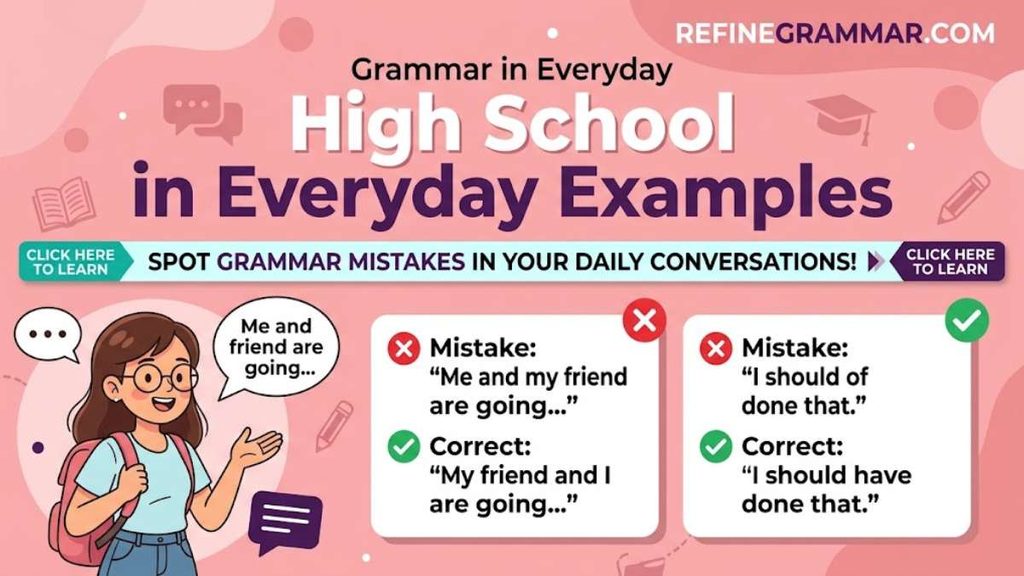
Seeing the correct form in real-world context makes the rule easier to remember.
In Emails
“I wanted to update you on my daughter’s high school schedule for this semester.”
In News
“The high school football team won the state championship this weCommon Mistakes with Highschool or High School
ekend.”
On Social MediaHighschool or High School Definition and Meaning

“Just found my old high school yearbook and I’m not okay.”
In Formal Writing
“Graduates of the high school program are eligible to apply for the scholarship.”
In Education
“Our high school curriculum includes advanced placement courses in mathematics and science.”
In Questions
“Which high school did you attend before starting college?”
Highschool or High School: Google Trends & Usage Data
Search and publishing data consistently show that “high school” (two words) is used far more often than “highschool” (one word) across newspapers, academic publications, and major style guides. This pattern has stayed stable for decades, meaning the highschool or high school question has a clear, unchanging answer: two words, every time.
Quick Comparison Table: Highschool vs High School
| Feature | “High School” (Correct) | “Highschool” (Incorrect) |
| Spelling | Two words, with a space | One merged word |
| Dictionary status | Recognized standard form | Not recognized |
| Use on resumes/diplomas | Correct | Incorrect |
| Used in US, UK, Canada, Australia | Yes | No |
| Adjective form | Hyphenated: “high-school student” | Not applicable |
Quick Rule
If you remember only one thing about highschool or high school, make it this: “high school” is always two words. There is no context where “highschool” is considered correct in formal or informal writing.
People Also Ask: Highschool or High School
Which is correct, highschool or high school?
“High school,” written as two words, is the only correct spelling in standard English.
Is “high school” one word or two words?
It is always two words: “high” and “school.”
Should you hyphenate high school?
Only when it works as an adjective before a noun, such as “high-school student.”
Is highschool spelled with a space?
Yes, the correct spelling always includes a space between “high” and “school.”
Do British people spell it differently?
No, British English also uses “high school” as two words, though “secondary school” is more common in the UK.
Is “high school” capitalized?
Only when it is part of an official name, such as “Lincoln High School.”
What’s the difference between a highschooler and a high schooler?
“High schooler” (two words) is the standard spelling for a student attending high school; “highschooler” is a common but incorrect variant.
Is “highschool” ever acceptable?
No major style guide or dictionary accepts “highschool” as a standard spelling, even in informal writing.
What’s the correct term to use on a resume or diploma?
Always use “high school” as two words on resumes, transcripts, and diplomas for a professional, error-free result.
Is high school written as one word in Canada or Australia?
No, both countries follow the same rule as the US and UK: “high school” is always two separate words.
Conclusion
The answer to the highschool or high school debate is simple: always write it as two words. Whether you are drafting an email, writing a resume, or posting on social media, “high school” is the standard two-word spelling in American and Canadian English — and it’s understood, though less commonly used, in British and Australian contexts, where “secondary school” is more typical.
Keep the easy memory tip in mind: compare it to “middle school,” and you will never make this mistake again. For more clarity on tricky word pairs, explore guides like emaculate vs immaculate or gauging interest vs gaging interest to keep sharpening your everyday writing.
