
Timeframe or time frame? If you’ve paused mid-sentence wondering which spelling is correct, you’re not alone. This is one of the most searched grammar questions in English, and the confusion makes sense both versions show up constantly in emails, reports, and articles. The good news is that both timeframe and time frame are correct, but knowing when to use each one instantly makes your writing look more polished. In this guide, we’ll settle the timeframe or time frame debate once and for all, with clear definitions, real examples, expert rules, and one simple tip you’ll remember forever.
Timeframe or Time Frame: Quick Answer
Here’s the short answer to the timeframe or time frame question: both spellings are grammatically correct, and dictionaries accept them equally.
Main Difference
Time frame (two words) is the traditional, formal spelling. Timeframe (one word) is the modern, condensed version that has grown more common in digital and business writing. Neither is “wrong” they’re simply different styles of the same word, similar to how other pairs get debated online, such as maintained or maintenanced, where usage and formality decide the winner rather than strict grammar rules.
Examples
- We need a realistic time frame for the renovation.
- The startup set an aggressive timeframe for its product launch.
Definitions with Examples
Time Frame (Definition)
As two words, time frame refers to a specific period during which an action, project, or event takes place.
Examples
- The report must be submitted within the agreed time frame.
- Doctors gave a six-month time frame for a full recovery.
Timeframe (Definition)
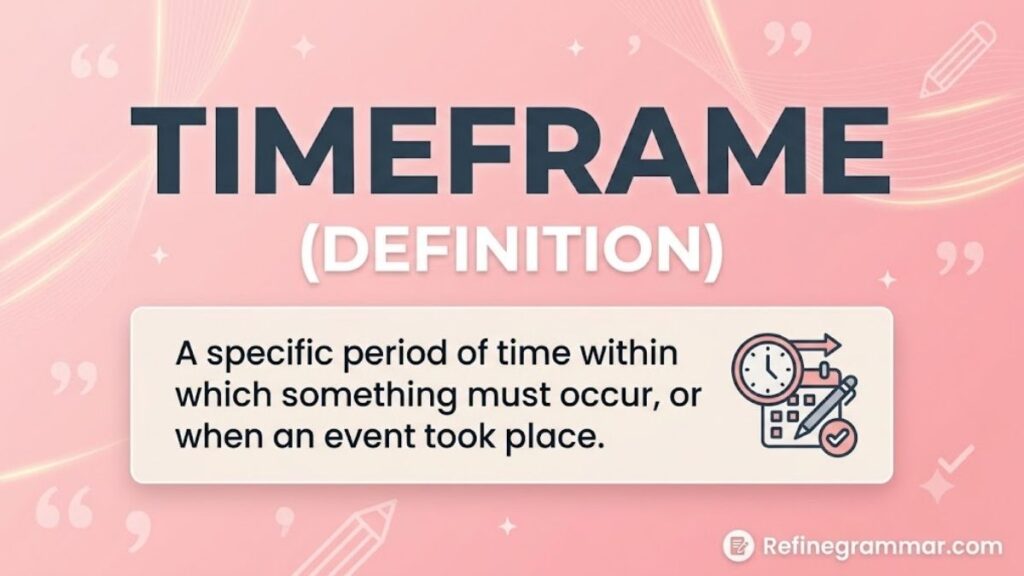
Written as one word, timeframe carries the exact same meaning a designated span of time for something to happen. It’s simply a more compact, modern spelling of the same concept.
Examples
- Our timeframe for the merger is the first quarter.
- She finished the marathon within her target timeframe.
Simple Meaning
In plain terms, both timeframe and time frame simply mean “how much time something takes or is allowed to take.” There’s no difference in meaning only in spelling and formality.
Merriam-Webster Definition
Merriam-Webster lists the two-word spelling as its primary entry, defining it as a stretch of time connected to a particular action or project, while noting timeframe as a less common but fully accepted variant. This settles a large part of the timeframe or time frame debate: major dictionaries treat both as legitimate, with time frame recognized as the more established form.
The Origin of Time Frame
Meaning Together
The term combines “time” (a duration) and “frame” (a structure or boundary) literally, a structure that holds a period of time in place. This origin explains why both timeframe and time frame naturally suggest boundaries: a clear start point and end point for an activity.
Example
The project’s time frame runs from January to June, giving the team a clear structure to plan within much like getting ordinal numbers right in dates, a common sticking point similar to 31st or 31th, where one form is standard and the other is simply a common error.
British English vs American English Spelling 🇬🇧🇺🇸
Key Point
Neither American nor British English strongly favors one spelling over the other for this term. Both regions primarily use time frame (two words) in formal writing, while timeframe (one word) appears more often in casual, digital, and business contexts. The timeframe or time frame spelling debate also raises the same kind of regional-preference question seen in other number-related spellings, like fourteen or forteen, where one spelling is simply a widespread typo rather than a regional variant.
Comparison Table
| Region | Preferred Style | Common Context |
| United States | Time Frame | Formal writing, journalism, legal documents |
| United Kingdom | Time Frame | Formal writing, academic papers |
| Canada | Time Frame | Business and government communication |
| Australia | Time Frame | News media and business writing |
Timeframe vs Time Frame: Key Difference Explained
The real difference between timeframe and time frame isn’t meaning it’s formality. Time frame reads as more traditional and polished, ideal for resumes, contracts, and official reports. Timeframe feels quicker and more modern, and it’s common in emails, blog posts, and casual business writing.
Comparison Table
| Feature | Time Frame | Timeframe |
| Word count | Two words | One word |
| Formality level | Formal | Informal / modern |
| Common use | Legal, academic writing | Business, digital writing |
| Style guide support | AP Style preferred | Growing acceptance |
Example
Compare: “Please confirm the time frame for delivery” (formal email) versus “What’s our timeframe?” (quick team chat message). Same meaning, different register.
Which One Should You Use?
Choosing between timeframe or time frame usually comes down to context and formality rather than strict correctness.
Use Time Frame When
- Writing formal documents, contracts, or academic papers
- Following AP Style or a traditional style guide
- Submitting professional or client-facing reports
Use Timeframe When
- Writing blog posts, emails, or casual content
- Speed and brevity matter more than formality
- Your organization’s style guide already prefers it
AP Style Rule
The Associated Press Stylebook specifically instructs writers to use time frame as two words, distinguishing it from timeline, which stays as a single word. If you’re writing for journalism or following AP guidelines, time frame is the required choice.
Easy Tip
Still unsure? Default to time frame (two words) for anything formal, and use timeframe (one word) for everyday writing. This one simple rule solves the timeframe or time frame dilemma in seconds.
Usage Tip (Very Important)
Whichever spelling you choose, consistency matters more than the choice itself. Mixing timeframe and time frame within the same document looks careless, even though both are technically correct. Pick one style per document and stick with it from start to finish.
Examples
- Consistent (correct): “Our timeframe is tight, and this timeframe won’t change.”
- Inconsistent (avoid): “Our timeframe is tight, but this time frame won’t change.”
Synonyms for Timeframe or Time Frame
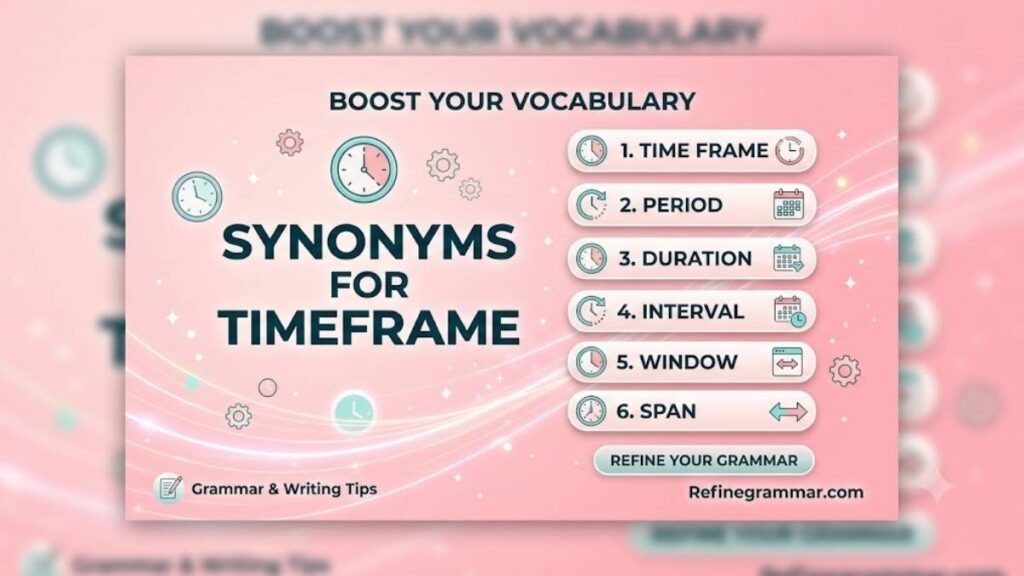
If you want to avoid repeating timeframe or time frame too often, try these alternatives: period, duration, window, span, term, interval, schedule, or deadline (when you specifically mean the final cutoff point). Picking the right synonym is a small but powerful readability upgrade, much like nailing tricky spellings such as refer or reffer, where one small letter change is the entire difference between correct and incorrect.
Common Mistakes with Timeframe or Time Frame
1. Thinking One Is Wrong
Many writers assume only one spelling is “correct.” In reality, both timeframe and time frame are accepted by major dictionaries the real choice is about style, not correctness.
2. Mixing Styles in One Document
Switching between timeframe and time frame mid-document is one of the most common errors writers make, similar to the inconsistency seen with other commonly confused word pairs, like protestors and protesters, where picking one spelling and staying consistent matters more than which variant you choose.
3. Using Wrong Context
Some writers confuse a time frame with a deadline. A time frame is the full window of time, while a deadline is only the final cutoff point within it. Context errors like this are common with other verb-form mix-ups too, such as focusses or focuses, where regional spelling rules quietly change which form fits.
4. Spelling Confusion
Time frame is never hyphenated as “time-frame” in standard modern English. This kind of small formatting mistake is easy to make, just like the confusion around stopping or stoping, where a missing consonant completely changes the word.
Time Frame in Everyday Examples
Daily Life
“I need a realistic time frame to finish unpacking the new house.”
Work
“Our team’s timeframe for the Q3 report is two weeks.” Small errors like a misclick or missclick in a shared calendar can also throw off a tight work timeframe, so double-checking dates matters just as much as spelling.
School
“Students must complete the assignment within the given time frame.”
Business
“The company set an aggressive timeframe to launch its new product line.”
Timeframe: Google Trends & Usage Data
Trends
Search interest in timeframe or time frame remains steady year-round, with time frame historically holding a slightly larger share of total searches. Timeframe has been gaining ground in recent years as digital and mobile-first writing continues to grow.
Region Table (US, UK, Canada, Australia)
| Region | Preferred Search Term | Trend |
| United States | Time Frame | Stable, slight edge over timeframe |
| United Kingdom | Time Frame | Strong, consistent preference |
| Canada | Time Frame | Stable across formal writing |
| Australia | Timeframe | Growing usage in digital content |
Top 10 Searches
1. timeframe or time frame
2. time frame meaning
3. timeframe definition
4. time frame synonym
5. is timeframe one word
6. AP style time frame
7. timeframe vs deadline
8. time frame example sentence
9. timeframe hyphen
10. British spelling time frame
Comparison Table
| Aspect | Time Frame | Timeframe |
| Spelling | Two words | One word |
| Formality | Formal | Casual / modern |
| Style guide | AP Style preferred | Growing acceptance |
| Dictionary status | Primary entry | Accepted variant |
| Best for | Contracts, reports, academic writing | Emails, blogs, everyday writing |
FAQs About Timeframe or Time Frame
Is timeframe one word or two words?
Timeframe can be written as one word, but the two-word form, time frame, is still the more traditional and widely used spelling.
Is it “time frame” or “timeframe” which is correct?
Both are correct. Time frame is more formal, while timeframe is more common in casual and digital writing.
Does timeframe need a hyphen?
No. Modern English doesn’t use the hyphenated “time-frame” it’s either one word or two.
What is the AP Style rule for timeframe or time frame?
AP Style requires the two-word spelling, time frame, while keeping timeline as one word.
What does timeframe mean?
It means a specific period during which something is planned to happen or must be completed.
What is a synonym for timeframe or time frame?
Common synonyms include period, duration, window, span, and interval.
Is timeframe spelled differently in British English vs American English?
No major difference exists; both regions generally favor time frame in formal writing.
Is timeframe a compound word?
Yes, it’s a compound of “time” and “frame,” and it can be styled as open, closed, or, rarely, hyphenated.
How do you use timeframe in a sentence?
Example: “Please confirm the timeframe for project completion by Friday.”
What is the Merriam-Webster definition of timeframe?
Merriam-Webster defines it as a period of time tied to a specific action or project, listing time frame as the primary spelling and timeframe as an accepted variant.
Conclusion
At the end of the day, the timeframe or time frame debate comes down to style, not correctness. Time frame remains the safer choice for formal writing and follows AP Style, while timeframe works well for faster, modern communication. Whichever you choose, stay consistent throughout your document, and you’ll never have to second-guess this spelling again.
