
If you’ve ever paused mid-sentence wondering whether to write nineth or ninth, you’re not alone. This single-letter mix-up is one of the most common ordinal-number mistakes in English.
Below, we’ll settle the nineth or ninth debate for good and show you how to use the word correctly every time. By the end, the nineth or ninth question will feel as simple as spelling any other everyday word.
“Nineth” is not a recognized word in any English dictionary. It’s a common misspelling that happens when writers assume the ordinal form of nine simply adds “-th” without any other change, much like the confusion some writers face with sitted or seated.
Whenever you see “nineth” in a sentence, treat it as a spelling error that needs fixing. It won’t pass a careful proofread, no matter how natural it looks at first glance.
Ninth
“Ninth” is the correct, dictionary-approved spelling. It’s the ordinal form of the number nine, used to describe position, order, or one of nine equal parts of something.
Whether you’re numbering a list, a floor, or an anniversary, ninth is the spelling you always want.
Nineth or Ninth Quick Answer
Here’s the short version: ninth is correct, and nineth is incorrect. If you remember only one thing from this article, remember that the nineth or ninth question always resolves in favor of ninth.
Every major dictionary, style guide, and grammar authority agrees there is no context, dialect, or exception where nineth is acceptable.
The Origin of Ninth
The word ninth comes from the Old English nigoða, closely tied to nigon, the Old English word for nine. As the language evolved through Middle English, the spelling shifted toward forms like nynthe before settling into the modern ninth.
Somewhere in that evolution, the final “e” from nine was dropped when the “-th” suffix was attached a pattern that also explains why fifth and eighth look the way they do, and why the nineth or ninth confusion doesn’t really extend to those other ordinals in the same way.
Linguists sometimes call this kind of change a sound-driven spelling shift: over centuries, English speakers simplified awkward letter combinations to make words easier to pronounce, and ninth is a textbook example.
Knowing this history gives you a handy memory trick. If you remember that ninth followed the same trimming pattern as fifth and eighth, the nineth or ninth question becomes far easier to answer on the spot.
British English vs American English Spelling
Good news for anyone worried about regional differences: the nineth or ninth debate has nothing to do with British versus American English. Unlike pairs such as colour/color, ninth is spelled identically everywhere English is written.
Whether you’re writing for a US, UK, Canadian, or Australian audience, ninth is the only accepted form. This makes it simpler than some other spelling questions, such as enrolment or enrollment, where the spelling genuinely does change between British and American usage.
So if you’re writing content for a global audience, you can stop worrying about localizing this particular word ninth stays ninth no matter where your readers are.
Which Spelling Should You Use?
Always use ninth. There is no formal, informal, academic, or casual context where nineth is acceptable. If you’re numbering a list, describing a date, or writing a ranking, ninth is the word you want.
Think of it like the difference between you too or you to one form is simply the accepted standard, and drifting from it reads as a mistake rather than a stylistic choice.
Once you internalize that nineth or ninth isn’t really a matter of opinion, sticking with ninth becomes automatic, and it protects your credibility in professional writing.
A simple habit helps here: before you send an email or publish a post, search your document for the word “nineth.” If it turns up, replace it with ninth.
This tiny proofreading step takes seconds, but it’s exactly the kind of small detail that separates careful writing from careless writing.
Common Mistakes with Nineth or Ninth
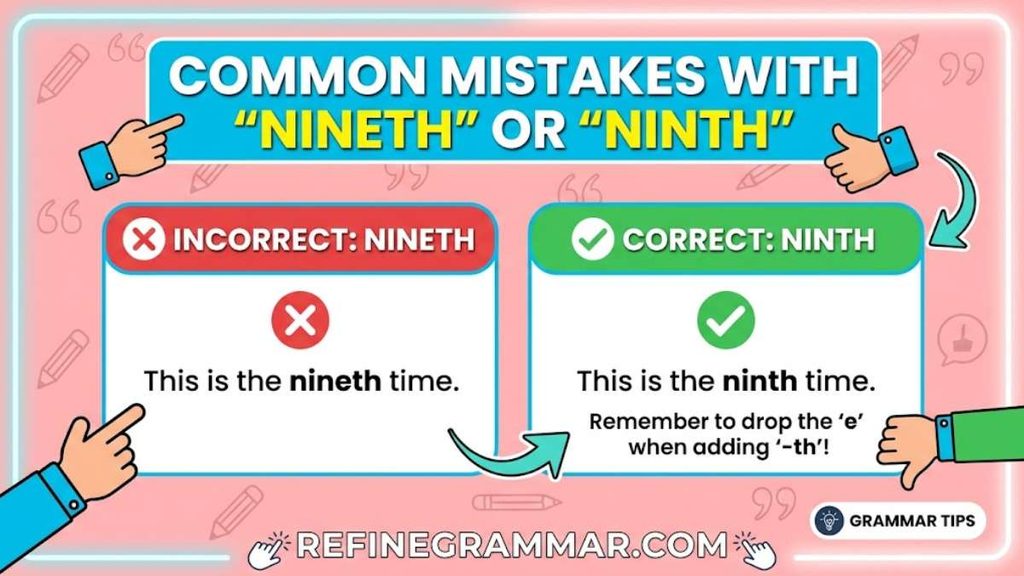
Even confident writers slip up here occasionally. Most nineth or ninth errors fall into a handful of predictable patterns:
- Writing “nineth” because it visually mirrors the spelling of “nine”
- Confusing “ninth” with “ninety” or “ninetieth”
- Misspelling compound ordinals, such as writing “twenty-nineth” instead of “twenty-ninth”
- Trusting autocorrect or spellcheck, which doesn’t always flag this error on mobile devices
- Using “nineth” in formal documents, resumes, contracts, or emails
These nineth or ninth slip-ups sit alongside other common English mix-ups, like confusing vendor or vender, or writing “to bad” instead of to bad vs too bad.
The good news is that once you learn the rule behind ninth, the mistake is easy to avoid for good.
Nineth or Ninth in Everyday Examples
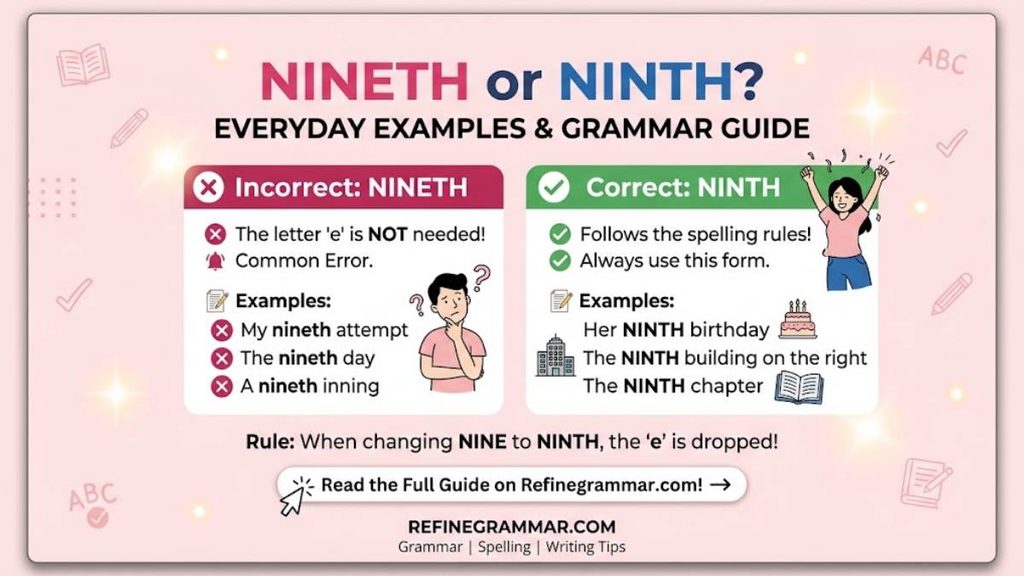
EThe nineth or ninth mix-up shows up across many types of writing, from quick everyday messages to polished, professional documents.
Seeing the correct usage in real-world context makes it much easier to remember which spelling to reach for automatically. Here’s how to handle it across a few common formats.
Emails
In professional emails, always spell out ninth rather than risk an autocorrect slip. For example: “Please join us for the ninth annual conference.”
This matters even more in client-facing emails, where a single typo can make an otherwise polished message look rushed.
News Writing
News writers should default to ninth in both print and digital content, especially in headlines the same way editors double-check tried or tryed before a story goes live.
Social Media
On social media, an informal tone doesn’t excuse spelling mistakes. Even a casual caption looks more polished with ninth instead of nineth.
Captions, bios, and event posts get shared and screenshotted often, so a spelling slip here can travel further than you’d expect.
Academic or Formal Writing
Academic papers, contracts, and official documents should always use ninth. This is one of those cases, much like weather vs whether vs wether, where a single letter can change how professional your writing appears.
Nineth or Ninth Google Trends & Usage Data

Search interest in nineth or ninth stays fairly consistent year-round, with noticeable spikes during school enrollment periods, exam seasons, and event-planning months.
Most of this search volume comes from people actively checking their spelling before submitting an assignment or article, not from confusion about meaning. That tells us the intent behind the nineth or ninth search is almost always about confirming correct spelling.
Usage data across published content also shows that ninth appears far more frequently than nineth, reinforcing that ninth is the dominant, standard form across both American and British publications.
This matches what we typically see with other easily-confused words: the incorrect spelling rarely disappears from search, but it also rarely overtakes the correct form in edited, published writing.
Comparison Table: Nineth vs Ninth
Sometimes a side-by-side view makes a spelling rule click faster than a full paragraph of explanation.
Here’s a quick comparison of nineth vs ninth across the factors that matter most:
| Feature | Nineth | Ninth |
| Correct spelling | ❌ No | ✅ Yes |
| Found in dictionaries | ❌ No | ✅ Yes |
| Accepted in formal writing | ❌ No | ✅ Yes |
| Used in British English | ❌ No | ✅ Yes |
| Used in American English | ❌ No | ✅ Yes |
| Common typo online | ✅ Yes | ❌ No |
FAQs
Nineth or Ninth Which One Is Correct?
Ninth is correct. Nineth is a common misspelling and doesn’t appear in any English dictionary.
What Is the Correct Pronunciation of Ninth?
Ninth is pronounced /naɪnθ/, similar to “nine” with a soft “th” sound added at the end.
What Does Ninth Mean?
Ninth is the ordinal form of nine, used to show position or order, or to describe one of nine equal parts of something.
Is It Ninth Day or Nineth Day?
It’s always “ninth day.” For example: “Today is the ninth day of the month.”
Is It Twenty-Ninth or Twenty-Nineth?
Twenty-ninth is correct. The same rule that applies to ninth also applies to every compound ordinal built from nine.
Why Is It Ninth and Not Nineth?
English drops the silent “e” from nine before adding “-th,” a historical spelling shift that gives us ninth.
What Is the Correct Spelling of Ninth as a Math Ordinal Number?
In math and everyday counting alike, ninth is the only correct spelling for the 9th position or fraction.
Learn More: Transferred vs Transfered: Correct Spelling Explained (2026)
Is It Ninth Week or Nineth Week?
It’s ninth week. For example: “We’re in the ninth week of the semester.”
Does British English Spell It Differently From American English?
No. Ninth is spelled the same way in British, American, and all other varieties of English.
Is “Ninty” a Word, or Is It Spelled Ninety?
The correct spelling is ninety. “Ninty” is a misspelling, just like nineth is a misspelling of ninth.
Conclusion
The nineth or ninth debate has one simple resolution: ninth is correct, and nineth is always a spelling mistake, regardless of tone, region, or context.
Once you remember that English drops the silent “e” from nine before adding “-th,” the nineth or ninth question stops being confusing at all.
If you found this guide helpful, you might also want to check whether it’s in-person or in person, or clear up another common mix-up like feen or fein.
