
English spelling trips up even confident writers, and few pairs cause as much hesitation as connecter vs connector. Both words look plausible, both sound identical when spoken, and both seem to follow familiar patterns from other English nouns. Yet only one of them belongs in a dictionary, a resume, a technical manual, or a piece of published content. This guide settles the connecter vs connector debate for good, walking through the meaning, the grammar rule behind it, real-world usage, and the small memory tricks that make the correct spelling stick permanently.
Quick Answer
The correct spelling is connector, not connecter. Every major dictionary, style guide, and professional publication recognizes connector as the standard noun form of the verb “connect.” The connecter vs connector question has a short answer: connecter is an outdated, largely unused variant, while connector is the version you should always write, whether you’re drafting an email, a product description, or a piece of technical documentation used together in one workflow.
Examples
- The technician replaced the loose connector on the router.
- Words like “however” and “therefore” act as a connector between two ideas.
- She found a reliable USB-C connector for her new laptop.
- A good connector in your essay helps sentences flow logically.
Is It Connector or Connecter?
If you’ve typed both spellings into a search bar hoping one would look more familiar, you’re not alone. The honest answer is simple: connector wins every time. The connecter vs connector comparison isn’t close once you check a dictionary connecter rarely appears in modern reference books at all,
and when it does, it’s flagged as archaic. Style guides used in journalism, publishing, and corporate communication all point to the same conclusion, which is why professional editors correct connecter to connector on sight.
Connecter vs Connector Meaning
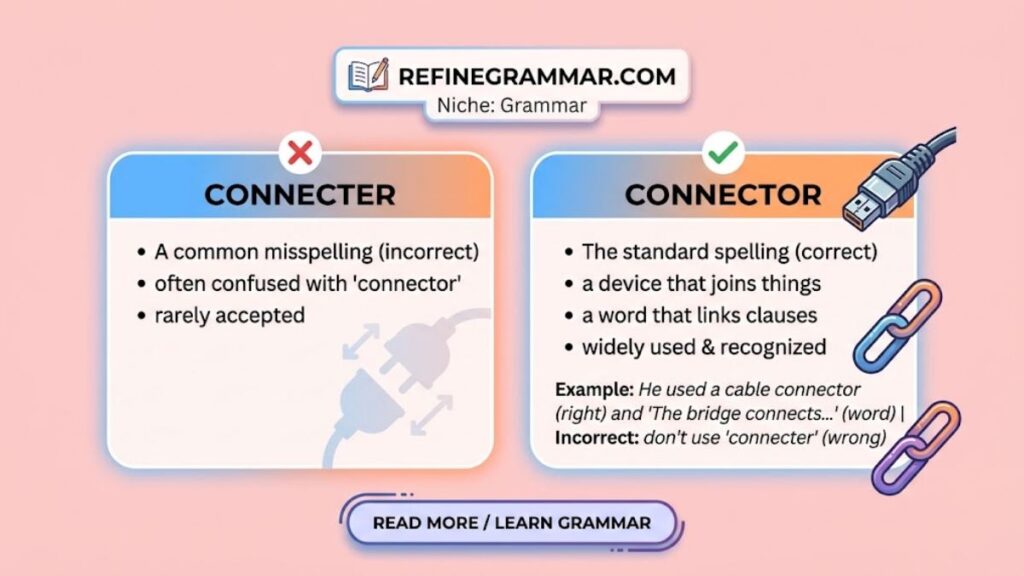
Understanding meaning is the fastest way to resolve any connecter vs connector confusion, because the definition doesn’t actually change between the two spellings — only the accepted form does.
Connector
A connector is a person or thing that joins, links, or brings two or more elements together. It applies to physical hardware (a cable connector), abstract ideas (a linguistic connector joining clauses), and even people (someone described as a natural connector in networking circles).
Connecter
Connecter carries the identical meaning but is treated as a spelling error in contemporary English. It surfaces occasionally in old manuscripts or in casual typing, but no current dictionary lists it as the preferred spelling in a manual or formal document. If you see it in published content today, it’s almost certainly a typo.
What Does It Mean to “Connect With Someone”?
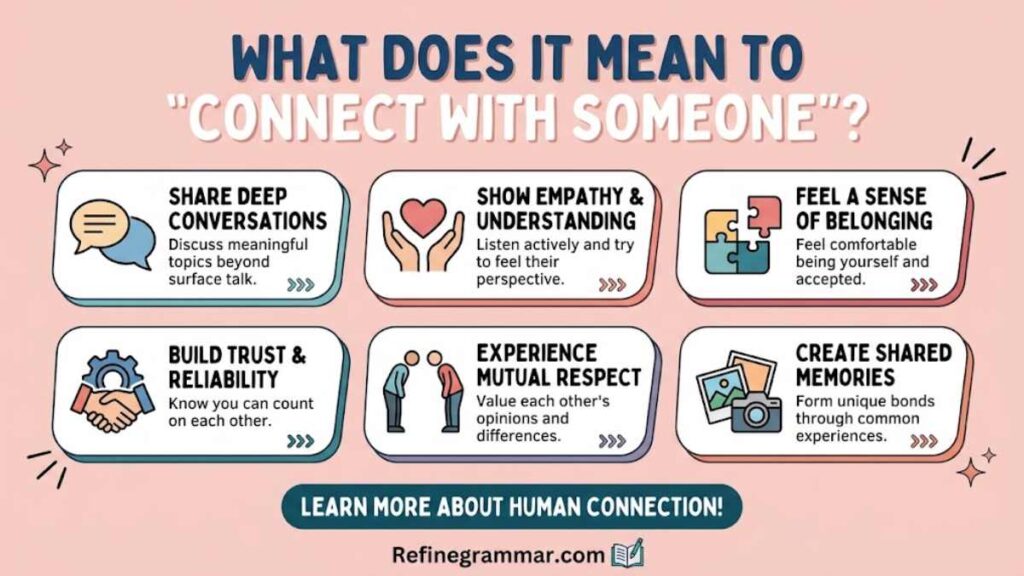
Before exploring the noun further, it helps to revisit the verb behind it. To “connect with someone” means to build rapport, understanding, or a genuine relationship with them emotionally, socially, or professionally.
This everyday phrase is the emotional root of the word connector: a person who connects easily with others is often praised as a great connector. Recognizing this verb-to-noun relationship makes the connecter vs connector spelling rule far easier to internalize.
Connecter vs Connector Difference
The table below summarizes the connecter vs connector difference at a glance.
| Feature | Connector | Connecter |
| Status | Correct, standard spelling | Incorrect, obsolete variant |
| Dictionary listing | Listed in all major dictionaries | Rarely or not listed |
| Common use | Technology, grammar, business | Almost none today |
| Recommended | Always | Never |
Types of Connectors
The word connector spans several industries, and knowing the categories helps reinforce why the correct spelling matters so much in professional writing.
- Electrical connectors — plugs, sockets, and terminals that join wires or devices
- Grammatical connectors — words like “and,” “but,” or “therefore” that link clauses
- Network connectors — cables and ports such as Ethernet or fiber-optic connectors
- Social connectors — people who naturally introduce and link others together
- Mechanical connectors — brackets, joints, and couplings used in engineering
Grammar Rule Depth
English noun formation offers a partial explanation for the connecter vs connector pattern, with one exception worth noting: spelling isn’t always predictable, and sometimes a form simply becomes standard through repeated, widespread use rather than strict rule.
Word Formation Pattern
Many English agent nouns are built by adding “-or” to a Latin-based verb stem: act becomes actor, direct becomes director, and connect becomes connector. This Latinate pattern is a strong, reliable signal for choosing “-or” over “-er” whenever the base verb has Latin roots.
Why Connecter Feels Wrong
Connecter “feels” wrong to trained readers because it breaks that Latinate pattern. It’s a small inconsistency, yet it’s enough to make the word look scarey at first glance to editors who spot it in a draft.
Origin of Connecter and Connector
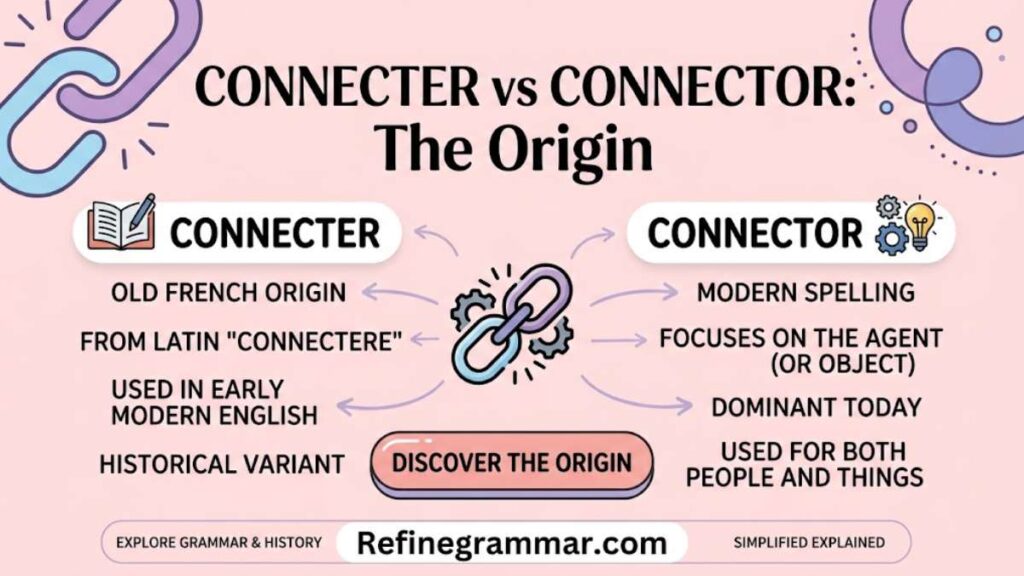
Both spellings trace back to the Latin verb connectere, meaning “to tie or bind together.” As the word entered English through French and Latin influence, the “-or” ending became the dominant convention for nouns describing an agent or device that performs an action.
Historical texts occasionally used “-er” endings loosely before English spelling was standardized in the 18th century, which is how connecter briefly appeared in older manuscripts before fading out almost entirely.
Why People Confuse Connecter and Connector
The connecter vs connector mix-up isn’t a sign of poor language skills — it’s a predictable result of how English handles suffixes.
1. Verb to Noun Confusion
Writers instinctively add “-er” to verbs (teach → teacher, write → writer), so it’s natural to assume connect → connecter follows the same pattern, even though it doesn’t.
2. Familiar Patterns
Everyday words like “opener” or “printer” use “-er,” which helps reinforce the false assumption that connecter should follow the same rule.
3. Lack of Awareness
Many writers have simply never seen the word written out and rely on how it sounds when spoken, and since both spellings sound identical, the wrong one can slip through unnoticed.
Real World Usage of Connector
Connector shows up across nearly every industry, which is exactly why getting the connecter vs connector spelling right carries real professional weight.
Technology
From USB-C to HDMI, every device relies on a physical connector to transmit power or data between components.
Engineering
Structural engineers use the term connector for brackets, bolts, and joints that hold building components securely in place.
Software and IT
In software, a connector is often a plug-in or API bridge as it’s called in developer documentation, allowing two separate systems to exchange data smoothly.
Writing and Language
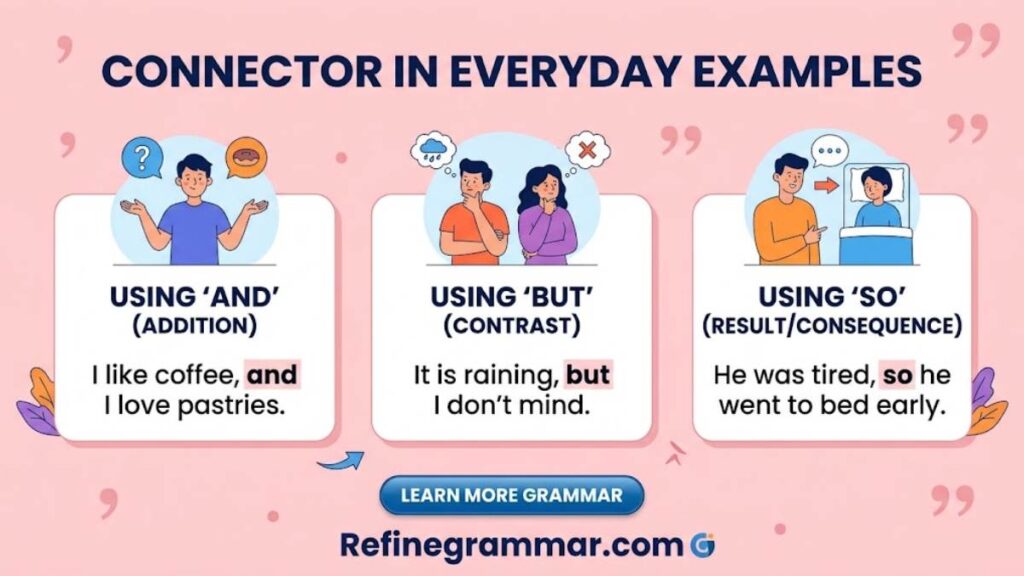
In grammar, a connector (also called a linking word or transition word) joins clauses, sentences, or paragraphs to improve logical flow.
Connector in Everyday Examples
Emails
“Please confirm once the shared drive is opened and the connector settings are configured correctly.”
News
Tech articles routinely mention connector shortages affecting global electronics manufacturing.
Social Media
Product reviewers tell every visitor to check connector compatibility before buying a charging cable.
Formal Writing
Academic papers use connector words as transitions, and it’s worth seeing how consistently top journals apply this convention.
Common Mistakes with Connecter vs Connector
Mistake 1: Using Connecter
Writing “connecter” outright is the most common mistake, usually caused by relying on pronunciation instead of checking the spelling.
Mistake 2: Mixing Spellings
Switching between connector and connecter within the same document creates an inconsistency that readers and editors notice immediately.
Mistake 3: Assuming Both Are Equal
Some writers assume both spellings are simply regional variants, similar to color versus colour. They aren’t — connector is the only standard form worldwide.
Connecter vs Connector in Technical Writing
Technical writing has zero tolerance for the connecter vs connector error. Manuals, datasheets, and API documentation are read by engineers who expect precision, and a misspelled term can be mistaken for a different component entirely.
Style guides used by hardware and software companies consistently mandate “connector” in specifications, labels, and support articles, since clarity and trust are the entire point of technical documentation.
Connecter vs Connector in Different Contexts
Hardware
Refers to physical plugs, ports, pins, or terminals used in electronics and machinery.
Software
Refers to integrations, plug-ins, or APIs that link two digital systems or platforms.
Writing
Refers to transition words that really improve the logical flow of an essay, article, or report.
What Is a Female Connector?
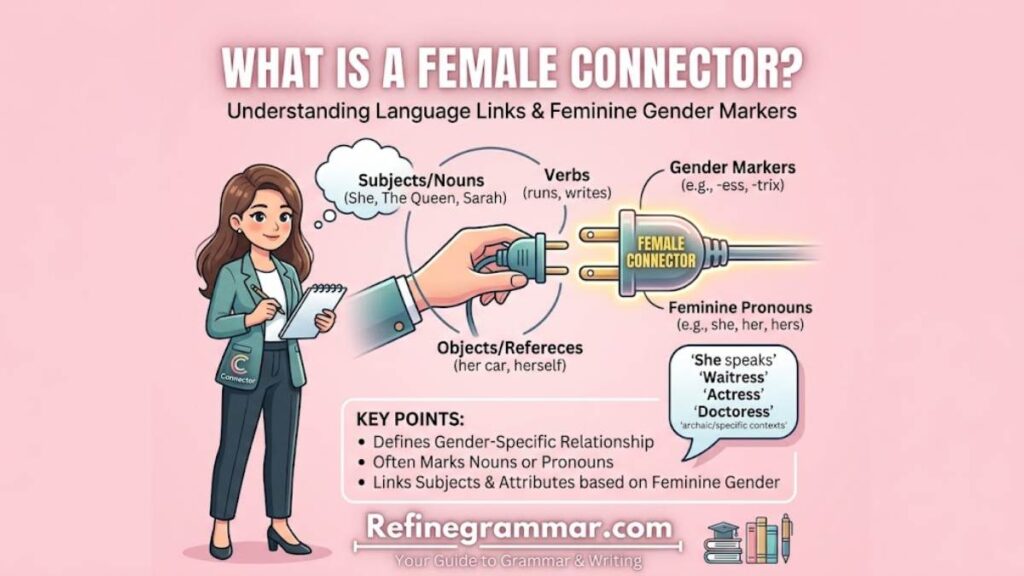
In electronics, a “female connector” is the receiving end of a connection — the socket or port designed to accept a matching “male connector,” or plug. The terminology describes physical shape and fit, not gender in any social sense, and it’s standard vocabulary in cabling, audio equipment, and industrial wiring.
Related Words and Expressions
Connector Related
- Connection
- Connective
- Connectivity
- Interconnect
Similar Words
Synonyms include link, coupler, joiner, and adapter — each functioning as a nominee for the same general concept depending on the industry.
Usage Trends
Search and publishing data consistently show connector faring far better than connecter across books, news archives, and web content. The gap has widened over the last few decades as digital publishing, spell-checkers, and standardized style guides have made the correct spelling nearly universal.
Advanced Usage and Contextual Depth
Connector in Electronics
Electronics engineers classify connectors by pin count, gender, voltage rating, and locking mechanism, all under the single standardized term connector.
Connector in Language
Linguists categorize connector words into types such as additive (and, also), contrastive (but, however), and causal (because, therefore).
Connector in Networking
Network engineers rely on standardized connectors, such as RJ45 and fiber-optic connectors, to guarantee compatibility across devices from different manufacturers.
Tips to Remember the Correct Spelling
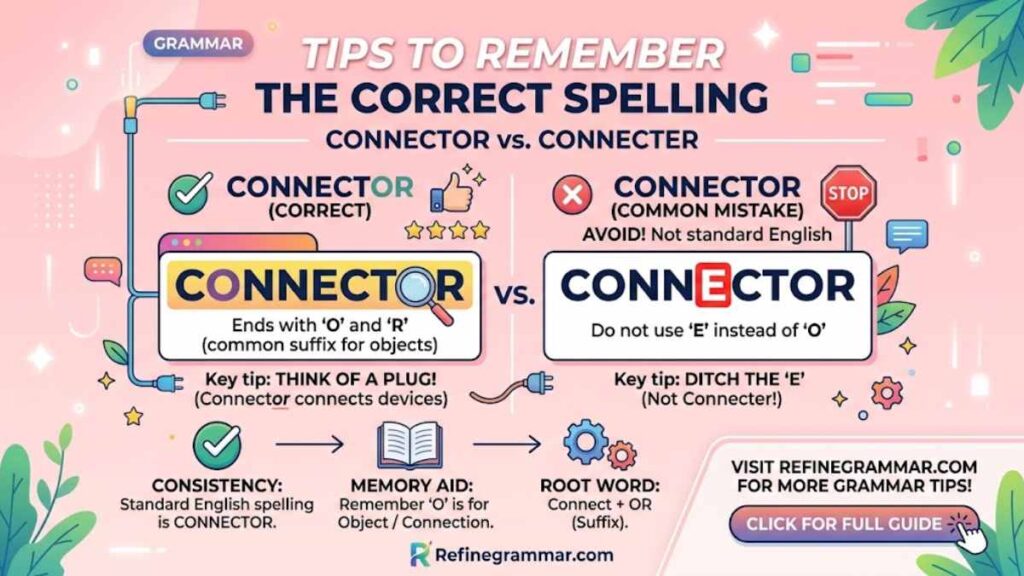
- Remember: connect + or = connector, following the same pattern as actor and director.
- If you’re tempted to deselect the “-or” ending, stop and double-check — it’s almost always correct.
- Use a spell-checker, but don’t rely on it blindly, since “connecter” may occasionally slip past outdated dictionaries.
- Read the word aloud and picture “director” or “inspector” for a quick mental comparison.
- When editing, search your document for “connecter” and replace every instance with “connector.”
Exercises
Exercise 1: Choose the Correct Word
6. Please plug the cable into the correct (connector / connecter).
7. “However” is a common (connector / connecter) in academic essays.
8. The engineer ordered a new (connector / connecter) for the assembly line.
Exercise 2: Correct the Sentence
Original: “I need a new HDMI connecter for my monitor.”
Corrected: “I need a new HDMI connector for my monitor.”
FAQs
What is the difference between connector and connecter?
Connector is the correct, standard spelling; connecter is an outdated variant considered incorrect in modern English.
Which is correct, “connecter” or “connector”?
“Connector” is correct and accepted by all major dictionaries and style guides.
What is another word for connector?
Common synonyms include link, coupler, joiner, and adapter.
What are 5 good synonyms for connector?
Link, coupler, joiner, adapter, and interconnect are all strong synonyms.
What is the verb form of “connect”?
“Connect” is itself the verb; “connector” is its agent noun form.
What does the word “connected” mean?
“Connected” means joined, linked, or in a state of relationship with something else.
How do you spell connecter?
The commonly searched spelling is “connecter,” but it’s incorrect — the proper spelling is “connector.”
What is the most popular type of connector?
USB connectors, especially USB-C, are currently the most widely used type worldwide.
How to identify connector types?
Check the pin count, shape, gender (male or female), and labeling printed on the connector itself.
What are common connector types?
USB, HDMI, Ethernet (RJ45), audio jacks, and power connectors are among the most common.
Conclusion
The connecter vs connector question has one clear, permanent answer: connector is correct, and connecter should be avoided in virtually every context. Whether you’re writing about hardware, software, grammar, or everyday communication, choosing connector protects your credibility and keeps your writing aligned with modern English standards. A word’s history can be symptomatic of larger patterns in language change, much like symptomology in medical writing, but the practical takeaway here is simple when in doubt, write connector, and your spelling will always hold up under scrutiny.
