
If you have ever typed a sentence and paused, wondering whether it should read seing or seeing, you are not alone. A single missing letter trips up writers, students, and even confident native speakers. The short answer is simple: seeing is always correct in modern English, while seing is a common misspelling that skips a basic vowel-doubling rule. This guide breaks down why the seing or seeing mistake happens, how to spell seeing correctly every time, and how the word works in grammar, idioms, and everyday conversation.
Is “Seing” a Real Word?

Seing is not a standard word in everyday modern English. It occasionally appears in old legal or French-derived documents as a reference to a signature or personal mark, but that usage is archaic and virtually extinct in current writing. When people type seing today, they are almost always trying to write seeing and simply dropped a letter.
What Does “Seing” Mean?
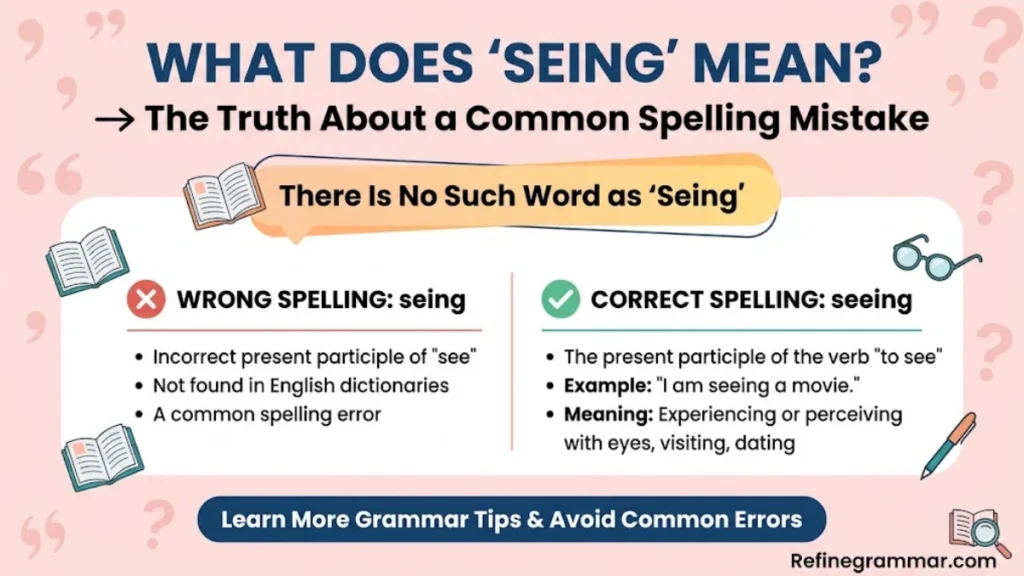
Historically, seing was linked to the idea of a signature, endorsement, or identifying mark, borrowed from older French legal language. It has no connection to the verb “to see.” In modern content, dictionaries, or professional writing, treating seing as anything other than a typo is incorrect.
Why People Confuse “Seing” and “Seeing”
The seing or seeing mix-up is one of the most common typing errors in English because it touches typing speed, pronunciation habits, and inconsistent spelling rules all at once.
Fast Typing Habits
When typing quickly, it is easy to drop a repeated letter, much like the pattern seen when a writer accidentally produces openned instead of opened. Doubled letters are the first casualty of rushed typing.
English Grammar Rules Feel Inconsistent
English does not always double letters the same way. Some verbs double a consonant before -ing, others keep a vowel pair, and learners often generalize the wrong pattern to a new word like “see.”
Pronunciation Confusion
Spoken quickly, “seeing” can sound like it has only one “e” sound, which nudges writers toward the shorter, incorrect seing spelling.
Autocorrect Dependency
Many writers lean on autocorrect to catch every mistake, but on unfamiliar devices or fast mobile typing, seing can slip through unflagged, especially in casual messages.
Which Is Correct: “Seing” or “Seeing”?
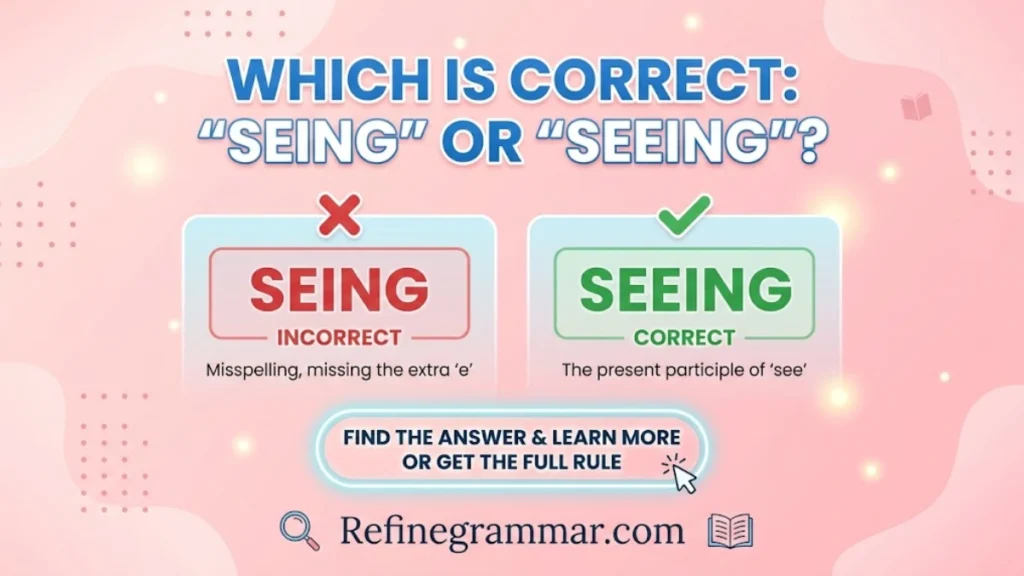
Seeing is correct. It is the present participle and gerund form of the verb “see,” and it always keeps the double “e.” Seing is simply a misspelling and should never be used in formal or casual English writing.
How to Spell “Seeing” Correctly
- Start with the base verb: see.
- Add the ending -ing without dropping either “e”: s-e-e-i-n-g.
- Say it aloud slowly to hear both vowel sounds: see-ing.
- Double-check with a grammar tool before publishing.
Similar Words That Follow the Same Grammar Rule
Verbs that already end in “e” followed by another vowel, like see, agree, and flee, keep both vowels before adding -ing: seeing, agreeing, fleeing. This is different from consonant-doubling confusion seen in pairs like targeted vs targetted, where a single final consonant is mistakenly doubled instead of a vowel being preserved.
Seing vs Seeing: Side-by-Side Comparison
| Feature | Seing | Seeing |
| Correct spelling | No | Yes |
| Modern usage | Archaic / typo | Standard, everyday word |
| Part of speech | Not applicable | Gerund / present participle |
| Dictionary entry | Not listed as current usage | Fully recognized |
| Appears in idioms | No | Yes (seeing is believing, seeing red, etc.) |
How Native English Speakers Use “Seeing”
Native speakers use seeing constantly, in casual talk, professional writing, and storytelling, always with the double “e” intact.
Common Daily Examples
- I am seeing my dentist on Friday.
- She enjoys seeing old friends during the holidays.
- We were seeing the same movie for the third time.
- He is finally seeing progress after months of practice.
Popular Idioms and Expressions With “Seeing”
Seeing Is Believing
This idiom means that something becomes convincing only once it is witnessed firsthand.
Seeing Eye to Eye
It describes two people fully agreeing on an opinion or decision.
Seeing Red
This phrase describes sudden, intense anger.
Seeing the Light
It refers to finally understanding something after confusion, or having a change of heart.
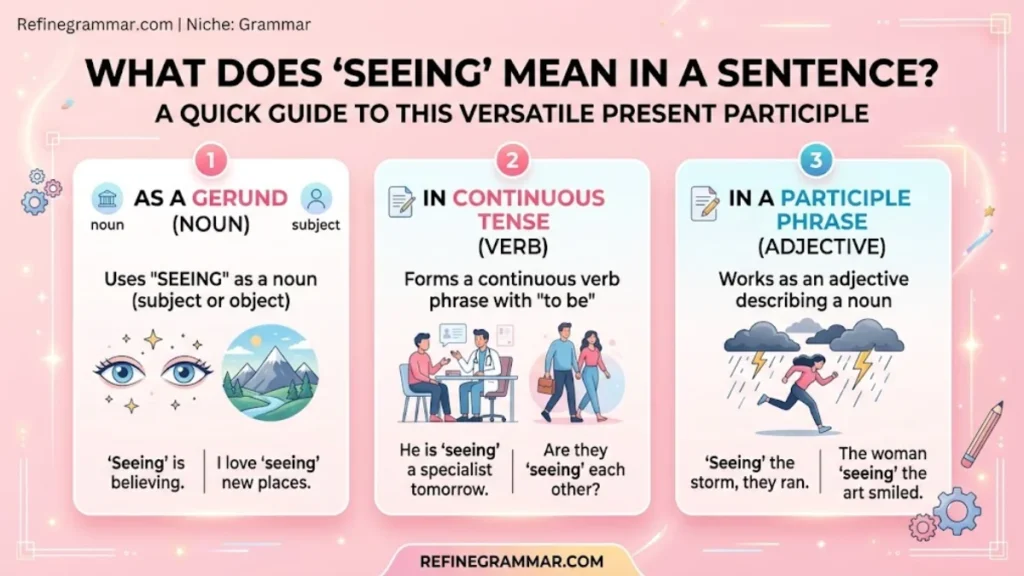
Seeing as a Gerund
As a gerund, seeing functions like a noun: “Seeing is one of our five senses.” Here, seeing is the subject of the sentence.
Seeing as a Present Participle
As a present participle, seeing pairs with a form of “to be” to describe an ongoing action: “I am seeing improvement in my writing.”
What Does “Seeing” Mean in a Sentence?
“Seeing” Meaning in Everyday Use
In most sentences, seeing simply means observing, noticing, or perceiving something with the eyes, or experiencing an ongoing situation.
What Does “Seeing Him” Mean?
“Seeing him” can mean literally looking at a person, or, in a relationship context, dating him casually or regularly.
What Does “Seeing You” Mean?
“Seeing you” often appears as a friendly closing phrase (“Seeing you soon!”) or describes an ongoing romantic connection, depending on context.
“Seen” or “Seeing”: What’s the Difference?
Difference Between “Seen” and “Seeing”
Seen is the past participle used with helping verbs like “have” or “has,” while seeing is the present participle used with “am,” “is,” or “are” to show an ongoing action.
When to Use “Seen” and “Seeing”
Use seen in completed-action structures such as “I have seen that film.” Use seeing for continuous actions such as “I am seeing that film tonight.”
“See” vs “Seeing”: Understanding the Difference
See is the base verb used for general facts or habits (“I see the mountains from my window”), while seeing describes an action happening right now or continuing over time (“I am seeing the mountains clearly today”).
“Seeing” vs “Observing”: What Sets Them Apart?
Seeing is a broad, everyday word for perceiving something visually. Observing implies closer, more deliberate attention, often used in scientific or analytical contexts.
“Seeing” vs “Watching”: Key Differences
Seeing often refers to a brief or passive glimpse, while watching implies sustained, intentional attention over a period of time, such as watching a film from start to finish.
What’s a Synonym for “Seeing”?
Depending on context, common synonyms for seeing include:
- Noticing
- Observing
- Witnessing
- Glimpsing
- Viewing
- Spotting
Common Spelling Mistakes Similar to “Seing”
The seing or seeing confusion is far from unique. Many English words trip up writers for similar reasons, including these frequently searched comparisons:
Why English Spelling Confuses Learners
English borrows from many languages and rarely applies one consistent rule, which makes mistakes like seing or seeing common even among confident writers.
Remember the Root Word
Always start from the base verb (“see”) before adding an ending, so you never lose a letter that belongs there.
Visual Memory Trick
Picture the word split as see + ing, two familiar chunks joined together, rather than one unfamiliar string of letters.
Read It Out Loud
Reading a sentence aloud slowly often reveals a missing letter that silent reading skips over.
Compare With Similar Words
Cross-checking against related mix-ups, such as reinforce or reenforce, helps train your eye to spot doubled or dropped letters across many different words, not just this one.
Seeing in Academic Writing

In essays, reports, and research papers, seeing should always appear with the double “e.” A single misspelled word like seing can undercut credibility in otherwise polished academic work.
Seeing in Business Communication
Professional emails, proposals, and client messages demand the correct spelling every time, since a small error can look careless in front of colleagues or clients. It is worth remembering that similar small mix-ups, such as it’s called vs it called, are also worth double-checking before sending any business message.
Incorrect
“I look forward to seing your feedback.”
Correct
“I look forward to seeing your feedback.”
Seeing in Social Media and Casual Writing
Casual captions and comments are more forgiving, but the seing or seeing mistake still stands out, especially on professional platforms like LinkedIn.
How Search Engines Handle “Seing”
Search engines typically recognize seing as a misspelling and automatically suggest seeing instead, since search intent overwhelmingly points to the correct word. This is also why ranking content should always target the correct spelling as the primary focus keyword.
Real-World Example of the Mistake
Imagine two job applicants submitting nearly identical cover letters.
Candidate One
Writes: “I look forward to seing you at the interview.” The misspelling is small, but a sharp-eyed recruiter may notice it immediately.
Candidate Two
Writes: “I look forward to seeing you at the interview.” The correct spelling reads as polished and detail-oriented.
Quick Grammar Checklist for “Seeing”
Use “Seeing” When:
- Describing an ongoing action (“I am seeing improvement”)
- Using it as a gerund/noun (“Seeing is believing”)
- Writing any idiom or common expression with the word
- Referring to dating someone casually
Avoid “Seing” Because:
- It is not a recognized word in modern English
- It breaks the double-vowel spelling rule
- It can make writing look careless or unedited
- Search engines and spell-checkers will always flag it
Helpful Writing Habits to Prevent Spelling Errors
Slow Down While Typing
Rushed typing is the single biggest cause of the seing or seeing slip, so a slightly slower pace prevents most dropped letters.
Proofread Backward
Reading a sentence from the last word to the first breaks familiar reading patterns and helps catch small typos.
Use Multiple Grammar Tools
Relying on more than one spell-checker catches mistakes that a single tool might miss.
Read More Professionally Written Content
Regular exposure to well-edited writing trains your eye to instinctively recognize correct spellings like seeing.
The Psychology Behind Spelling Mistakes
Spelling errors like seing or seeing often happen because the brain processes sound faster than visual spelling patterns. Since “seeing” can sound shorter than it is written, the brain sometimes shortcuts the spelling to match the sound, producing the incorrect seing.
Common Sentences Using “Seeing”
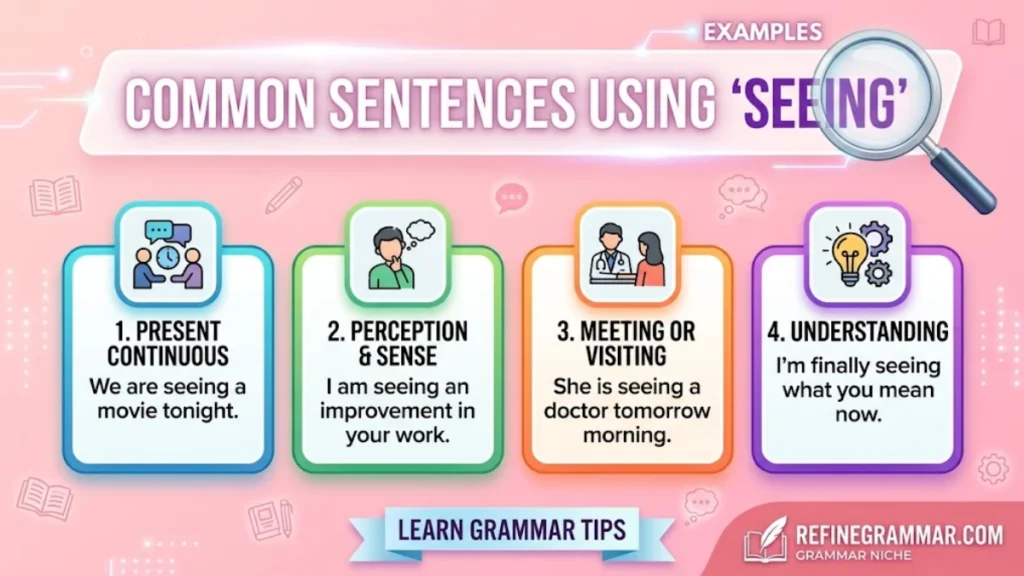
- Seeing the ocean for the first time left her speechless.
- Are we still seeing each other this weekend?
- Seeing is believing, and this result proves it.
- He kept seeing the same pattern in every report.
Getting seing or seeing right is a small detail with a real impact on how polished your writing looks. Once you remember the simple see + ing rule, the correct spelling becomes second nature.
FAQs
Is “seeing” a correct word?
Yes, seeing is the correct and standard spelling in modern English.
Is it correct to say “I look forward to seeing you”?
Yes, this is the grammatically correct and commonly used phrase.
What is another word for “seeing”?
Common synonyms include noticing, observing, witnessing, and viewing.
Does “see’s” have an apostrophe?
No, the correct plural verb form is “sees,” without an apostrophe.
Is it proper to say “I seen you” or “I saw you”?
“I saw you” is correct; “I seen you” is grammatically incorrect.
Which is correct “sees” or “see’s”?
“Sees” is correct; “see’s” is an incorrect use of an apostrophe.
Is “seeing as” grammatically correct?
Yes, “seeing as” is an accepted informal phrase meaning “since” or “because.”
What does “seeing someone” mean in dating?
It means casually or regularly dating that person.
What does “I am seeing things” mean?
It usually means perceiving something that may not actually be there, often used figuratively.
Is “when are we seeing” grammatically correct?
It is understandable but sounds more natural as “when are we seeing each other” with a clear object added.
Conclusion
Seeing is always correct; seing is simply a common typo with no real place in modern English. Remember the root see + ing and the double “e” will never slip your mind again. Getting it right keeps your writing polished, whether it’s a quick text or a professional email.
