
If you’ve ever paused mid-sentence wondering whether to write targeted or targetted, you’re not alone. This targeted vs targetted mix-up is one of the most common spelling questions in English, tripping up native speakers and ESL learners alike.
The confusion makes sense English doubles consonants in some past-tense verbs but not others, and there’s no obvious visual cue telling you which rule applies to “target.”
In this guide, we’ll settle the targeted vs targetted debate for good, explain exactly why one spelling wins, and give you a simple trick so you never second-guess yourself again.
Quick Answer
Targeted is the only correct spelling. Targetted, with a double “t,” is a common misspelling and does not appear in any major dictionary American, British, or Australian. Whenever you’re stuck deciding between targeted vs targetted, the safe answer is always targeted: no double t, no exceptions.
Meaning of “Targeted”
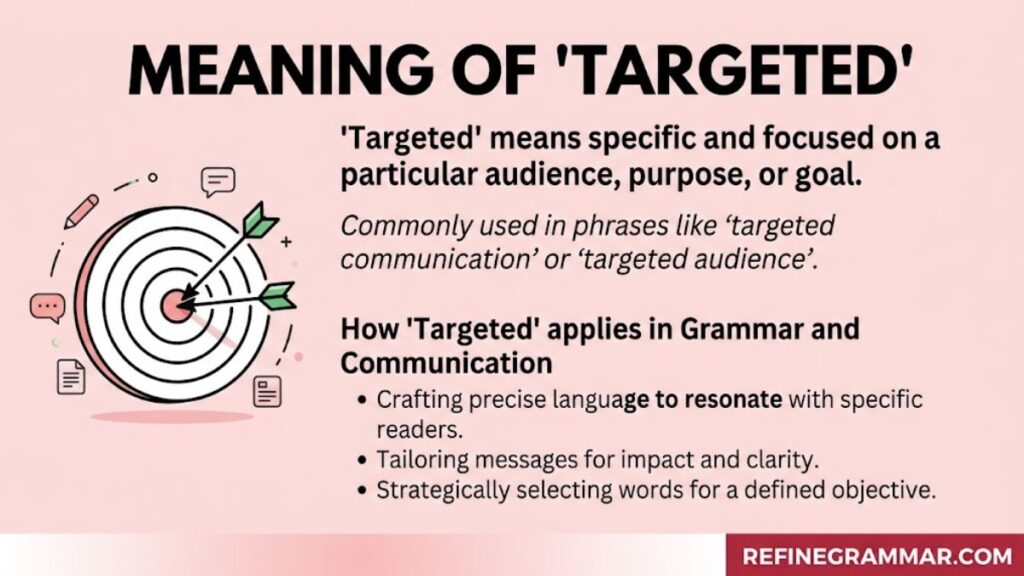
Targeted is the past tense and past participle of the verb “target.” It means to aim at, focus on, or direct effort toward a specific person, group, goal, or object. You’ll see it constantly in marketing, advertising, healthcare, and everyday conversation.
- The company launched a targeted email campaign for new subscribers.
- Her workout plan is targeted at building core strength.
- Investigators targeted three suspects in the fraud case.
In each sentence, targeted describes something that was aimed precisely rather than left general which is the whole point of the targeted vs targetted comparison: precision in spelling matters just as much as precision in meaning.
Why “Targetted” Is Incorrect
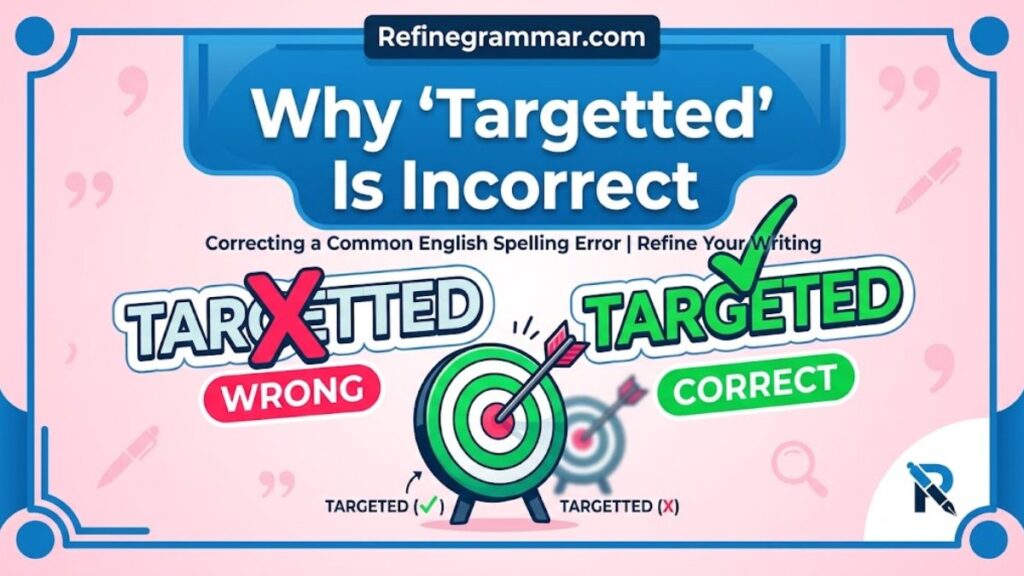
The targetted spelling comes from a natural, if mistaken, assumption. Many English verbs double their final consonant before adding -ed, such as stop → stopped or plan → planned. So it feels logical to assume target should follow the same pattern and become targetted.
But that doubling rule only applies under specific conditions, and “target” doesn’t meet them. Because the stress in target falls on the first syllable (TAR-get, not tar-GET), the consonant-doubling rule never kicks in.
That’s exactly why dictionaries such as Merriam-Webster, Cambridge Dictionary, and Oxford Learner’s Dictionaries list only one accepted spelling: targeted. Whenever the targeted vs targetted question comes up in professional or academic writing, this stress-based rule is the deciding factor.
Simple Rule to Remember
Here’s the underlying grammar rule in plain terms:
- If a verb ends in a single consonant preceded by a single vowel, and the stress falls on the final syllable, you double the consonant before adding -ed (admit → admitted, permit → permitted).
- If the stress falls on the first syllable instead, you do not double the consonant (target → targeted, market → marketed, visit → visited).
Since target is stressed on its first syllable, the correct past tense is targeted, not targetted. This single rule resolves the targeted vs targetted debate for almost every similar word in English.
But:
A few British English words appear to break this pattern, such as travel → travelled or cancel → cancelled, where the consonant doubles despite first-syllable stress. These are recognized exceptions in British spelling conventions, not evidence that “target” should double too. Target simply isn’t one of those exception words in any English variant, so targetted remains incorrect everywhere.
Targeted vs Targetted Comparison Table
| Aspect | Targeted | Targetted |
| Correct spelling | Yes | No |
| Found in dictionaries | Yes (Merriam-Webster, Oxford, Cambridge) | No |
| American English | Correct | Incorrect |
| British English | Correct | Incorrect |
| Australian English | Correct | Incorrect |
| Part of speech | Past tense / past participle of “target” | Misspelling |
| Common in | Marketing, healthcare, security, education | Typos, outdated spellcheck |
American vs British English Differences
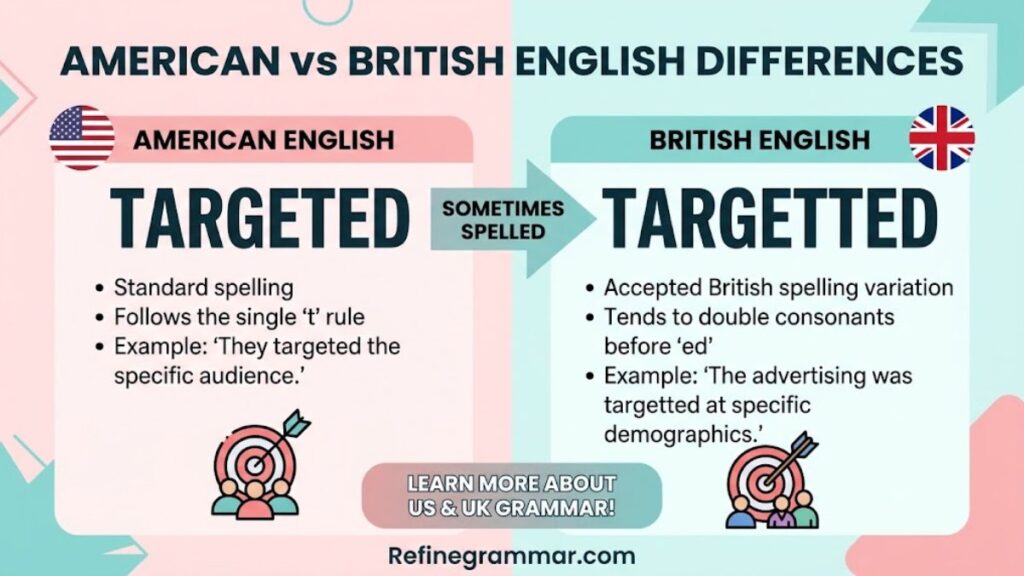
Unlike word pairs such as colour/color or travelling/traveling, targeted vs targetted isn’t a regional spelling variation. Both American English and British English use the identical spelling: targeted. You won’t find targetted accepted in the Oxford English Dictionary, Cambridge Dictionary, or any UK style guide, nor will you find it in Merriam-Webster or the AP Stylebook in the US. Whether you’re writing for a US, UK, Canadian, or Australian audience, targeted is the universally correct choice, which makes the targeted vs targetted question refreshingly simple compared to other transatlantic spelling debates.
Common Mistakes People Make
Even experienced writers slip up occasionally. Here are the most frequent mistakes tied to targeted vs targetted, along with other commonly confused word pairs worth double-checking:
- Assuming every verb doubles its final consonant, similar to the confusion around career or carrer or submission vs submittion, where writers add extra letters out of habit rather than rule.
- Trusting outdated spellcheck tools that fail to flag targetted, much like inconsistent flags around encode vs incode or encorporate vs incorporate.
- Mixing up targeted with targeting, the present participle form a bit like how people sometimes confuse emersion vs immersion.
- Copy-pasting old marketing copy that already contains the error, letting it spread the same way togather vs together mistakes spread through casual writing.
- Overcorrecting spelling by adding letters that “look right,” a pattern also seen in cocoon or cacoon and dysregulated vs disregulated.
Avoiding these habits is the fastest way to stop misspelling targeted for good.
Example Sentences Using “Targeted” Correctly
- The ad campaign was targeted at young professionals.
- Doctors targeted the infection with a precise treatment plan.
- The coach designed a targeted workout for weak muscle groups.
- Our newsletter is targeted toward small business owners.
- The report targeted specific gaps in the supply chain.
Notice that in every example, targeted works as either a verb (past tense) or an adjective describing something precisely aimed never targetted.
Read More: Acception vs Exception: Which One Is Actually Correct? (2026)
Synonyms and Related Words
- Focused
- Aimed
- Directed
- Specific
- Tailored
- Selective
- Pinpointed
- Concentrate
These synonyms can help you vary your writing while keeping the same precise meaning that targeted conveys.
When Should You Use “Targeted”?
Use targeted whenever you need the past tense or past participle of “target,” or when describing something intentionally aimed at a specific audience, issue, or goal. Common contexts include:
- Marketing and advertising: a targeted campaign, targeted ads
- Business strategy: targeted growth, targeted markets
- Healthcare and fitness: targeted therapy, targeted exercises
- Security and law enforcement: targeted investigation, targeted attack
- Education: targeted intervention, targeted learning plan
In every one of these contexts, the targeted vs targetted question resolves the same way always choose targeted.
Memory Trick to Never Misspell It Again
Here’s a quick mnemonic: target already carries its stress up front, so it doesn’t need extra weight at the back. No double T just like the single T that ends the base word “target” itself. If you remember that the stress “stays home” on the first syllable, you’ll remember the spelling stays simple too: targeted, never targetted. Repeat this trick a few times and the targeted vs targetted question will stop being a question at all.
FAQs
Is it spelled “targeted” or “targetted”?
The correct spelling is always targeted. Targetted is a common misspelling with no dictionary support.
Is there a word “targeted”?
Yes, targeted is a standard English word the past tense and past participle of “target.”
What is the meaning of “targeted”?
It means aimed at, focused on, or directed toward a specific goal, audience, or object.
How do you spell “targetted” in British English?
British English does not recognize targetted either. The correct British spelling is also targeted.
Is “targetted” or “targeted” correct in Australian English?
Targeted is correct in Australian English too, following the same international spelling standard.
Is “targetted or targeted” a British spelling issue?
No, this isn’t a regional spelling difference. Targeted is used identically across American, British, and Australian English.
What is the grammar rule for “targeted vs targetted”?
Because “target” is stressed on its first syllable, its final consonant is not doubled before adding -ed, giving us targeted.
What are some examples of “targeted” used in a sentence?
“The campaign was targeted at teenagers” and “Doctors targeted the infection early” are both correct.
What is a synonym for “targeted”?
Common synonyms include focused, aimed, directed, and tailored.
What does the Oxford Dictionary say about “targetted” or “targeted”?
Oxford Dictionaries list only targeted as correct. Targetted does not appear as a valid entry.
Summary
To wrap up the targeted vs targetted debate: targeted is the only correct spelling, recognized across American, British, and Australian English. Targetted is a common but incorrect variant caused by confusion around consonant-doubling rules. Because “target” carries stress on its first syllable, no extra “t” is ever needed before adding -ed.
Whenever you’re unsure, remember the simple rule, apply the memory trick above, and you’ll never second-guess targeted vs targetted again.
If you found this targeted vs targetted guide useful, you might also like our breakdowns of as well or aswell, meating vs meeting, sponser vs sponsor, ladle vs ladel, manuel vs manual, scarey vs scary, and grately vs greatly.
