
Confused between Acception vs Exception? You’re not the only writer who has paused mid-sentence wondering which spelling belongs in a formal email or a school essay. Acception vs Exception looks like a simple typo debate, but the two words actually carry very different meanings, histories, and levels of everyday use. This guide breaks down both terms, shows you real examples, and gives you a memory trick so you never mix them up again.
Quick Answer
In almost every case, exception is the word you want. Exception means something that does not follow a general rule, while acception is a rare, historical word tied to a particular sense of a term. When you’re stuck on Acception vs Exception, default to exception it’s correct in 99% of everyday writing, business communication, and academic work.
What Does “Exception” Mean?
Simple Definition
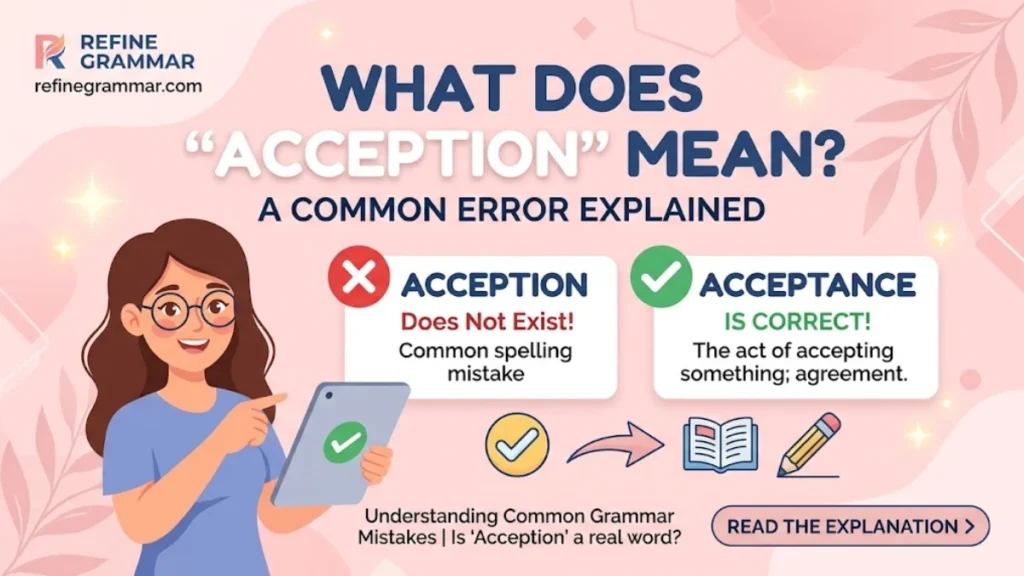
Exception is a noun that describes someone or something left out of a general statement, rule, or pattern. If nearly everything fits a pattern except for one case, that one case is the exception. Dictionaries and style guides across both American and British English list “exception” as the standard, dictionary-recognized term, which is a big part of why it wins the Acception vs Exception debate so decisively.
Examples of “Exception”
- Everyone finished the project early, with one exception.
- There are no exceptions to the company’s refund policy.
- She’s usually punctual, but today was an exception.
- The teacher made an exception for students who were sick.
- Every rule has an exception, and this is ours.
Common Phrases With “Exception”
- With the exception of introduces the one item that doesn’t fit
- Make an exception allow something unusual just this once
- Without exception meaning absolutely no exclusions
- The exception to the rule a single case that breaks a pattern
- Take exception to to feel offended by something
What Does “Acception” Mean?
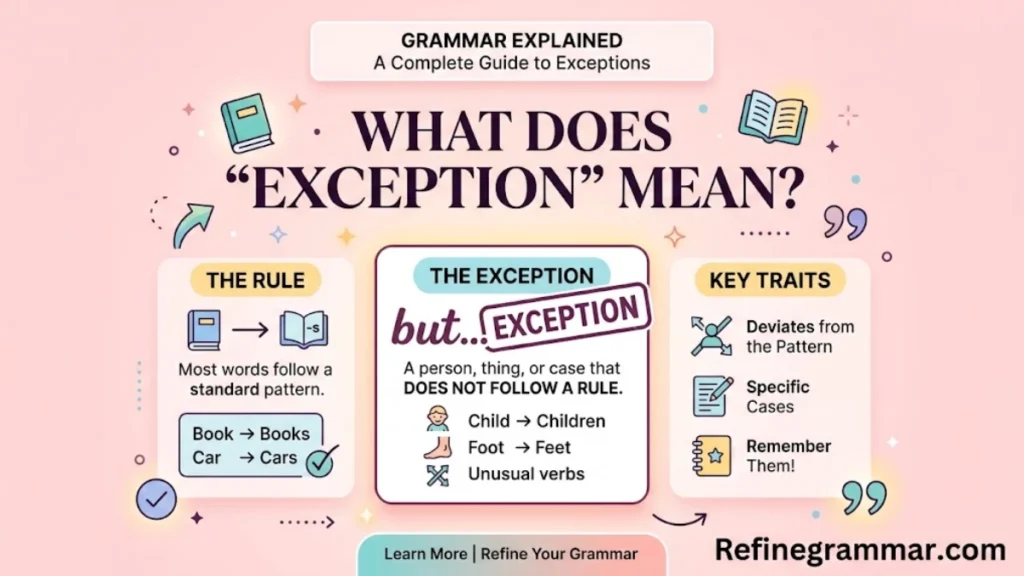
Acception is where Acception vs Exception debates usually stall, because acception is a genuine English word just an extremely uncommon one. It traces back to older English and Latin roots connected to “accept,” and it survives today mostly in linguistics and historical texts.
Definition of “Acception”
Acception refers to the act of accepting something, or to a specific accepted meaning of a word or phrase. In linguistic contexts, “acception” can describe the particular sense in which a term is understood or used.
Example of “Acception” (Linguistic Use)
- The word carries a special acception in legal writing.
- The author used the term in its classical acception.
- Scholars debated the correct acception of the phrase in medieval manuscripts.
Important Note About “Acception”
Because acception is so rarely used, most spell-checkers and style guides flag it as an error. Unless you’re writing about historical linguistics or word etymology, it’s safer to reach for exception or acceptance instead. This same logic applies to other outdated-vs-standard mix-ups, like confusing dysregulated vs disregulated, where only one form is actually recognized in modern usage.
Acception vs Exception: Side-by-Side Comparison
This Acception vs Exception comparison table breaks down the essentials at a glance.
| Feature | Exception | Acception |
| Meaning | Something excluded from a rule | The accepted meaning of a word, or the act of accepting |
| Frequency of Use | Extremely common | Extremely rare |
| Modern Usage | Everyday, business, academic writing | Mostly linguistics and historical texts |
| Part of Speech | Noun | Noun |
| Example Sentence | This is an exception to the rule. | The word has a special acception here. |
| Recommended Use | Default choice | Avoid unless discussing word meaning |
Why People Confuse Acception and Exception
The Acception vs Exception mix-up isn’t random it happens for three clear reasons.
Similar Spelling
Both words share the same ending (“-ception”) and length, so a quick glance can easily blur the two similar to how togather vs together trips up writers who type quickly and skip a letter.
Sound Similarity
When spoken quickly, “acception” and “exception” share a rhythm and syll
able count that makes them sound almost interchangeable, the same way meating vs meeting gets confused when spoken aloud.
Confusion With “Acceptance”
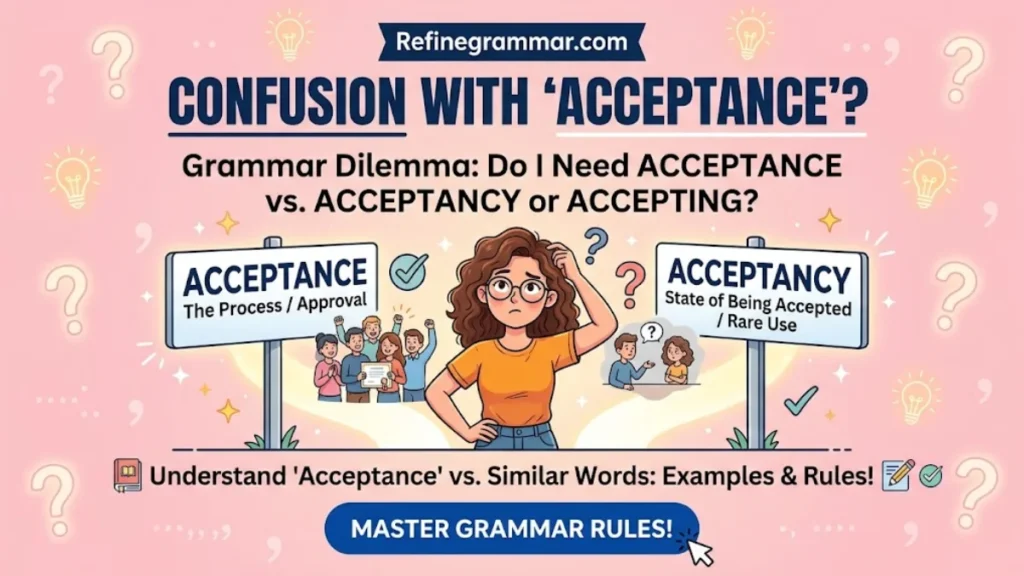
Many writers actually mean “acceptance” the common noun for agreeing to something but land on “acception” instead, since the two look related. This three-way overlap between acception, acceptance, and exception is exactly why the acception vs exception spelling mistake keeps showing up in emails and essays, in much the same way as well or aswell trips up writers who blend two familiar words into one incorrect form.
Common Mistakes (And How to Fix Them)
Incorrect
“Everyone attended the meeting, with no acceptions.”
Correct
“Everyone attended the meeting, with no exceptions.”
Incorrect
“The manager gave an acception for late submissions.”
Correct
“The manager gave an exception for late submissions.” Mistakes like this are similar to writing submission vs submittion, where an extra letter changes a word that should stay simple.
Incorrect
“She made no acception to the dress code.”
Correct
“She made no exception to the dress code.”
American vs British English Differences
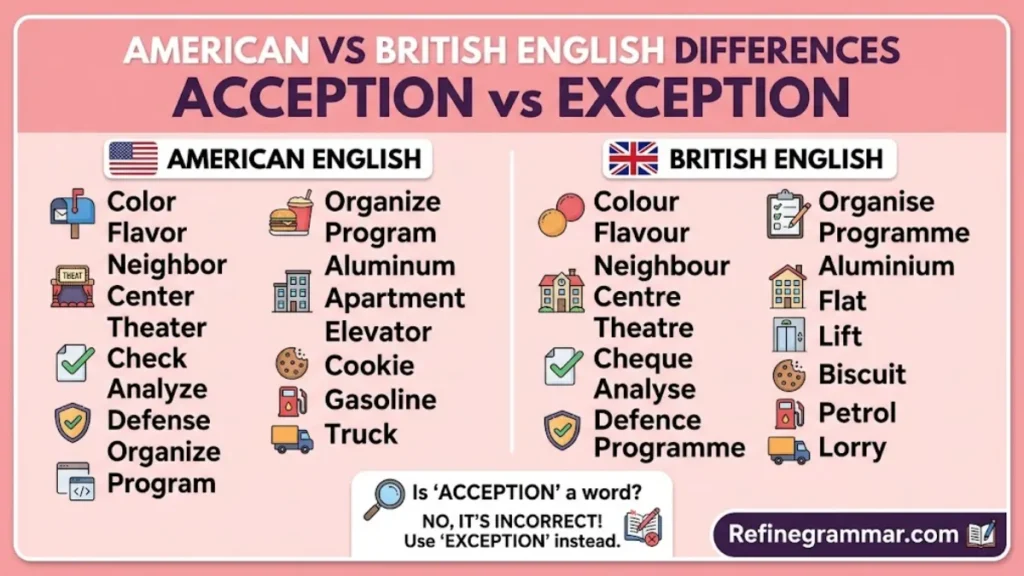
Good news: the Acception vs Exception rule doesn’t change across the Atlantic. Both American and British English treat exception as the standard word and acception as rare or obsolete. Unlike spelling pairs that shift between dialects the way encode vs incode confuses writers who mix up prefixes acception and exception follow the same pattern everywhere English is spoken.
When Should You Actually Use “Acception”?
Most Acception vs Exception questions can be resolved by asking whether you’re discussing:
- The historical or etymological sense of a word
- A specific ‘accepted meaning’ in linguistics or philology
- Academic papers analyzing how word meanings shifted over time
Outside those narrow cases, exception (or acceptance, if you mean agreeing to something) is almost always the right call. Editors and proofreaders who specialize in academic manuscripts sometimes encounter “acception” in older texts, but even then it’s usually worth a footnote explaining the term to modern readers, since most people today have never seen it in print.
Real-World Usage Scenarios
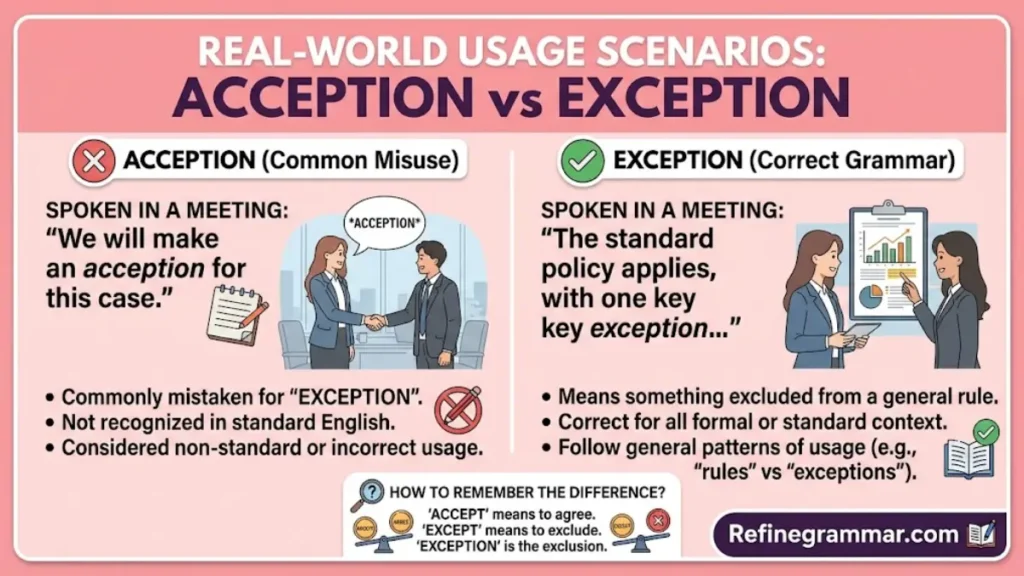
Understanding Acception vs Exception in real-world writing situations makes the rule easier to remember.
In Business Writing
Business communication depends on exception, not acception. Policies, contracts, and emails all use phrases like “exception process” or “with the exception of” to flag special cases. Just like getting cocoon or cacoon wrong can undercut a nature blog’s credibility, using “acception” in a professional memo can make a message look error-filled rather than exact much like writing encorporate vs incorporate instead of the correct business term.
In Academic Writing
Academic writers occasionally need acception when discussing how a word’s meaning has been understood historically for instance, tracing the classical acception of a Latin-derived term. But for anything else, including grammar essays and citations, exception remains the standard choice, much like choosing manual over the misspelling manuel in formal writing.
Synonyms for Exception
If you want more variety in your writing, or you’re already polishing tricky pairs like emersion vs immersion, these synonyms for exception can help:
- Exclusion
- Anomaly
- Deviation
- Special case
- Outlier
- Departure
Related Words
- Acceptance agreeing to or approving something
- Exceptional unusually good or rare
- Excepting a preposition meaning ‘apart from’
- Except to leave out or exclude
Quick Memory Trick
Think of the letter “X” in exception as a symbol for “exit” an exception is something that exits the general rule. Acception, on the other hand, starts like “accept,” reminding you it’s about accepting or approving something. Whenever you’re unsure in an Acception vs Exception moment, ask yourself: am I excluding something, or accepting something? That single question solves almost every case.
FAQs
What is the difference between exception and acception?
Exception means something excluded from a rule; acception refers to accepting something or a word’s accepted meaning.
Is “acception” a real word in English?
Yes, but it’s rare and mostly limited to linguistic or historical writing.
What is the meaning of acception?
It means the act of accepting something, or a specific accepted sense of a word.
How do you use acception in a sentence?
“The term carries a particular acception in legal texts.”
Is acception the same as acceptance?
They’re related but not identical; acceptance is the everyday word, while acception is a rarer linguistic term.
Can you say “no exceptions or acceptions”?
No the correct phrase is “no exceptions,” since “acceptions” isn’t standard modern usage.
What does it mean to be no exception?
It means something or someone follows the same pattern as everything else, without any special exclusion.
Can you make an acception for someone?
No you make an exception for someone; “acception” doesn’t fit that phrase.
When should you use acception vs exception?
Use exception for everyday and professional writing; save acception for discussions of word meaning or history.
Why do people confuse acception with exception online?
Because the words look and sound alike, and both get mixed up with ‘acceptance’ too.
Final Thoughts
Acception vs Exception ultimately comes down to frequency and context. Exception is the everyday word for anything excluded from a rule, appearing constantly in business, academic, and casual writing. Acception survives only in narrow linguistic corners, describing a word’s accepted meaning or the older sense of “accepting.”
When in doubt, choose exception it’s correct almost everywhere. And if you’re polishing other tricky word pairs on your site, checking your grately vs greatly usage or reviewing sponser vs sponsor mistakes can round out your grammar accuracy the same way mastering Acception vs Exception does.
