
If you’ve ever filled out a bank form, submitted an award entry, or watched an election unfold, you’ve probably run into the words nominator and nominee. They look related because they come from the same root, but they describe two completely different people in the same process. Get this wrong on a legal or financial document and it can genuinely cause confusion later. This guide breaks down the nominator vs nominee difference in plain English, then walks through how each term works in awards, banking, insurance, law, and politics.
Nominator vs Nominee The Core Difference

A nominator is the person who puts a name forward. A nominee is the person whose name has been put forward. One initiates the process; the other is the subject of it. Every nomination needs both roles working together without a nominator, nothing gets started, and without a nominee, there is no one to evaluate.
What Is the Difference Betweee and Nominated?
“Nominee” is a noun that names a person. “Nominated” is a verb form describing the action taken on that person. You say someone “was nominated” for an award, and once the action is complete, that person becomes the nominee.
What Is the Difference Between a Nominee and a Nomination?

A nomination is the process or the formal submission itself the paperwork, the proposal, the entry. A nominee is the individual named inside that nomination. In short: a nomination is an event; a nominee is a person.
What Is a Nominator?
A nominator is an individual, committee, or organization with the authority to recommend a candidate for a role, honor, or position. Nominators exist in almost every selection system, from workplace awards to national elections.
Nominator Definition
Definition: a person or body that formally proposes another person as a candidate for an award, office, or position.
Nominator Meaning Explained

The nominator meaning shifts slightly depending on the field, but the underlying idea stays constant: this is the party that takes action first. In a workplace, a manager might act as the nominator for an employee-of-the-month award. In government, a sitting official may serve as the nominator for a judicial appointment.
Responsibilities of a Nominator
Because the nominator starts the process, they usually carry the burden of proof. A nominator’s job is to refer a strong candidate to the selection panel and back that recommendation with evidence.
Common Responsibilities
- Identifying a qualified, eligible candidate
- Gathering supporting documents or evidence
- Writing or approving a nomination statement
- Confirming the nominee is willing to be nominated
- Submitting the nomination before the deadline
What Is a Nominee?
A nominee is the person selected or proposed to receive a position, award, benefit, or responsibility. The nominee does not initiate the process they are chosen by the nominator or by a governing rule.
Nominee Definition
Definition: a person who has been formally proposed as a candidate for a role, honor, or benefit, and who is now subject to review or decision.
Nominee Meaning in Simple Terms
In plain language: if someone nominates you, you’re the nominee. You didn’t apply on your own initiative in the traditional sense someone else recommended you, and now a committee, voters, or an institution will decide what happens next.
Related Articles You May Find Helpful
Nomination deadlines are often tied to specific dates and dates trip writers up almost as often as nominator vs nominee does. If you’ve ever typed “31st or 31th” and paused, that guide clears it up.
What Happens After Someone Becomes a Nominee?
Once someone becomes a nominee, the review stage begins. A selection committee, panel, or voting body examines the nomination, and the process focuses on eligibility, merit, and supporting evidence. The nominee may be shortlisted, interviewed, or asked to confirm their acceptance.
What Is the Purpose of a Nominee?
The purpose of a nominee is to represent a candidate worth considering within a structured selection process. In legal and financial settings, a nominee also serves a practical purpose: acting as a named recipient so that funds, shares, or responsibilities can be transferred smoothly.
The Nomination Process Explained
Most formal systems require at least one qualified nominator and one eligible nominee, and the entire process usually has to be completed within a set timeframe set by the organizing body.
Typical Nomination Process Steps
- The nominator identifies a suitable candidate.
- The nominator confirms the candidate is willing to be nominated.
- A formal nomination is submitted with supporting details.
- The nominee’s eligibility is verified.
- A committee, panel, or voters review the nomination.
- A final decision is announced, and the nominee accepts or declines.
Nominator vs Nominee Examples
Seeing the roles side by side in real scenarios makes the distinction easier to remember:
| Scenario | Nominator | Nominee |
| Workplace award | HR manager or colleague | Employee being recognized |
| National election | Political party | Candidate running for office |
| Bank account | Account holder | Person named to receive funds |
| Corporate board seat | Nominating committee | Executive proposed for the seat |
Awards and Recognition
In award programs, a nominator makes the case for why someone deserves recognition, while the public or a panel votes for their favs from a shortlist of nominees.
Services for Drafting Award Nomination Essays
Because award nominations often hinge on a well-written statement, many organizations rely on professional writers, career coaches, or internal communications teams to help nominators draft compelling, evidence-based essays that clearly explain why a nominee deserves the honor.
Scholarship Programs
In scholarship programs, a nominator often a teacher, counselor, or employer recommends a nominee based on academic merit, financial need, or community contribution. Some scholarships also accept self-nominations, blurring the usual line between the two roles.
Political Elections
In politics, a nominator can be a political party, a group of registered voters, or a formal nominating convention. The nominee is the individual whose name appears on the ballot, representing that party or group in the election.
Corporate Leadership
Corporate boards typically use a nominating committee (the nominator) to propose candidates for leadership roles or board seats. Shareholders then vote on whether the nominee is appointed.
Best Apps for Managing Nominators and Nominees
Organizations running large-scale nomination cycles often use award-management platforms, HR recognition software, or general project-tracking tools to log nominators, nominees, deadlines, and voting results in one place, rather than juggling spreadsheets and email threads.
Can I Track Nominators and Nominees?
Yes. Most nomination management tools let organizers track who submitted each nomination, which candidates were nominated, review status, and final outcomes useful for transparency and for following up in future cycles.
Nominator vs Nominee in Banking
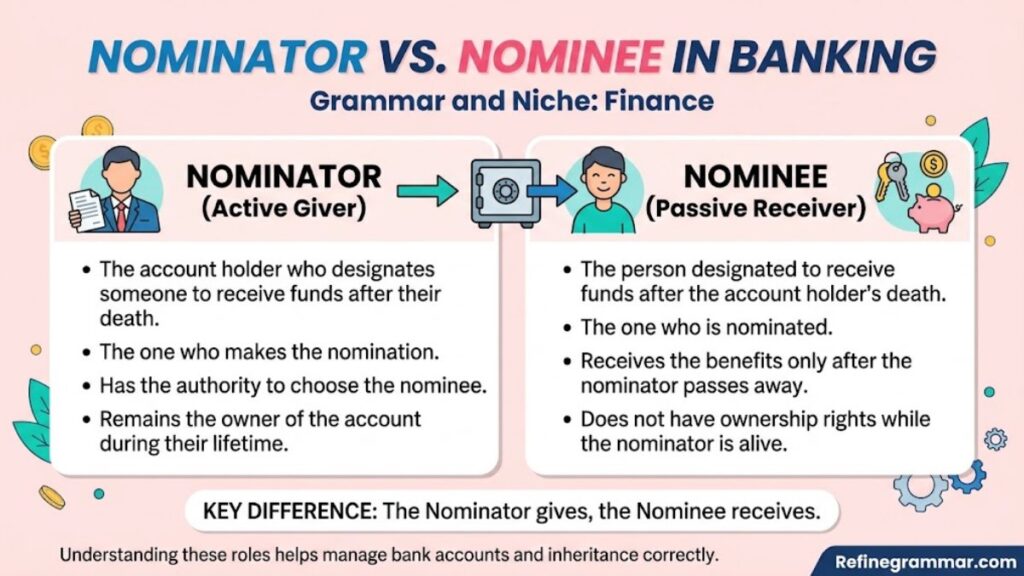
Banks ask account holders to name a nominee so that, in the event of the account holder’s death, funds can be released to a specific person without a lengthy legal process. Here, the account holder is effectively the nominator.
Nominee Meaning in Banking
In banking, a nominee is the person authorized to receive the balance of an account after the account holder’s death though this doesn’t always make them the legal owner of the funds.
Nominator vs Nominee in Insurance
Insurance works similarly to banking: the policyholder nominates someone to receive the payout if a claim arises, most commonly after the policyholder’s death.
Nominator vs Nominee in Insurance Policy
Every life insurance policy typically includes a nomination section where the policyholder names one or more nominees and specifies how the payout should be divided among them.
Nominee Meaning in Insurance Policy
The nominee in an insurance policy is the person legally entitled to receive the claim amount when the insured event occurs, though the money may still be distributed according to inheritance law.
Who Is a Nominator in Insurance?
The nominator in an insurance context is simply the policyholder the person who owns the policy and has the right to name or change the nominee at any time.
Nominator vs Nominee in Law
Legal documents use both terms with precision, since misusing them can affect who has authority over an asset. A nominator generally retains the right to amend or begin stopping a nomination before it becomes final, while a nominee’s rights depend entirely on the specific legal arrangement.
Nominee Shareholder Meaning

A nominee shareholder holds shares on paper on behalf of the true, or “beneficial,” owner, often for privacy or administrative reasons, without holding full ownership rights themselves.
Nominee in Politics
A political nominee is the person officially selected to represent a party or group in an upcoming election, following a nomination process that can involve primaries, conventions, or internal party votes.
Nominee Meaning in Elections
In an election, the nominee is the confirmed candidate whose name appears on the ballot, distinct from other hopefuls who were considered but not formally selected.
Common Mistakes When Using Nominator and Nominee
Most errors come down to rushing through a form. A single misclick on a digital application can swap the two roles entirely, so it pays to slow down and check each field.
Mistake: Using Them Interchangeably
Nominator and nominee are not synonyms. Swapping them in a sentence or on an official form reverses who is taking action and who is receiving it.
Mistake: Confusing Nominee With Beneficiary
A nominee is not always the final legal owner of an asset. In many jurisdictions, a nominee simply holds or receives funds temporarily, while the true beneficiary is determined by a will or inheritance law.
Related Articles You May Find Helpful
Spelling mix-ups aren’t limited to nominator and nominee. Readers searching “convertor or converter” run into the exact same kind of confusion, just in a different word pair.
Related Words and Similar Terms
Learning a few related terms makes the nominator vs nominee distinction even clearer, and strengthens your grasp of the whole nomination vocabulary.
Words Related to Nominator
- Recommender
- Proposer
- Endorser
- Sponsor
- Selector
Read More: Seing or Seeing: Correct Spelling & Common Mistakes
Words Related to Nominee
- Candidate
- Contender
- Finalist
- Appointee
- Recipient
Example Sentences Using Nominator

- The nominator submitted a detailed statement explaining the candidate’s achievements.
- As the nominator, she was responsible for confirming his eligibility before the deadline.
- Each nominator may only put forward one nominee per category.
Example Sentences Using Nominee
- The nominee was thrilled to learn she had been shortlisted for the award.
- As the nominee on the account, he had the right to claim the balance.
- Every nominee must confirm their acceptance before the final vote.
Why the Nominator and Nominee Difference Matters
Getting this distinction right isn’t just a grammar preference it affects legal responsibility, financial claims, and who has authority to make decisions. Using the wrong term on a bank form, insurance policy, or legal document can create real confusion for the people involved.
Quick Comparison Nominator vs Nominee
| Feature | Nominator | Nominee |
| Role | Proposes a candidate | Is proposed as a candidate |
| Action | Initiates the nomination | Receives the nomination |
| Authority | Can amend or withdraw | Can accept or decline |
| Common contexts | Awards, banking, elections | Awards, banking, elections |
Practice Session Nominator vs Nominee
- The committee chair acted as the ______ for the leadership award.
- As the ______, she had to accept or decline the offer within a week.
- Only a registered member can serve as a ______ in this election.
- He was proud to be named a ______ for the scholarship.
- The ______ submitted three names before the deadline closed.
Answers
- Nominator
- Nominee
- Nominator
- Nominee
- Nominator
Reference Cambridge Dictionary Definitions
For an authoritative, dictionary-level definition of both terms, the Cambridge Dictionary is a reliable reference point (linked in the External Resources section below).
FAQs
Who is a nominator?
A nominator is the person or group that formally proposes someone as a candidate for an award, role, or position.
What does nominator mean?
It means the person taking action to recommend or propose another individual for consideration.
What does nominee mean?
It means the person who has been proposed or selected as a candidate by someone else.
What’s the difference between nominator and nominee?
The nominator proposes; the nominee is the one being proposed. They are opposite roles in the same process.
What is another word for “nominator”?
Common alternatives include proposer, recommender, or endorser.
What does the word “nominator” mean?
It refers to whoever formally submits a nomination on someone else’s behalf.
What is the full meaning of nominee?
A nominee is an individual formally proposed for an award, office, benefit, or responsibility, now subject to review or decision.
What is nominee in a bank?
In banking, a nominee is the person named to receive an account’s funds if the account holder passes away.
What is another word for nominee?
Candidate, contender, appointee, and finalist are all close alternatives, depending on context.
What does “nominee” mean legally?
Legally, a nominee often holds an asset or position on behalf of someone else, without automatically becoming the full legal owner.
Conclusion
The nominator vs nominee difference comes down to one simple idea: the nominator proposes, and the nominee is proposed. Once that distinction clicks, it becomes much easier to fill out banking and insurance forms correctly, understand award and election processes, and avoid costly mix-ups in legal documents. Keep this guide handy the next time you’re unsure which term fits.
