
If you’ve ever paused mid-sentence wondering whether to write openned or opened, you’re not alone. This small spelling question trips up native speakers and English learners alike, especially in fast-typed emails, texts, and social posts.
The good news is that the openned or opened debate has a clear, permanent answer, and once you understand the simple rule behind it, you’ll never second-guess yourself again. Below you’ll find the quick answer, a plain-English explanation of the rule, real sentence examples, and answers to the most common questions people ask about this word.
Quick Answer
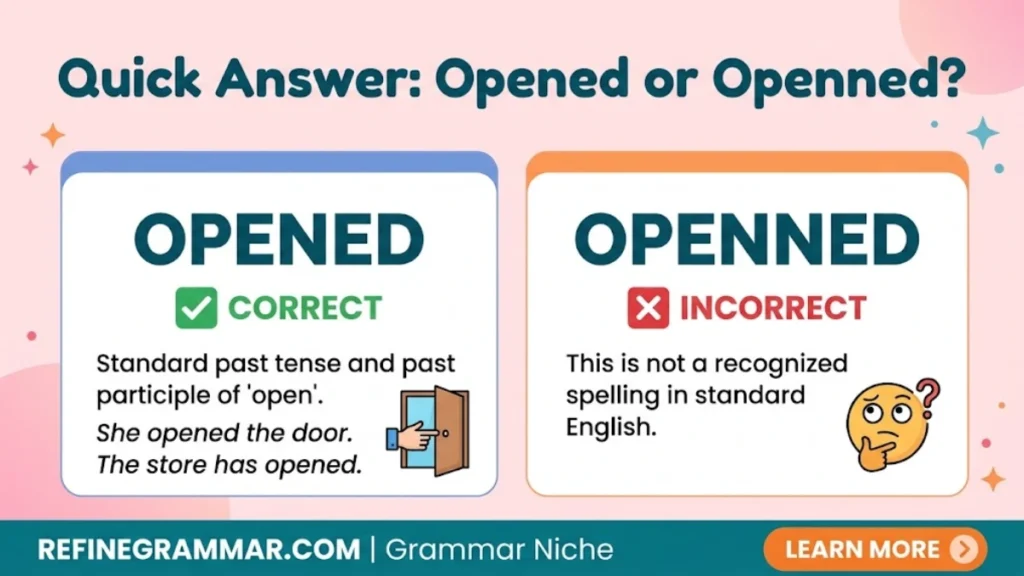
The correct spelling is opened. Openned is a spelling mistake it doesn’t appear in any English dictionary, whether American, British, Australian, or otherwise. So the next time you’re stuck between openned or opened, remember: only opened is correct.
Is opened correct? Yes, always. The openned or opened spelling confusion usually comes from a mix-up with words that double their final consonant before adding -ed, but open isn’t one of them.
Meaning of “Opened”
Opened is the past tense and past participle of the verb open. It describes an action that has already happened something that moved from closed to accessible, or from inactive to active.
Common meanings include:
- Making something accessible She opened the door.
- Starting an event or activity The ceremony opened with a speech.
- Beginning operations The bakery opened at 7 a.m.
- Becoming available A new position opened on her team.
Whenever you see “opened,” you’re looking at a completed action in the past not the incorrect openned or opened spelling that sometimes creeps into rushed writing.
Why People Mistakenly Write “Openned”
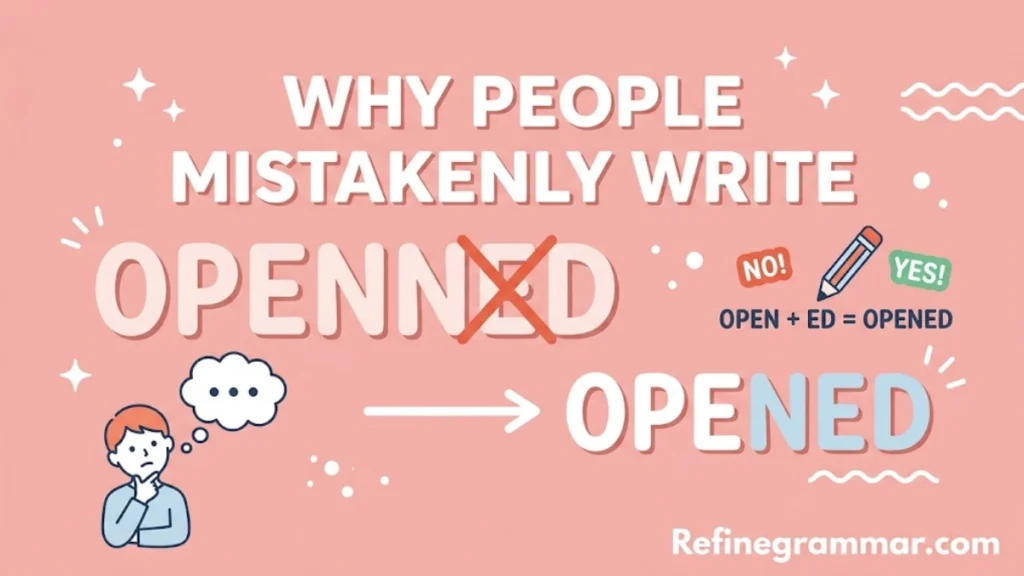
The openned or opened mix-up isn’t random; it follows a logical, if mistaken, assumption. English does have a real rule where some one-syllable verbs double their final consonant before adding -ed think stop → stopped, plan → planned, or drop → dropped. Because open ends in a single vowel followed by “n,” writers sometimes assume the same doubling rule applies.
It doesn’t. The doubling rule only applies when the stress falls on the final syllable of the word. Open is pronounced OH-pen, with the stress on the first syllable, so the “n” is never doubled. This is the same underlying logic that keeps other frequently confused pairs straight, such as sponsor vs sponser, where a single misplaced letter changes a word’s correctness rather than its tense.
Autocorrect fatigue, fast typing, and muscle memory from words like “planned” all contribute to why openned or opened remains one of the more frequently searched spelling questions in English.
Simple Rule to Remember
Here’s the rule in one line: if the stress isn’t on the last syllable, don’t double the final consonant. Open → opened, not openned.
Is opened a verb? Yes it’s the simple past tense and past participle form of the verb “open,” and it follows the regular -ed pattern used by thousands of English verbs.
Knowing when to use open and opened comes down to timing:
- Use open to describe a current state or a command The store is open. Please open the window.
- Use opened to describe a completed past action The store opened at nine. She opened the window an hour ago.
Keep this trick in mind: open + ed = opened. No extra letters, no exceptions.
Comparison Table: Openned vs Opened
This open vs opened grammar comparison makes the difference between open and opened easy to see at a glance, and it settles the openned or opened grammar question for good:
| Feature | Opened (Correct) | Openned (Incorrect) |
| Spelling status | Standard, dictionary-recognized | Misspelling, found in no dictionary |
| Grammar role | Past tense / past participle of “open” | Not a recognized word |
| Usage in writing | Acceptable in all writing types | Always an error |
| American English | Correct | Incorrect |
| British English | Correct | Incorrect |
| Example sentence | She opened the box. | She openned the box. ❌ |
Examples in Sentences
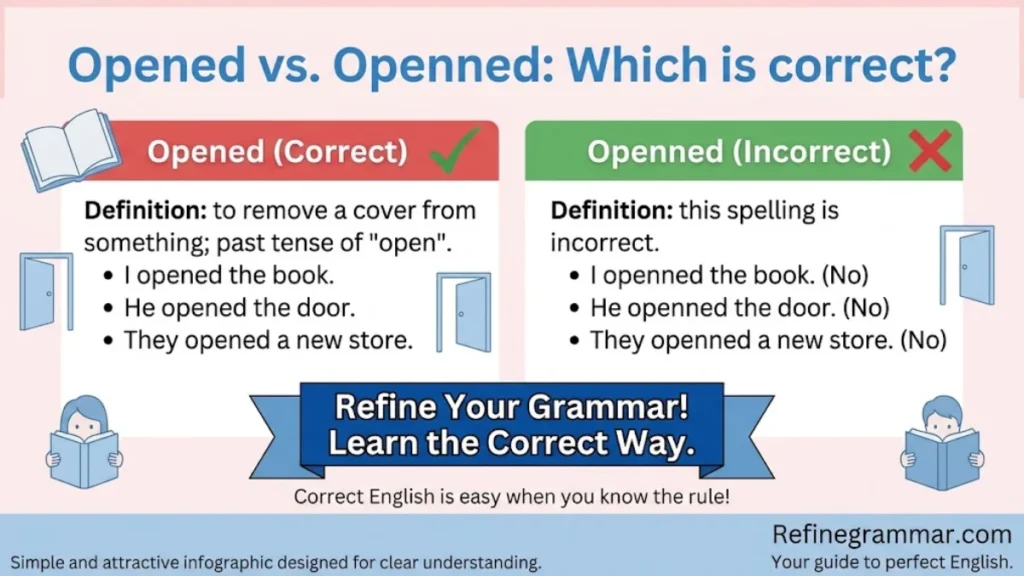
Seeing opened in a sentence across different settings makes the rule easier to remember. Here’s how it works in real, everyday contexts and how the incorrect openned or opened spelling sneaks in when people aren’t paying attention.
Daily conversation
In everyday speech, you’ll hear both open and opened depending on the sentence. “The store is open” describes the current state, while “the store opened at nine” describes a completed action.
If you’re wondering whether to say the store is open or opened, the answer depends on whether you mean right now (open) or a finished action (opened). Casual texting is also where quick-typing slips happen, like typing togather instead of together a mistake driven by the same rushed-typing habit as openned or opened.
Professional writing
In business emails and reports, accuracy matters. “I opened your proposal this morning and have a few questions” reads as professional and clear. Can you make a sentence using the word opened?
Absolutely: “The company opened three new offices last quarter.” Just as writers should double-check words like manual, not manuel in formal documents, they should proofread for openned or opened before hitting send.
Read More: Acception vs Exception: Which One Is Actually Correct? (2026)
Academic writing
Academic papers demand precision, and a stray openned or opened mistake can distract from otherwise strong research. “The study opened new avenues for investigation” is a common academic phrasing. Students also frequently mix up submission and the incorrect submittion in formal reports both are small spelling errors that can quietly undercut credibility.
Digital communication
Online, speed often wins over accuracy, which is why is opened or openned shows up so often in comments, forums, and social captions. Autocorrect usually catches it, but not always especially on mobile keyboards. The same goes for tech-related mix-ups like encode versus incode, where a single letter changes the entire meaning of a word.
Common Mistakes to Avoid
Beyond the openned or opened spelling error itself, a few related mistakes are worth flagging:
- Doubling the “n” unnecessarily openned instead of opened
- Dropping the “e” before adding -ed opend instead of opened
- Confusing open and opened in the wrong tense
- Assuming British and American English spell this word differently (they don’t)
Why is opening not openning? The same rule applies here because the stress in “open” sits on the first syllable, the present participle also keeps a single “n”: opening, not openning. This mirrors other easily confused pairs, like incorporate, not encorporate or ladle, not ladel, where writers add or misplace letters out of habit rather than following the actual rule.
American vs British English Differences
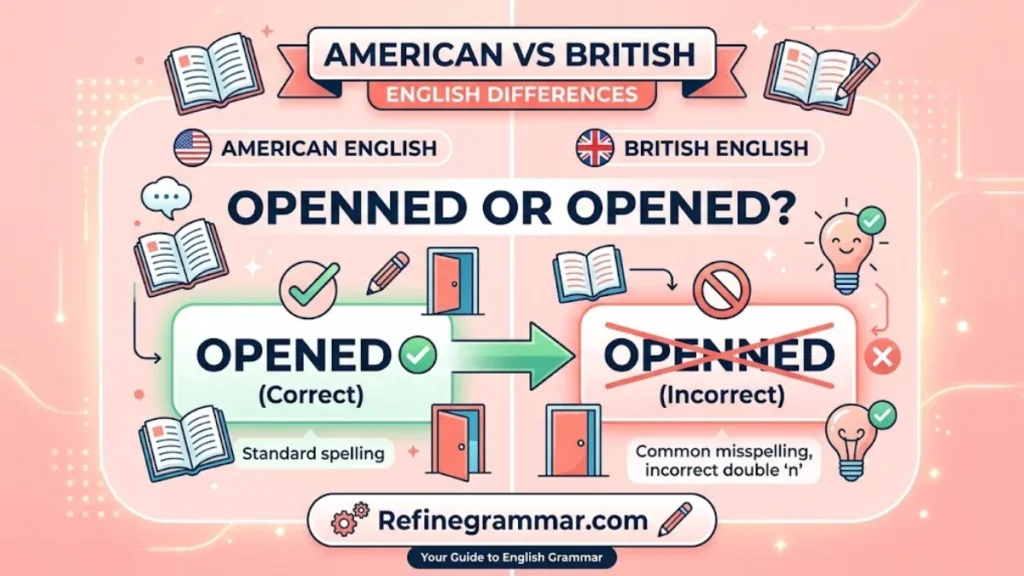
Unlike words such as colour/color or travelled/traveled, opened doesn’t change between American and British English. Both varieties use the same single-n spelling, so there’s no regional exception to memorize.
That said, English does have real US/UK spelling differences elsewhere such as targeted versus targetted, where American English typically keeps one “t” and British style guides sometimes double it. Openned or opened isn’t one of those cases; it’s simply incorrect everywhere, in every variety of English.
Related Forms of “Open”
Understanding the full verb family reinforces why opened is the only correct past form:
- Base form: open
- Present participle: opening
- Past tense: opened
- Past participle: opened
- Opened as an adjective: used descriptively, as in “an opened package” or “a newly opened store”
What is the past tense of open? It’s opened every time, in every context, with a single “n.”
Synonyms for “Opened”
Looking for variety in your writing? These synonyms can replace opened depending on context:
- Unlocked
- Unfastened
- Launched
- Initiated
- Revealed
- Unveiled
For example, instead of “She opened the meeting,” you could write “She launched the meeting” or “She initiated the discussion.” As with any word choice, precision matters much like knowing the difference between an acception and the correct exception, picking the right synonym keeps your writing accurate and polished.
There isn’t a separate open or opened adjective form beyond what’s listed above; opened simply doubles as both verb and adjective depending on sentence structure.
Read More: It’s Called vs It Called: Which Is Correct? (Quick Guide)
Mini Spelling Test (Try Yourself)
Test yourself with these five quick sentences. Choose opened or openned for each:
1. She ___ the window this morning.
2. The shop ___ its doors at 10 a.m.
3. He ___ the email and replied instantly.
4. They ___ a new restaurant last month.
5. The book ___ to the exact page she needed.
Answer key: all five correct answers are opened. If you’d like more practice with tricky words, similar exercises exist for pairs like scarey versus the correct scary, which follow their own separate spelling logic but trip people up for the same reason habit outweighing rule.
Why Correct Spelling Matters
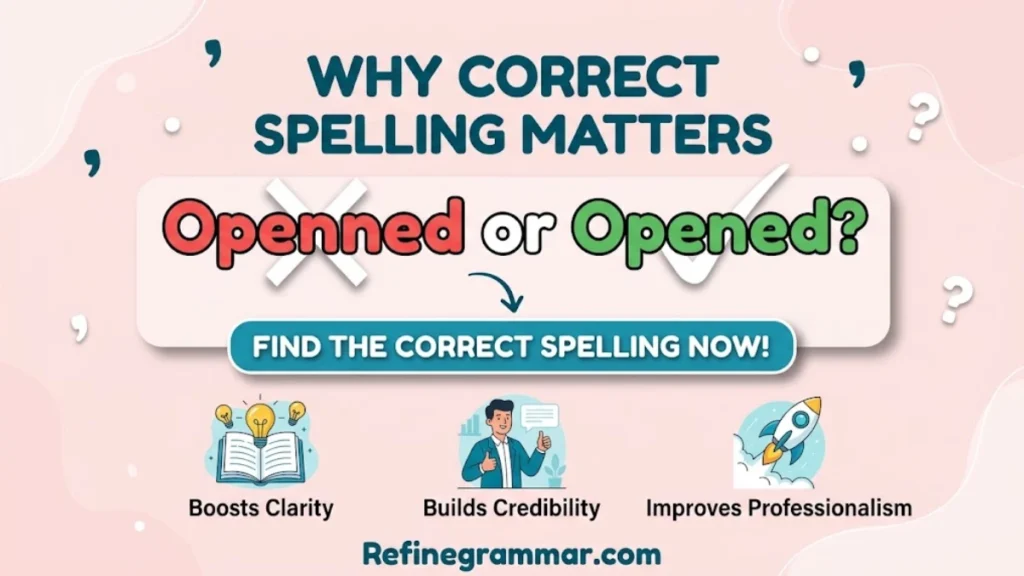
A single typo like openned or opened might seem minor, but small errors add up in how readers judge your writing. In resumes, client emails, and published content, spelling mistakes can suggest carelessness even when the underlying message is solid.
Just as writing grately instead of greatly can undercut an otherwise polished sentence, using openned instead of opened chips away at credibility. Clear, correct spelling builds trust and trust is central to good communication, whether you’re writing a school essay or a company newsletter.
FAQs
Which is correct, opened or openned?
Opened is correct; openned is a misspelling not found in any English dictionary.
What is correct, open or opened?
It depends on tense open describes a current state, while opened describes a completed action.
Does the word “opened” exist?
Yes, it is the standard past tense and past participle of “open.”
Is “opened” a correct grammar?
Yes, it is grammatically correct and used in every variety of English.
Which is correct: “the door is open” or “the door is opened”?
“The door is open” describes its current state; “the door is opened” describes an action being done to it.
Which is correct: “has been open” or “opened”?
“Has been open” describes the duration of a state; “has opened” describes a completed action both are correct in different contexts.
Do you say open or opened?
Say “open” for a present state or command, and “opened” for a completed past action.
What is the past tense of open?
The past tense is opened, spelled with a single “n.”
Can you make a sentence using the word “opened”?
Yes: “She opened the store early to prepare for the sale.”
Why is opening not openning?
Because the stress falls on the first syllable of “open,” the final consonant is never doubled, so it is opening, not openning.
Summary
The openned or opened question has one simple, permanent answer: opened is correct, and openned is always a mistake. The rule is easy to remember open is stressed on its first syllable, so the final “n” never doubles before adding -ed. Whether you’re writing a text, an email, an essay, or a business report, sticking to opened keeps your writing accurate and professional. And if you want to reinforce your grammar skills instead of “reenforce” them, bookmarking guides like this one is a great place to start.
