
If you’ve ever paused mid-sentence wondering whether to write “unselect” or “deselect,” you’re not alone. Both words describe the same everyday action — reversing a choice you already made, whether that’s a checkbox, a highlighted file, or a block of text. The unselect or deselect debate shows up constantly in software manuals, UX copy, and casual writing, and the confusion is understandable because both words look equally plausible. This guide settles the unselect or deselect question with dictionary evidence, real product examples, and practical guidance you can apply immediately in your own writing or design work.
Straight Answer Up Front
“Deselect” is the correct, standard, and dictionary-recognized term. “Unselect” is understood and occasionally used in casual or space-limited interfaces, but it is not the preferred form in professional, technical, or formal writing. Whenever you’re stuck on unselect or deselect, default to deselect.
Which Is Correct: Unselect or Deselect?
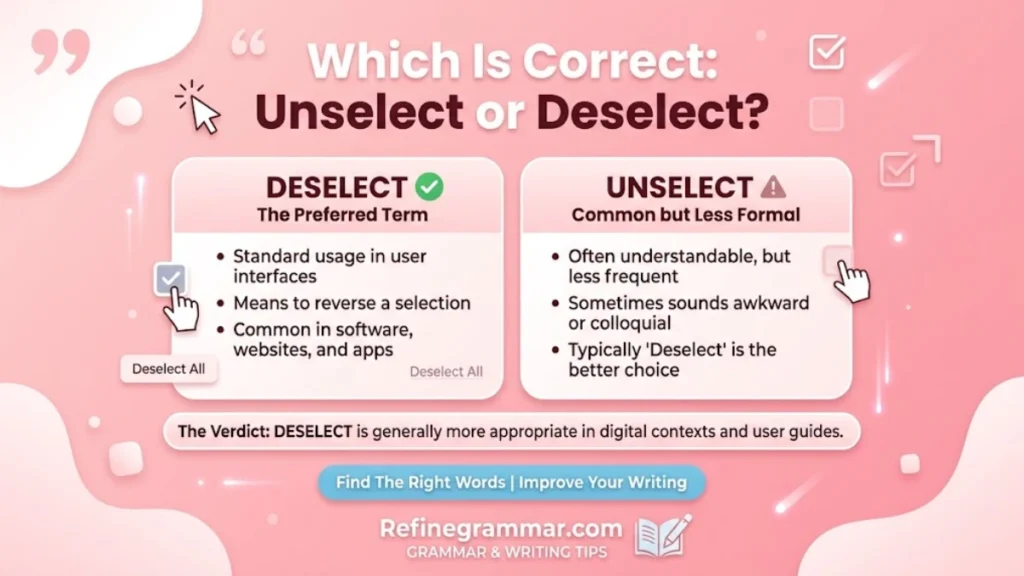
When people search for unselect or deselect, they’re usually trying to settle a real disagreement — often inside a style guide meeting or a code review. Deselect uses the prefix “de-,” which linguistically means “to reverse or undo,” matching words like deactivate or decode. Unselect uses “un-,” which typically means “not” rather than “reverse.” That subtle mismatch is part of why grammar authorities and major style guides lean firmly toward deselect as the technically accurate choice.
Clear Definitions That Don’t Hide Behind Jargon
What “Deselect” Means
Deselect is a verb meaning to remove the selected status from an item, option, or element that was previously chosen. Clicking a highlighted file a second time to remove the highlight is a textbook example of deselecting.
What “Unselect” Means
Unselect carries the same practical meaning — undoing a selection — but it developed informally, largely through spoken habit and casual software copy rather than through recognized grammatical rules. It behaves less like an established word and more like a word English speakers expect to exist because “un-” attaches so easily to other verbs.
Unselected or Deselect: Which Form Is Correct?
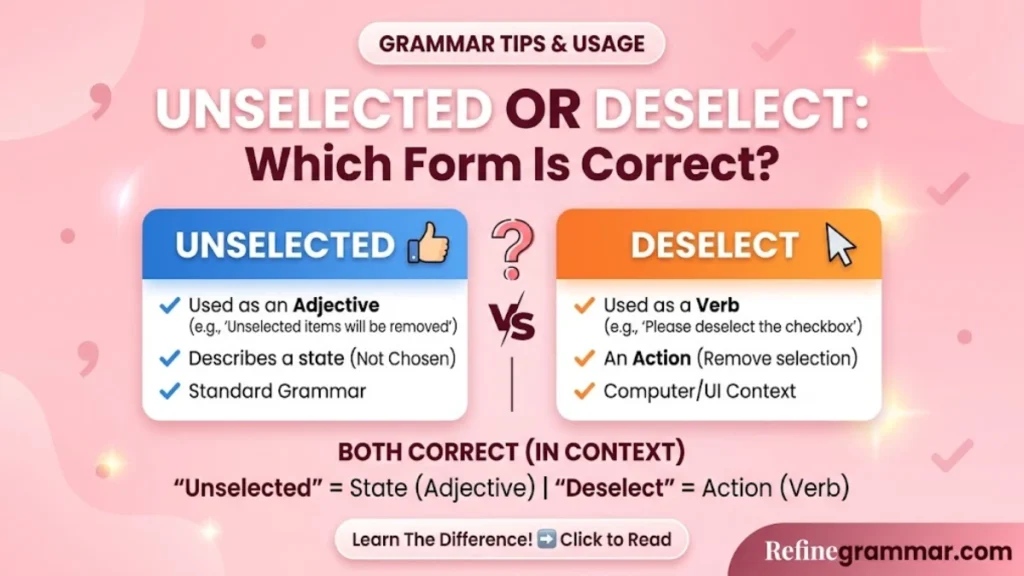
As an adjective, “unselected” does appear in everyday writing to describe an item that was never chosen or has since been removed from a selection — for example, “the unselected rows remained hidden.” But as an action verb, deselect remains the stronger, formally recognized choice. This mirrors other spelling patterns where one variant edges out another over time, similar to how scarey vs scary or manuel vs manual eventually settle into a single accepted form despite both spellings circulating in casual use.
Why Both Words Exist at All
The Prefix Problem Explained Simply
English speakers instinctively reach for whichever prefix feels more natural in the moment. “De-” technically signals reversal, while “un-” more often signals negation or absence. The overlap between the two prefixes creates genuine ambiguity, not unlike the confusion behind pairs such as encorporate vs incorporate or encode vs incode, where a prefix swap changes how “correct” a word looks even though only one form is standard.
Spoken Language vs Written Standards
In conversation, people rarely pause to weigh unselect or deselect before speaking — both come out naturally. Written standards are stricter, though, and dictionaries, technical documentation, and style guides consistently side with deselect once a word moves from speech into formal text, much the way spoken habits also shape confusions like grately vs greatly long before anyone checks the written rule.
How Technology Quietly Rewrites Language
UI Language as a Vocabulary Engine
Software interfaces introduce and normalize thousands of small, action-based words every year. Because millions of people read the same button labels daily, UI copy has enormous influence over which informal terms eventually feel acceptable — even when dictionaries haven’t caught up yet.
Real Product Language Examples
Most major platforms, including Microsoft Office, Adobe products, and Google Workspace, favor deselect in their official documentation and style guides, even in cases where an older button or legacy tool still displays “unselect.” This inconsistency is exactly why the unselect or deselect question keeps resurfacing — users encounter both terms depending on which tool, version, or era of software they’re using.
How to Deselect or Unselect in Excel, Photoshop, and AutoCAD
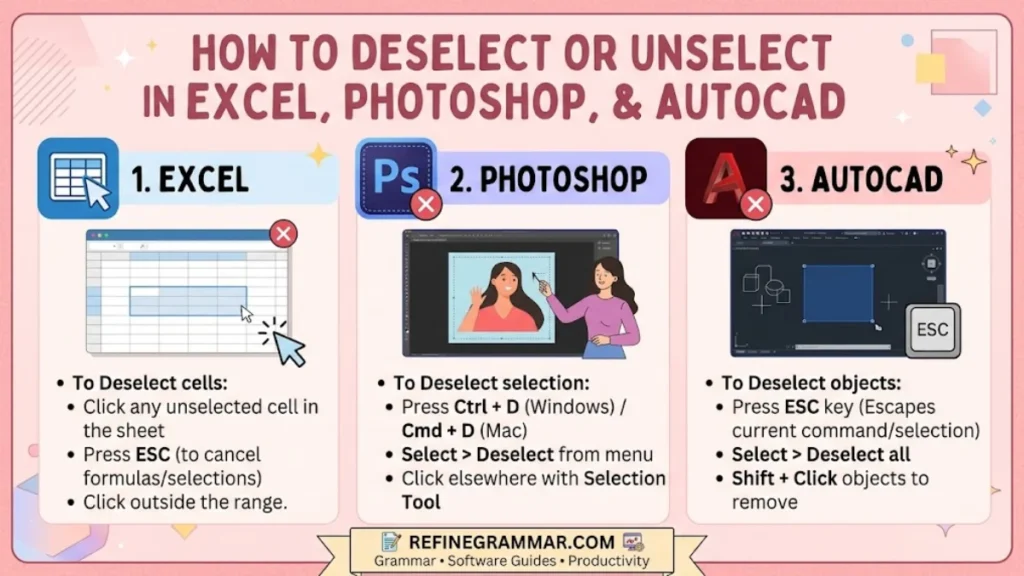
● Excel: Click any empty cell, or press Esc, to deselect a highlighted range without altering its contents.
● Photoshop: Use Select > Deselect, or the shortcut Ctrl+D (Cmd+D on Mac), to clear an active selection.
● AutoCAD: Press Esc, or click an empty area of the drawing canvas, to deselect chosen objects.
Across all three tools, the official menu language and documentation consistently use deselect, reinforcing it as the standard professional term regardless of the software category.
Keyboard Shortcut to Deselect or Unselect
| Application | Shortcut (Windows) | Shortcut (Mac) |
| Photoshop | Ctrl+D | Cmd+D |
| Illustrator | Ctrl+Shift+A | Cmd+Shift+A |
| Excel | Esc | Esc |
| AutoCAD | Esc | Esc |
| Google Docs / Sheets | Esc or click outside | Esc or click outside |
Deselect or Unselect a Checkbox: UI-Specific Usage
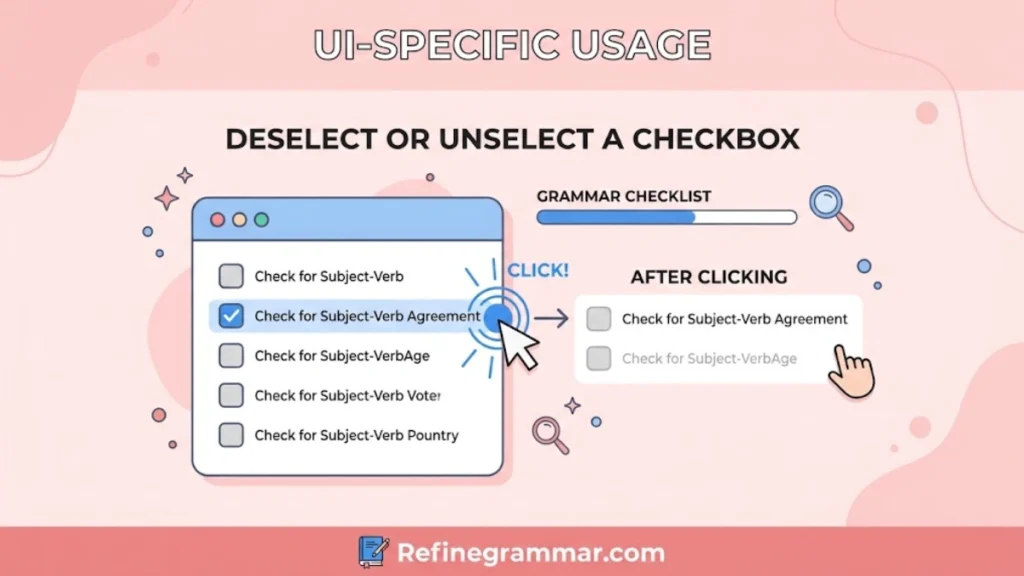
Clicking a checked checkbox a second time is universally described in professional style guides as deselecting it, not unselecting it. Design systems from major tech companies specifically instruct writers to use deselect for this exact interaction, since it reads as more precise and predictable for end users scanning instructions quickly.
Deselect All: Clearing Multiple Selections at Once
“Deselect All” is the standard label for clearing every active selection in a list, gallery, or spreadsheet in one action. It differs from simply never selecting anything, because it actively reverses a prior batch selection rather than describing an empty default state. Usability testing consistently shows users recognize “Deselect All” faster than “Unselect All,” which is one more reason deselect wins the unselect or deselect debate in interface design specifically.
What Dictionaries and Data Actually Say
Dictionary Coverage
Deselect appears in major dictionaries as a recognized standard verb. Unselect, by contrast, is largely absent from primary dictionary entries or listed only as a secondary, informal variant, which is a strong signal for anyone still weighing unselect or deselect in formal writing.
Corpus and Usage Trends
Large text corpora tracking published English consistently show deselect appearing far more often in technical writing, journalism, and official documentation, while unselect clusters more heavily in casual forums and spoken transcripts. That usage gap has held steady for years, much like other lasting spelling divides seen in pairs such as togather vs together or acception vs exception, where one form dominates edited text despite the other persisting informally.
Synonyms for Unselect and Deselect
● Clear selection
● Remove selection
● Unmark
● Uncheck
● Cancel selection
UX Writing and Product Design Standards
Industry Style Guides and Design Systems
Established design systems, including guidance echoed in the Microsoft Writing Style Guide, direct writers toward deselect for clearing checkboxes, radio buttons, and multi-select lists. Consistency here matters just as much as it does in fixing recurring spelling slips like submission vs submittion or ladle vs ladel, where one small inconsistency can quietly undermine a document’s credibility.
Accessibility and Clarity Concerns
Screen readers and accessibility tools rely on predictable, standardized action words. Because deselect is more consistently documented, it also tends to pair more reliably with clear ARIA labels and voice-navigation cues, reducing ambiguity for users who depend on assistive technology — the same predictability that style editors chase when standardizing phrasing questions like it’s called vs it called across a site’s content.
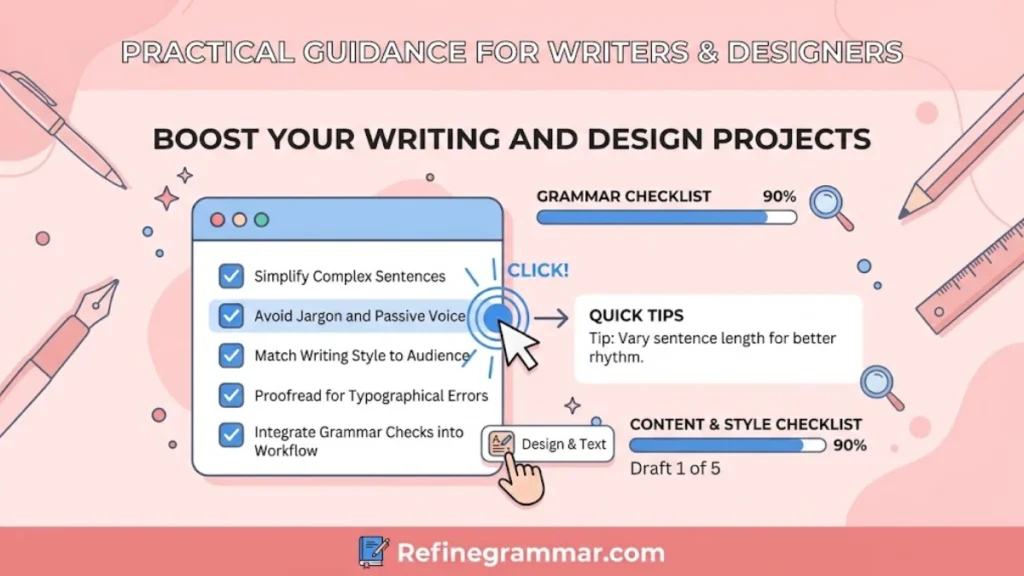
Practical Guidance for Writers and Designers
When to Use “Deselect” Without Question
Use deselect in technical documentation, UI copy, formal business writing, help articles, and anywhere consistency with established software standards matters — the same standard-first mindset that resolves debates like sponsor vs sponser or reinforce or reenforce in favor of the dictionary-backed spelling.
When “Unselect” Might Appear (But Should Be Reconsidered)
Unselect sometimes survives in tight button labels, internal tools, or legacy codebases where changing the term isn’t worth the engineering effort. Even then, it’s worth flagging for a future update, the same way small, ingrained mistakes like openned or opened or targeted vs targetted tend to linger in old content until someone deliberately audits and corrects them.
UX Microcopy Examples That Work
| Weak Microcopy | Stronger Microcopy |
| Unselect this item to remove it from your cart. | Deselect this item to remove it from your cart. |
| Tap again to unselect all filters. | Tap again to deselect all filters. |
| Unselect the checkbox to opt out. | Deselect the checkbox to opt out. |
Quick UX Writer Reference Table
| Term | Status | Best Use Case |
| Deselect | Standard / Preferred | UI copy, documentation, formal writing |
| Unselect | Informal / Discouraged | Casual speech, internal notes, legacy tools |
| Unselected | Standard adjective | Describing items not chosen |
The bottom line on unselect or deselect is simple: reach for deselect whenever your writing needs to look polished, consistent, and professionally reviewed. Reserve unselect only for the rare casual moment where formality genuinely doesn’t matter, and even then, know that switching to deselect will never read as wrong.
Read More: Really vs Realy: The Clear Grammar Answer & Proper Usage
FAQs
1. Is it “unselect” or “deselect”? Which one is correct? — “Deselect” is correct and standard; “unselect” is informal.
2. Do native English speakers say “unselect” or “deselect”? — Many say both in speech, but writing consistently favors deselect.
3. Is “unselect” actually a real word? — Yes, it’s understood, but it’s rarely listed as a primary dictionary entry.
4. What is the opposite of “select” — unselect or deselect? — Deselect is the recognized opposite of select in formal usage.
5. What is a synonym for “unselect”? — Clear selection, remove selection, or uncheck all work well.
6. What is the keyboard shortcut to deselect or unselect an item? — It varies by app; Ctrl+D (Cmd+D) or Esc are the most common.
7. How do you deselect or unselect a checkbox? — Click the checked box again to remove its checked state.
8. How do you unselect or deselect in Excel and Photoshop? — Press Esc in Excel, or use Select > Deselect (Ctrl/Cmd+D) in Photoshop.
9. What does “deselect all” mean, and how is it different from selecting none? — It actively clears an existing multi-selection rather than describing an empty starting state.
10. How do you deselect selected text? — Click anywhere outside the highlighted text or press an arrow key.
Conclusion
The unselect or deselect debate has one clear winner: deselect is the dictionary-backed, professionally standard term, while unselect remains a casual, informal stand-in. Major style guides and leading software platforms consistently favor deselect for checkboxes, multi-select lists, and any UI action reversing a prior choice. When polish and consistency matter, always choose deselect.
