
You’re typing a sentence about strengthening a wall, a habit, or an argument, and your fingers pause. Is it reinforce or reenforce?
Go with reinforce. It’s the standard spelling in American and British English, and dictionaries list it first. Reenforce does exist, but only as a rare variant.
The mix-up behind reinforce or reenforce isn’t random, though. Words like reenter and reelect take a double e, so reenforce feels logical. Similar traps show up in pairs like nosey vs nosy and habbit vs habit.
Below, you’ll find the meanings, examples, a comparison table, and a memory trick.
Quick Answer
Reinforce is the correct spelling. Reenforce is a rare variant that most editors treat as an error. Dictionaries list reinforce as the standard form, and readers expect it. Example: “The crew will reinforce the wall.” When you weigh reinforce or reenforce, pick reinforce.
Meaning of Reinforce vs Reenforce
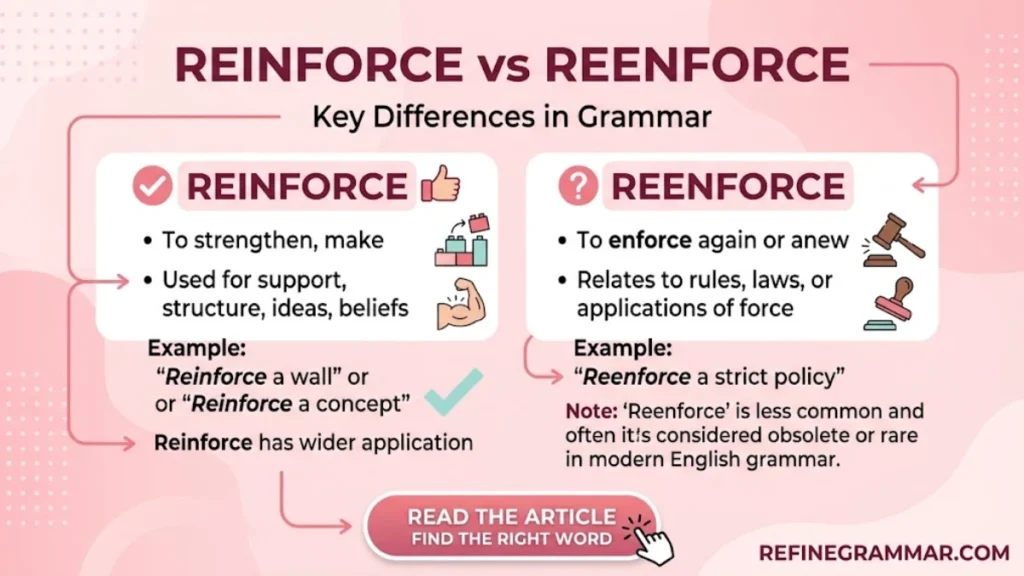
Before settling the reinforce or reenforce debate for good, it helps to understand what the word actually means and why one spelling has survived while the other hasn’t. English absorbed the word from French centuries ago, and the spelling that stuck through generations of dictionaries, textbooks, and style manuals is the one we still use today.
Reinforce
Reinforce is a verb meaning to strengthen, support, or make something more solid or effective. It applies to physical structures, arguments, habits, relationships, and even military forces. Steel bars reinforce concrete, evidence reinforces an argument, and praise reinforces good behavior.
Reenforce
Reenforce is simply a nonstandard spelling of reinforce. It appears when writers assume the prefix “re-” should be bolted directly onto “enforce,” but that isn’t how the word was actually formed. No dictionary lists reenforce as a standard entry, so whenever the choice is reinforce or reenforce, every dictionary sides firmly with reinforce.
Is Reenforce a Word?
Technically, reenforce is not a recognized word in current English. It doesn’t appear as a standard headword in Merriam-Webster, Cambridge Dictionary, or Oxford Learner’s Dictionaries. A few older texts used it centuries ago, but modern usage has settled the reinforce or reenforce question firmly in favor of reinforce across every English-speaking region.
Why Reinforce Is the Preferred Spelling
The word traces back to Old French renforcer, combining “re-” (again) with “enforcer” (to strengthen), which itself comes from the Latin fortis, meaning strong. Over centuries of use, English settled on the spelling reinforce, and that etymology is exactly why the reinforce or reenforce question has only one correct answer today.
- Every major dictionary lists only “reinforce” as the standard entry
- Spell-checkers and grammar tools flag “reenforce” as an error
- Academic style guides, including Chicago and APA, use “reinforce” exclusively
- Search engines and editors treat “reenforce” as a typo, not a valid variant
Mix-ups like this aren’t unique to reinforce. Writers run into the same kind of confusion with word pairs such as career or carrer, emersion or immersion, and manuel or manual, where one spelling looks plausible but only one is actually correct.
Reinforce vs Re-Enforce: What’s the Difference?

Some writers wonder if “re-enforce” with a hyphen is acceptable, since it visually separates the prefix from “enforce.” In practice, re-enforce is rare and only makes sense in a narrow legal or procedural context, such as re-enforcing a rule that had lapsed. Outside that specific case, the standard answer to reinforce or reenforce, hyphenated or not, remains reinforce.
Comparison Table: Reinforce vs Reenforce
Here’s a quick side-by-side breakdown of reinforce or reenforce so you can see exactly why one spelling wins every time.
| Feature | Reinforce | Reenforce |
| Status | Correct, standard spelling | Incorrect / archaic |
| Dictionary listing | Listed in all major dictionaries | Not listed as standard |
| Origin | Old French renforcer | Mistaken re- + enforce blend |
| US English | Preferred | Avoid |
| UK English | Preferred | Avoid |
| Formal/academic use | Always correct | Flagged as an error |
Common Mistakes Writers Make
Even confident writers slip up with reinforce or reenforce, usually for predictable reasons:
- Assuming “re-” attaches directly to “enforce” instead of learning the word’s real origin
- Relying on autocorrect, which doesn’t always catch the error in every browser or app
- Confusing the spelling with unrelated but similarly tricky pairs like sponser or sponsor or encode or incode
- Typing quickly and creating typos similar to togather or together or submission or submittion, where an extra or missing letter changes the whole word
The fix is the same every time: pause, remember the rule, and default to reinforce. Reading your sentence back out loud, or running it through a grammar checker before publishing, catches most of these slips before readers ever see them.
American vs British English Differences
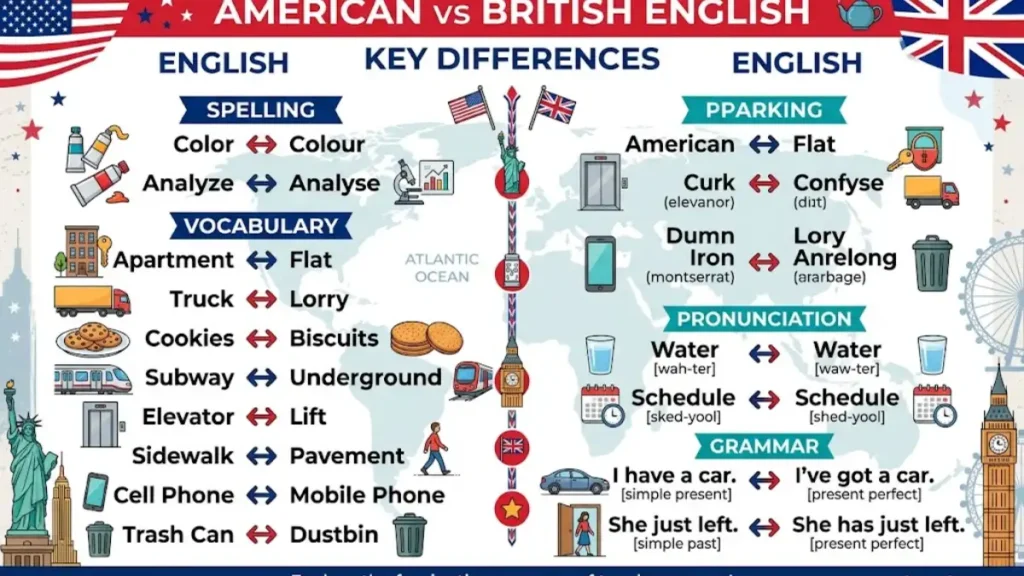
Reinforce or reenforce: does region matter?
No. Reinforce is the standard form in both the United States and the United Kingdom. Dictionary entries don’t tie reenforce to either country. So you can’t call it “the British spelling” or “the American spelling.” It’s just a rare variant. Writing for a US or UK reader? The answer is the same, and so is the pronunciation.
Real transatlantic splits do exist elsewhere. Compare customize or customise and learned or learnt. Those pairs follow regional habits. Reinforce doesn’t.
When to Use Reinforce (Real-Life Contexts)
Understanding when to use reinforce or reenforce (in practice, always reinforce) becomes easier once you see it applied across different fields:
Construction and engineering: “Workers reinforced the foundation before the storm.”
Education: “The teacher reinforced the lesson with extra practice problems.”
Psychology and habits: “Positive feedback reinforces good behavior over time.”
Military and security: “Additional troops were sent to reinforce the base.”
Relationships and communication: “Consistent actions reinforce trust between partners.”
Notice that in every one of these contexts, the meaning stays consistent even though the subject matter changes completely, which is exactly why reinforce is such a versatile, high-frequency verb in everyday and professional English alike.
Read More: Targeted vs Targetted: The Correct Spelling Explained
Synonyms of Reinforce (LSI Keywords)
Using varied vocabulary keeps writing natural while still supporting the same meaning as reinforce. Useful alternatives include:
Strengthen
Bolster
Support
Fortify
Solidify
Augment
Boost
These synonyms work well in the same contexts where writers might also mix up other word pairs, like grately or greatly, cocoon or cacoon, or ladle or ladel, so it’s worth double-checking spelling whenever a sentence relies on precise vocabulary.
Is It Reinforcement or Reenforcement?
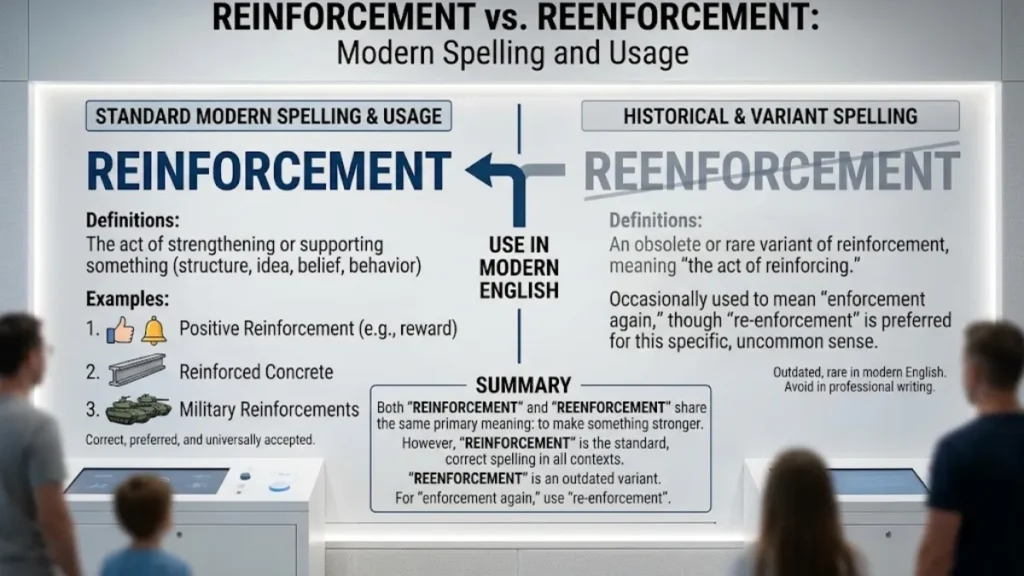
The same reinforce or reenforce logic applies directly to the noun form: reinforcement is correct, and reenforcement is not a standard word. Reinforcement refers to the act or process of strengthening something, whether that’s a physical structure, an argument, or a learned behavior.
Memory Trick to Avoid Confusion
The easiest way to lock in reinforce or reenforce for good is to remember one image: think of “rein,” as in the reins used to guide a strong horse, or as in “reindeer,” a strong and resilient animal. If you can picture “rein” at the start of the word, you’ll never write reenforce again. It’s a small trick, similar to remembering the difference between dysregulated or disregulated or scarey or scary, where one memorable detail anchors the correct spelling permanently.
Example Sentences Showing Correct Usage

These examples put the reinforce or reenforce rule into action across everyday writing:
- The new evidence reinforced the lawyer’s argument.
- Engineers reinforced the bridge with steel cables.
- Her calm response reinforced everyone’s confidence in the plan.
- Regular practice reinforces memory and skill retention.
- The company reinforced its cybersecurity after the breach.
- Just as writers double-check encorporate or incorporate or meating or meeting before hitting send, it pays to double-check reinforce before publishing any formal document.
FAQs
Why is reinforce spelled with an “i” and not reenforce?
Because the word comes from Old French renforcer, not from adding “re-” to “enforce.” That origin settles reinforce or reenforce in favor of the “i” spelling.
What does “reinforce” mean?
It means to strengthen, support, or make something more solid, whether physically, emotionally, or structurally.
What is another word for “reinforce”?
Common synonyms include strengthen, bolster, support, fortify, and boost.
How do you spell “reinforce” correctly?
R-E-I-N-F-O-R-C-E. Remember “rein” comes first, just like in “reindeer.”
What is the opposite of reinforce?
Antonyms include weaken, undermine, and destabilize.
What does it mean to “reinforce each other”?
It means two things mutually strengthen or support one another, such as ideas, habits, or relationships.
What is an example of reinforce in a sentence?
“Steel beams reinforce the building’s frame during earthquakes.”
Is “reinforce” or “reenforce” the correct spelling in the UK?
Reinforce is correct in UK English too; reinforce or reenforce is not a regional difference, since reenforce is never standard.
What is a better word for reinforce?
Depending on context, “strengthen” or “fortify” can work as a strong alternative.
What do you mean by reinforce?
It means adding support, strength, or emphasis to something that already exists.
Summary
Reinforce or reenforce? Reinforce wins every time. It’s the standard spelling in major dictionaries. Reenforce survives only as a rare variant. The hyphenated re-enforce means “enforce again.”
Here’s a quick check before you hit send: reinforce has an “in” in the middle. Say the word slowly, hear the “in,” and type it that way. That habit keeps the double-e trap away from every draft you write.
