
If you have paused mid-sentence wondering whether to write “dought” or “doubt”, you’re not alone. The Dought vs Doubt question is one of the most common spelling mix-ups in English, and it comes down to one silent letter. Here’s the correct spelling, meaning, pronunciation, and usage explained simply.
Dought vs Doubt
The short answer to the Dought vs Doubt debate is simple: “doubt” is the only correct spelling. “Dought” is not a recognized English word in any major dictionary it is a misspelling that usually happens because the silent “b” in doubt is easy to forget and the “gh” pattern feels familiar from words like “thought” or “bought.”
Dought vs Doubt Meaning
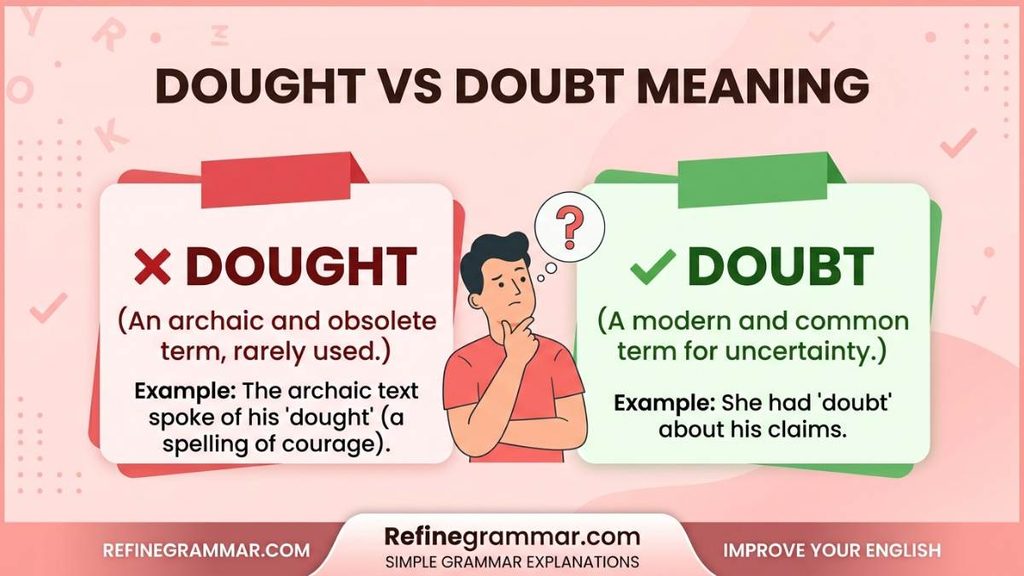
In the Dought vs Doubt comparison, only one side actually carries meaning. “Doubt” refers to a feeling of uncertainty, hesitation, or lack of full confidence in something. “Dought” has no meaning at all it is simply an incorrect spelling with no dictionary entry, no history, and no accepted usage.
What Does “Doubt” Mean?
Simple Definition of Doubt
“Doubt” is a noun or verb describing a state of being unsure about the truth, reliability, or outcome of something. It can apply to facts, people, decisions, or even your own abilities.
Examples of Doubt in Everyday English
- She had doubts about taking the new job.
- I doubt he will arrive on time.
- There is no doubt that the plan worked.
Doubt vs Doubt
Doubt works as both a noun and a verb, and this dual role is often where real confusion lies not between doubt and dought, but in how doubt behaves grammatically depending on the sentence.
Doubt as a Noun
Examples
- His doubt grew stronger after the meeting.
- There’s a shadow of doubt in her voice.
Common Synonyms
Uncertainty, skepticism, hesitation, suspicion, and misgiving.
Real-Life Example
A student might say, “I have doubt about my exam results,” meaning they feel unsure how well they performed.
Doubt as a Verb
Examples
- I doubt that the store is still open.
- She doubted his explanation.
Common Sentence Structures
The verb form usually follows patterns like “doubt + that clause” or “doubt + whether clause”, covered further in the grammar section below.
Is “Dought” a Real Word?
No. In the Dought vs Doubt debate, “dought” is not listed in Merriam-Webster, Cambridge, or Oxford dictionaries. It appears only as a typo or phonetic guess, never as a standard word.
Why People Write “Dought” Instead of “Doubt”
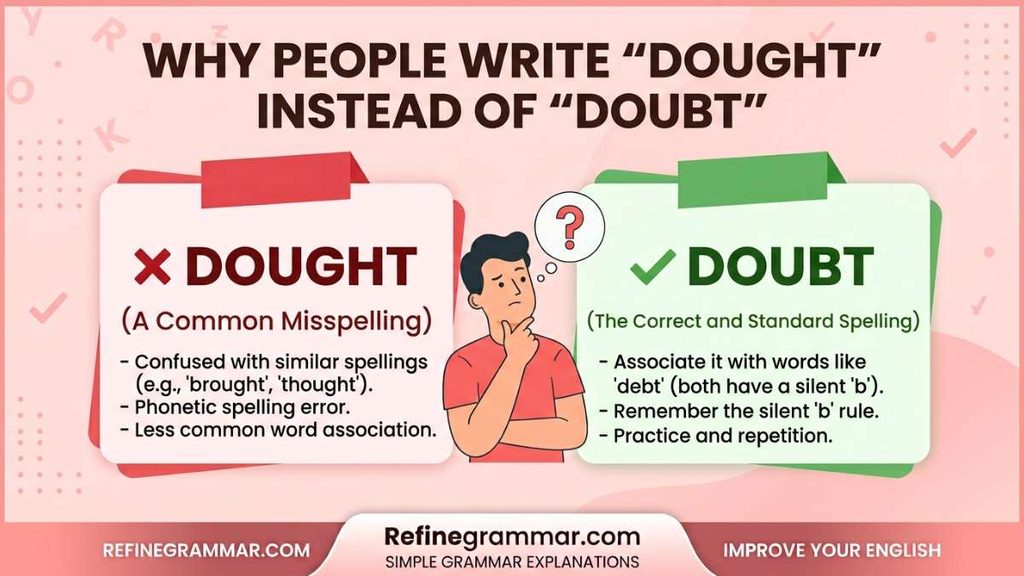
The mistake happens because the “gh” pattern in “thought,” “bought,” and “fought” trains the eye to expect something similar, so writers instinctively swap the silent “b” for “gh.”
Other Reasons for the Mistake
Autocorrect slips, fast typing, and unfamiliarity with silent letters all play a part. English is full of similar traps the career vs carrer spelling mix-up mix-up, the cocoon or cacoon spelling debate, and even the as well or aswell usage rules all stem from the same phonetic guesswork.
Historical Background of the Word “Doubt”
“Doubt” comes from the Old French “doute” and Latin “dubitare,” meaning “to waver.” The silent “b” was added later to reflect the Latin root visually, even though it was never pronounced in English.
Dought vs Doubt: Side-by-Side Comparison
| Feature | Dought | Doubt |
| Correct spelling | No | Yes |
| Dictionary entry | None | Yes |
| Meaning | None | Uncertainty or hesitation |
| Pronunciation | N/A | /daʊt/ (silent B) |
| Common usage | Typo only | Noun and verb |
Why Silent Letters Cause So Much Confusion
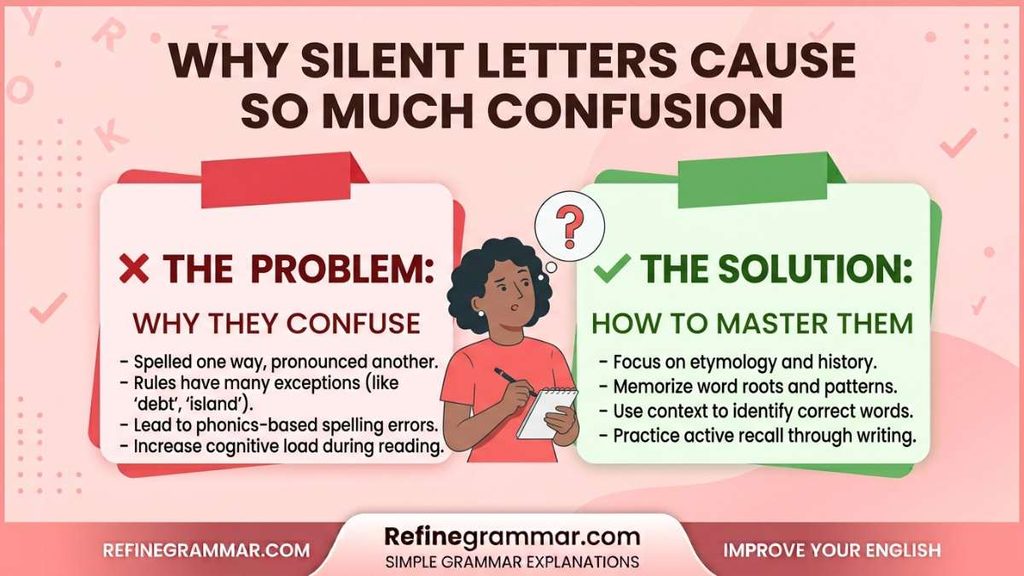
English has dozens of silent letters left from older spellings the “k” in “knee,” the “w” in “write,” and the “b” in “doubt” all survive from earlier forms of the language even though pronunciation changed.
Dought vs Doubt Pronunciation
Correct Pronunciation
“Doubt” is pronounced /daʊt/ rhyming with “out.” The “b” is completely silent.
Important Tip
If you can say the word without pronouncing the “b,” you’re saying it correctly.
Remember the Silent B Family
Doubt shares its silent-B pattern with “debt,” “subtle,” and “climb.”
Use a Visual Association
Picture the “b” hiding inside the word present in writing, silent in speech.
Create a Phrase
Try “B is Buried in Doubt” to lock in the spelling.
Common Examples of Doubt in Sentences
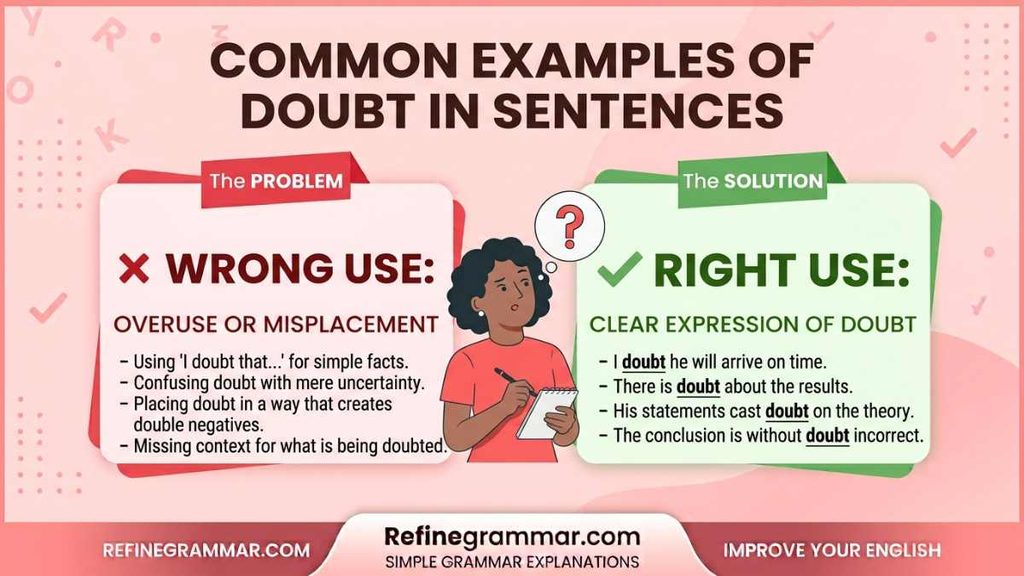
Everyday Conversation Examples
- I doubt it will rain today.
- No doubt, that was the best meal I’ve had all year.
Workplace Examples
- The manager expressed doubt about the new schedule.
- Without a doubt, this quarter’s results were strong.
Academic Examples
- The researcher had doubts about the sample size.
- Her thesis addressed common doubts in the field.
Popular Idioms and Phrases With “Doubt”
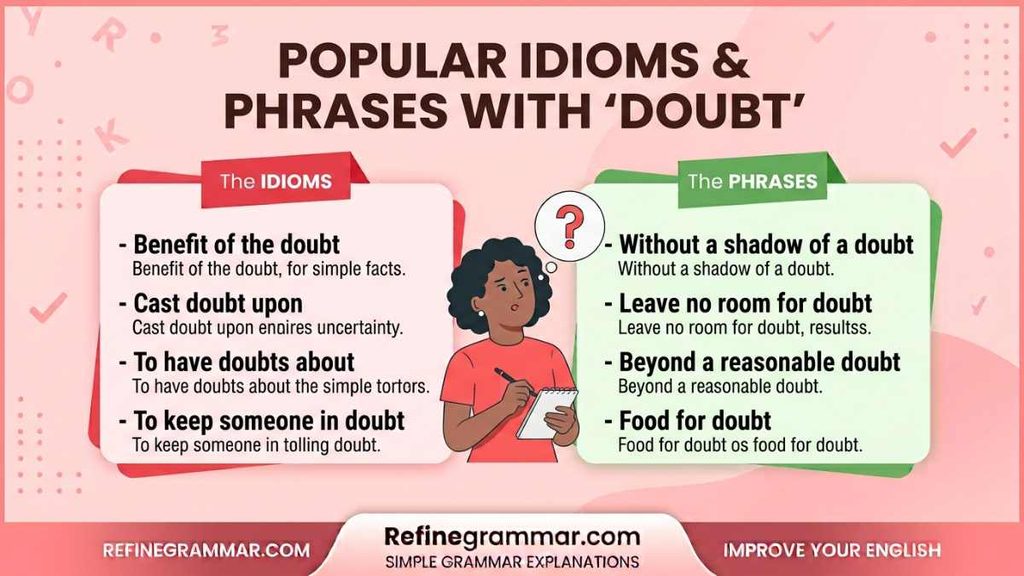
Without a Doubt
Expresses total certainty: “Without a doubt, she is the best candidate.”
Benefit of the Doubt
This answers the common “Benefit of Doubt or Benefit of the Doubt?” question the correct version always includes “the”: “benefit of the doubt.”
In Doubt
“When in doubt, ask for clarification.”
Beyond Doubt
Means something is proven or undeniable.
No Doubt About It
An emphatic way of confirming something is true.
“When in Doubt, Choose Change” – Meaning
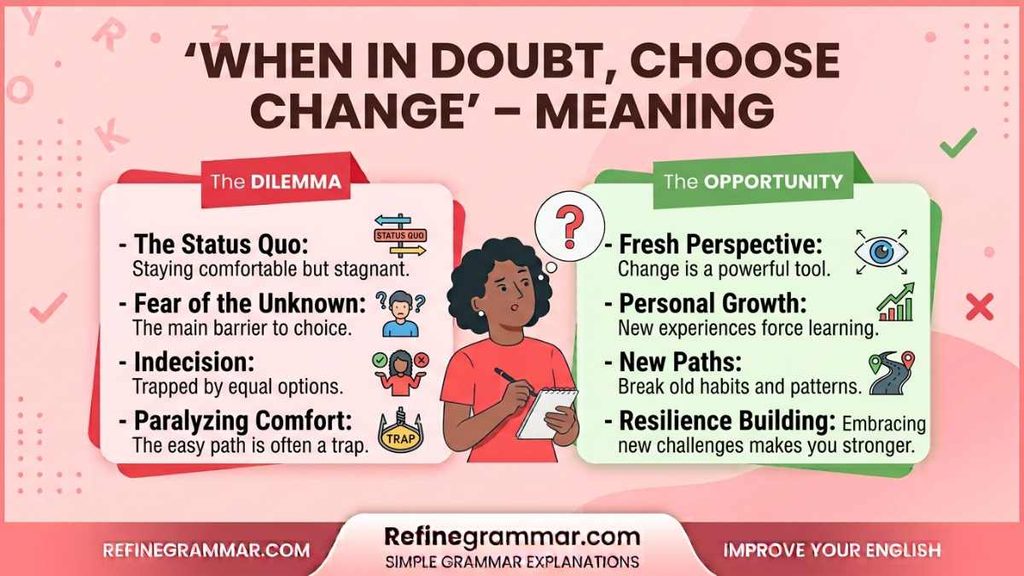
This popular saying encourages people to embrace uncertainty as an opportunity for growth rather than staying stuck out of fear. It frames doubt not as a weakness, but as a signal that change might be worth considering.
Grammar Rules for Using Doubt Correctly
Doubt That
“I doubt that he finished on time.”
Doubt Whether
“I doubt whether the plan will succeed.”
Negative Usage
“I don’t doubt that…” often means the speaker is fairly confident, which can confuse non-native speakers.
Doubt or Doubts – Which Is Correct?
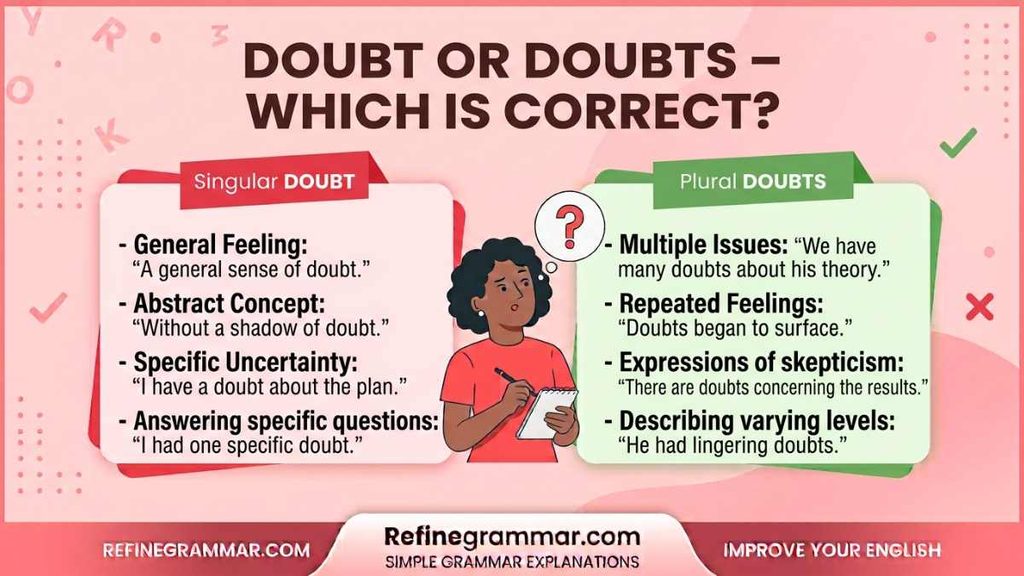
Both work depending on context: “doubt” (uncountable) for a general feeling, “doubts” (plural) for specific concerns. Most native speakers favor “doubts” in everyday use.
Words Commonly Confused With Doubt
Doubt vs Suspicion
Suspicion implies believing something bad is happening, while doubt simply means being unsure.
Doubt vs Uncertainty
Uncertainty is broader and applies to facts or outcomes; doubt carries a more personal weight.
Doubt vs Fear
Fear is an emotional response to danger; doubt is a cognitive state of questioning similar to how people mix up dysregulated vs disregulated confusion or the emersion vs immersion mix-up.
How Doubt Affects Communication
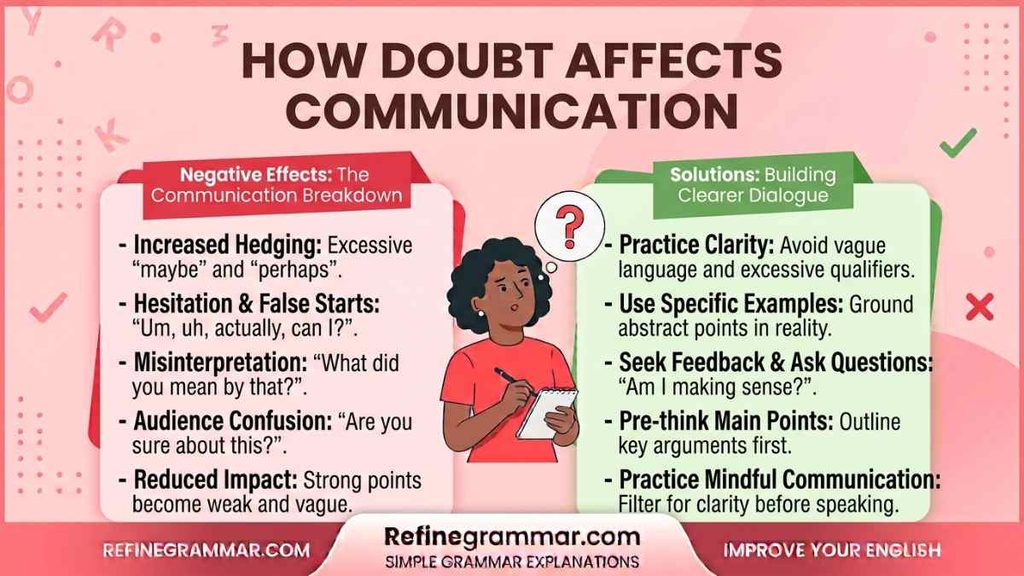
Strong Communication Balances Doubt
Healthy communication acknowledges doubt without letting it derail confidence. Leaders who admit doubt appropriately often build more trust than those who claim false certainty.
Example in Business
A manager who says, “I have some doubt about this timeline, but let’s proceed carefully,” sounds more credible than one who overpromises.
The Psychology Behind Doubt
Positive Effects of Doubt
Doubt can encourage careful thinking and prevent overconfidence.
Negative Effects of Excessive Doubt
Chronic self-doubt can lead to procrastination and missed opportunities when it becomes constant rather than occasional.
Doubt in Literature and Famous Quotes
Doubt is a recurring theme in literature and philosophy, often explored as tension between certainty and questioning, and used to build suspense or reveal a character’s inner conflict.
Common Mistakes People Make With “Doubt”
Misspelling It as “Dought”
This remains the most searched version of the Dought vs Doubt question, largely because of how the word sounds when spoken quickly.
Pronouncing the B
Some learners mistakenly pronounce the silent “b,” which sounds noticeably unnatural to native speakers.
Using Double Negatives Incorrectly
Saying “I don’t doubt that it isn’t true” creates confusing double negation and should be simplified.
Confusing It With Similar Words
Just as writers sometimes mix up meating vs meeting typo or a sponser vs sponsor spelling error, doubt is sometimes confused with related but distinct words like suspicion or hesitation.
Quick Memory Chart for Dought vs Doubt
| Trick | How It Helps |
| Rhymes with “out” | Confirms the silent B and correct vowel sound |
| “B” is Buried | Reminds you the letter B is present but unheard |
| No “gh” ending | Separates it from thought, bought, fought |
| Check the dictionary | Dought never appears in any standard dictionary |
Why Correct Spelling Matters in Writing
Professional Consequences
A misspelled word like “dought” in an email or report can undermine your credibility, even if the rest of the message is well-written.
SEO Impact
Search engines reward accurate spelling and clear intent ranking for Dought vs Doubt requires content that directly answers the confusion, not just the misspelling itself.
How Teachers and Editors View “Dought”
Academic Standards
Most teachers and editors treat “dought” as a clear spelling error and mark it down in essays, reports, and professional documents.
Real-World Case Study: How One Letter Changes Credibility
Resume A
“I have no dought about my ability to lead this team.” a single error that raises questions about attention to detail.
Resume B
“I have no doubt about my ability to lead this team.” reads as polished and professional.
Best Ways to Avoid Spelling Mistakes Like “Dought”
Read More Frequently
Regular reading builds natural familiarity with correct spelling patterns.
Use Spell Check Tools
Built-in spell checkers catch most silent-letter mistakes instantly.
Slow Down While Typing
Many “dought” errors happen simply from typing too fast.
Learn Word Families
Grouping words like doubt, debt, and subtle together the same way you might study encorporate vs incorporate mistake alongside encode vs incode difference helps the correct spelling stick.
Related Words Derived From Doubt
- Doubtful showing or feeling doubt
- Doubtless without doubt; certainly
- Undoubted not disputed
- Self-doubt lack of confidence in oneself
English is full of these small distinctions, much like grately vs greatly spelling slip, submission vs submittion spelling, and ladle vs ladel confusion.
Why English Spelling Feels So Inconsistent
English borrows heavily from Latin, French, and Germanic languages, which is why spelling rules often break down. Silent letters and irregular patterns are remnants of this mixed history exactly why ladle vs ladel confusion searches like Dought vs Doubt remain common.
Dought vs Doubt Reddit
Online discussion threads about Dought vs Doubt confirm the same answer found in dictionaries: “doubt” is correct, and “dought” is just a common typo, not an accepted variant.
Dought vs Doubt in Hindi
In Hindi, “doubt” translates to “sandeh” (संदेह) or “shanka” (शंका). “Dought” has no equivalent, since it isn’t a real English word.
Dought vs Doubt in Tagalog
In Tagalog, “doubt” translates to “pag-aalinlangan.” As with Hindi, there is no Tagalog equivalent for “dought,” since the word doesn’t exist in English either.
Dought vs Doubt Synonym
Common synonyms for doubt include uncertainty, skepticism, hesitation, and misgiving. “Dought” has no synonyms, since it isn’t a real word.
Dought in a Sentence
Because “dought” isn’t a standard word, it should never appear in a sentence correct any such sentence to use “doubt” instead.
Dought vs Doubt Examples
- Incorrect: I have no dought about this decision.
- Correct: I have no doubt about this decision.
- Incorrect: She doughted his story.
- Correct: She doubted his story.
Conclusion
The Dought vs Doubt debate has one clear winner: “doubt” is the only correct spelling, backed by dictionaries, history, and everyday usage. “Dought” is simply a common typo caused by silent-letter confusion. Once you remember that the “b” is silent and the word rhymes with “out,” you will never second-guess the spelling again.
FAQs
What is the difference between the words “doubt” and “dought”?
“Doubt” is the correct English word meaning uncertainty; “dought” is simply a common misspelling with no dictionary meaning.
What is the correct spelling of doubt?
The correct spelling is “doubt,” with a silent “b.”
Why is there a B in doubt?
The silent “b” was added to reflect the word’s Latin root “dubitare,” even though it was never pronounced.
How do you pronounce “dought”?
“Dought” isn’t a real word, so it has no official pronunciation; the correct word “doubt” is pronounced /daʊt/.
Which is correct: “doubts” or “doubt”?
Both can be correct “doubt” for a general feeling, “doubts” for specific concerns.
Is it doubt or dout?
“Doubt” is correct; “dout” is not a standard English spelling.
What does “dought” mean in English?
“Dought” has no meaning it is a misspelling of “doubt.”
What is another word for “doubt”?
Common alternatives include uncertainty, skepticism, and hesitation.
Is it right to say “I have a doubt”?
It’s understandable, but “I have doubts” or “I’m not sure” sounds more natural in standard English.
What removes doubt?
Clear evidence, confirmed facts, and honest communication are the most effective ways to remove doubt.
Final Thought
Spelling confusion between Dought vs Doubt is common, but the fix is simple once you know the rule. Remember: the “b” is silent, the word rhymes with “out,” and “dought” never belongs in your writing.
