
Many writers pause mid-sentence wondering whether to type “scary” or “scarey,” and that small hesitation is exactly why the scarey vs scary debate keeps showing up in search results. If you have ever typed a Halloween caption or a movie review and second-guessed the spelling, you are not alone. This guide settles the scarey vs scary question for good, walking through the meaning, grammar rules, regional usage, and common mistakes people make with this everyday adjective. By the end, spelling “scary” correctly will feel automatic, and you will understand exactly why “scarey” never earned a permanent place in standard English dictionaries.
FREE GRAMMAR CHECKER
Scarey vs Scary Meaning in Plain English
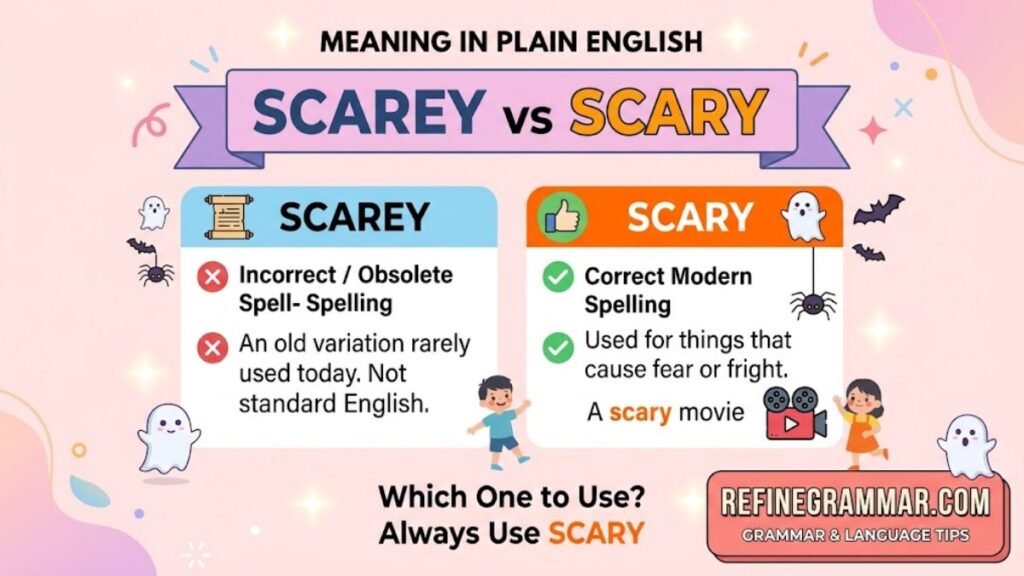
When people search for the scarey vs scary meaning, they usually want a fast, clear answer: “scary” is the only correct spelling, and “scarey” is a nonstandard variant that occasionally slips into casual writing. Both versions are pronounced identically, which is exactly why the confusion spreads so easily online. But spelling still matters for credibility, especially in blog posts, resumes, and professional emails, where a stray “scarey” can make otherwise polished writing look careless.
What Does Scary Mean? Definition, Context, and Usage
“Scary” is an adjective that describes something causing fear, alarm, or unease. It can apply to physical danger, like a scary storm, or emotional discomfort, like a scary job interview. Dictionaries define it broadly enough to cover everything from horror movies to nerve-wracking life decisions. Context shapes the intensity: a “scary movie” suggests entertainment-driven fear, while a “scary diagnosis” carries real emotional weight. Understanding this range helps you use the word precisely instead of defaulting to it as a catch-all for anything unpleasant.
Is Scarey a Word? Breaking the Myth
Technically, “scarey” is not recognized as a standard word in major dictionaries such as Merriam-Webster or Oxford Learner’s Dictionaries. Some older texts and informal word lists include it as a rare variant spelling, which is why the myth persists that it might be acceptable. In reality, it functions the same way “nite” functions next to “night” understandable, but never standard. When you’re weighing scarey vs scary for anything formal, always choose “scary.”
The Real Difference Explained
The real difference in the scarey vs scary comparison isn’t meaning both spellings, if used, would communicate the same idea of fear. The difference is purely orthographic: “scary” follows the standard English rule of dropping a silent “e” before adding a vowel suffix, while “scarey” breaks that rule. The same pattern shows up in other words, like “shine” becoming “shiny” and “ice” becoming “icy,” not “shiney” or “icey.”
Is “Scarey” a Valid Scrabble Word?
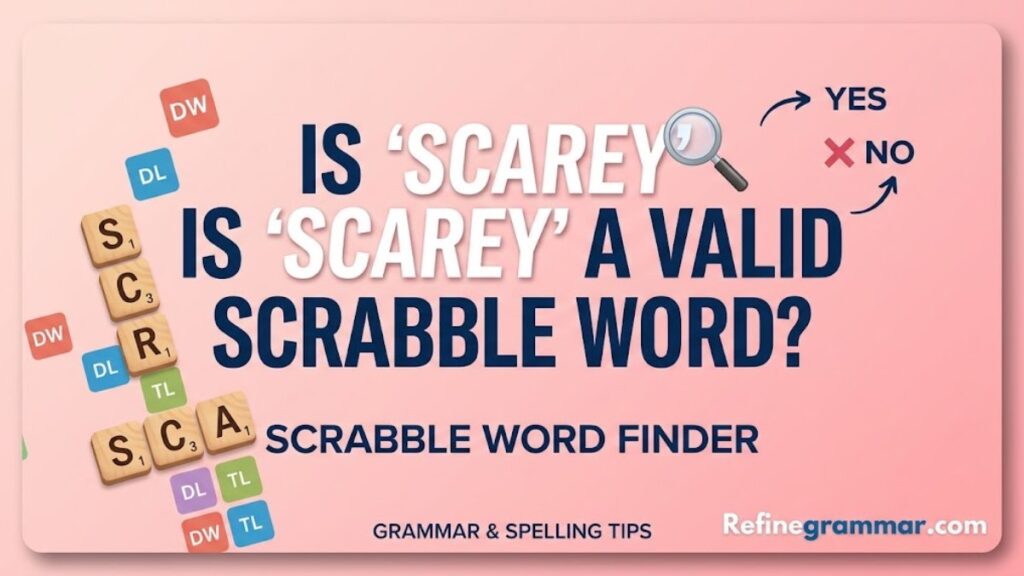
In competitive Scrabble, dictionary compliance matters. “Scarey” is not accepted in the official Tournament Word List (TWL) used across North America, nor is it valid in the Collins Scrabble Words (CSW) list used internationally. Only “scary” scores points. Players who rely on “scarey” during a match risk a challenge and losing their turn, so it’s worth memorizing this rule before your next game night.
The Grammar Behind the Correct Spelling of Scary
English spelling follows a consistent pattern when converting a root word into an adjective using the “-y” suffix: drop the silent “e” at the end of the root before adding “-y.” “Scare” becomes “scary,” just as “noise” becomes “noisy” and “grease” becomes “greasy.” Keeping the “e,” as in “scarey,” breaks this pattern and produces a spelling that looks unfamiliar to fluent readers.
Is Scary a Verb or an Adjective?
“Scary” is exclusively an adjective it describes a noun rather than expressing an action. The verb form is “scare” (“The movie will scare you”), while “scary” describes the quality that results from that action (“The movie is scary”). This distinction trips up some learners who assume any word ending in “-y” could double as a verb, but “scary” never functions that way in standard grammar.
How to Spell Scary Correctly Without Hesitation
A simple memory trick eliminates future hesitation in the scarey vs scary debate: think of the word “scar.” Both “scar” and “scary” share the same four starting letters, with no extra “e” involved. If you can spell “scar,” you can spell “scary” just add “y.” Repeating this trick a few times while proofreading builds lasting muscle memory.
Scary vs Scarey: US vs UK Usage
There is no regional exception here. American English, British English, Australian English, and Canadian English all treat “scary” as the only correct spelling. Some learners assume “scarey” might be a British variant, similar to how “colour” differs from “color,” but that assumption is incorrect. Every major English-speaking style guide agrees: scarey vs scary isn’t a regional debate it’s simply right versus wrong.
Using Scary in Real Sentences and Everyday Language
Seeing “scary” in context reinforces correct usage:
- The abandoned house looked scary at night.
- Public speaking feels scary for many people.
- That was a scary moment during the flight.
- Her scary story kept everyone quiet around the campfire.
- The scary statistics convinced them to change their habits.
Each example shows how flexible the word is it works for physical settings, emotional states, and abstract situations alike, which is part of why the scarey vs scary spelling question comes up so often in everyday writing.
Scary vs Creepy vs Spooky
These three words overlap but carry different shades of fear. The table below breaks down the distinction:
| Word | Core Meaning | Example |
| Scary | Causes fear or alarm; broad, general-purpose | A scary movie |
| Creepy | Unsettling; suggests something unnatural or unpleasant | A creepy doll |
| Spooky | Ghostly, mysterious; often playful or seasonal | A spooky legend |
Expanding Vocabulary with a Scary Synonym List
Once you’ve settled the scarey vs scary spelling question, expanding your vocabulary helps you avoid repeating “scary” too often in writing:
- Frightening
- Terrifying
- Alarming
- Eerie
- Spine-chilling
- Hair-raising
- Dreadful
- Unsettling
- Horrifying
- Bone-chilling
Scary vs Frightened Difference
“Scary” describes the source of fear, while “frightened” describes the emotional state of the person experiencing it. A haunted house is scary; the visitor walking through it is frightened. Mixing these up is common (“I am scary” instead of “I am frightened”), but it changes the meaning entirely “I am scary” implies you cause fear in others, not that you feel afraid.
Scared vs Scary: What’s the Difference?
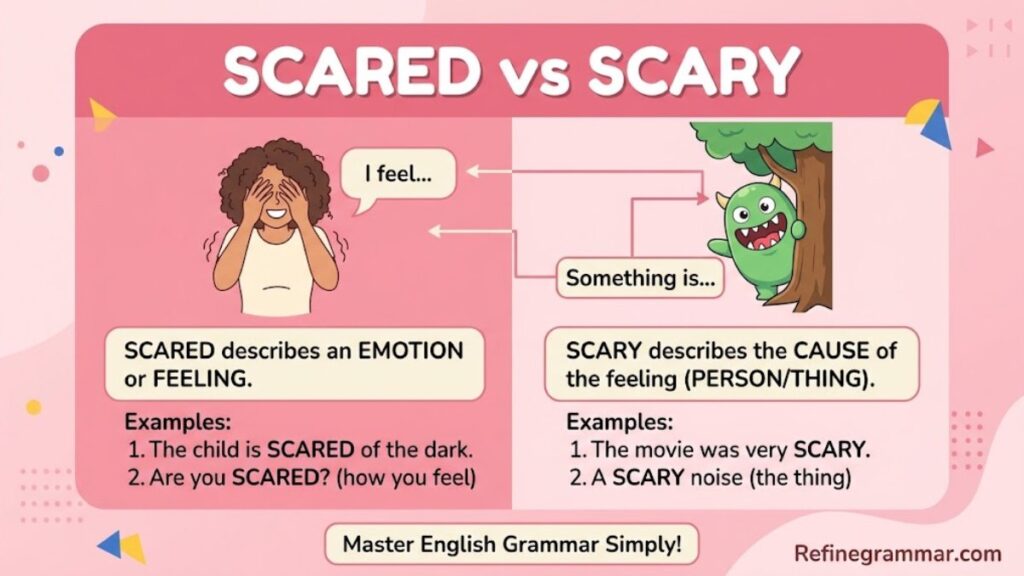
Similar to the frightened comparison, “scared” describes a person’s internal feeling, while “scary” describes an external quality. “I am scared of spiders” is correct; “Spiders are scary” is also correct but “I am scary of spiders” is not. Keeping subject and object straight resolves this confusion instantly, and it’s a useful check whenever the scarey vs scary or scared-vs-scary mix-up creeps back into your writing.
Related Word Confusions You Should Avoid
The scarey vs scary mix-up is far from the only spelling trap in English. These commonly confused word pairs trip up writers in similar ways:
- carrer or career a frequent typo in resumes and cover letters.
- cocoon or cacoon mixed up due to unfamiliar vowel patterns.
- as well or aswell one of the most common one-word errors online.
- dysregulated vs disregulated confused because of similar-sounding prefixes.
- emersion vs immersion a classic case of one letter changing the whole meaning.
- meating vs meeting an easy typo when typing quickly.
- sponser vs sponsor a spelling slip seen often in marketing copy.
- encorporate vs incorporate mixed up due to similar prefixes.
- encode vs incode another prefix-driven point of confusion.
- grately vs greatly a common misspelling of a very frequent adverb.
- submission vs submittion an extra letter that changes the whole word.
- ladle vs ladel confused because of how the word sounds when spoken.
- togather vs together one of the most searched spelling questions online.
- manuel vs manual a name-versus-word mix-up that catches many writers off guard.
Why “Scarey” Still Appears in Searches and Content
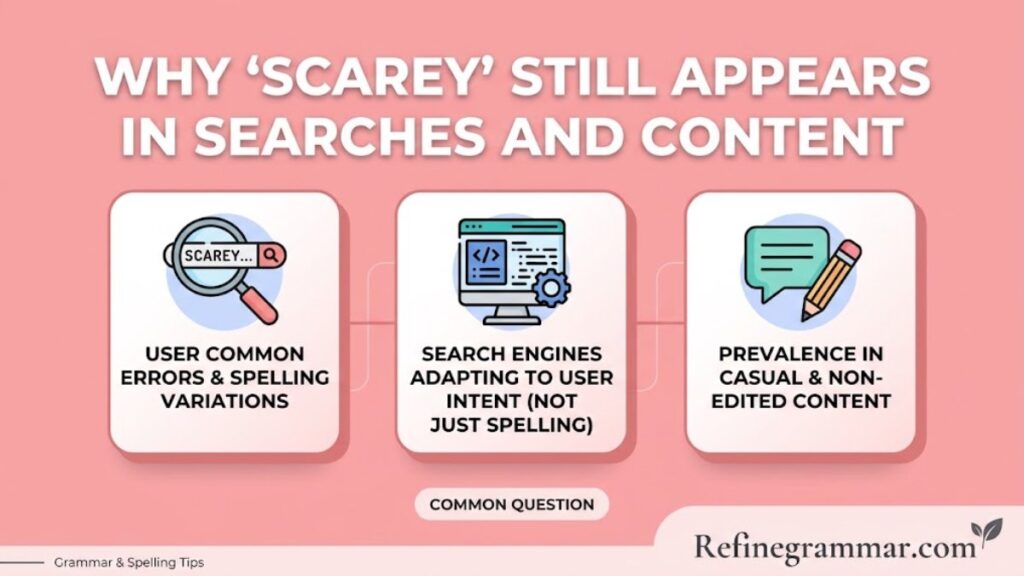
Despite being nonstandard, “scarey” keeps appearing in search bars and casual writing for a few consistent reasons: autocorrect inconsistencies across devices, older texts that used variant spellings before dictionaries standardized, and the simple assumption that the “e” in “scare” should carry over. Search engines display results for both spellings because they interpret user intent rather than correctness but that doesn’t make “scarey” acceptable in polished writing. Whenever the scarey vs scary question resurfaces in your own drafts, treat it as a quick reminder to proofread.
English Practice Session
Test what you’ve learned about scarey vs scary with a short practice round.
Multiple Choice Questions
1. Which spelling is correct? a) Scarey b) Scary c) Scarry d) Scarie
2. “Scary” is formed by: a) Adding “y” and keeping the silent “e” b) Dropping the silent “e” and adding “y” c) Doubling the final consonant d) Adding “ey”
3. Which sentence uses the word correctly? a) The movie was scarey. b) The movie was scary. c) The movie was scaryy. d) The movie was scarry.
4. “Scary” functions grammatically as a/an: a) Verb b) Noun c) Adjective d) Adverb
5. Is “scarey” valid in official Scrabble word lists? a) Yes, always b) No, never c) Only in the UK d) Only in casual games
Fill in the Blanks
1. The haunted house looked very ______ at night.
2. She told a ______ story around the campfire.
3. Public speaking can feel ______ for beginners.
4. That was a ______ moment during the storm.
5. His costume was so ______ that kids ran away.
Answers
Multiple Choice Answers
1. b) Scary
2. b) Dropping the silent “e” and adding “y”
3. b) The movie was scary.
4. c) Adjective
5. b) No, never
Fill in the Blanks Answers
1. scary
2. scary
3. scary
4. scary
5. scary
FAQs
Which is correct, “scary” or “scarey”?
“Scary” is correct. “Scarey” is a nonstandard variant not recognized by major dictionaries.
Is “scarey” a word in the dictionary?
No. It occasionally appears in informal word lists, but it is not a standard dictionary entry.
Is “scarey” a valid Scrabble word?
No. Neither the TWL nor the CSW word list accepts “scarey” as valid.
Does “scary” have an E in it?
No. The silent “e” in “scare” is dropped before adding “-y.”
Is “scary” a verb or an adjective?
“Scary” is an adjective. The related verb form is “scare.”
What is the difference between “scary” and “creepy”?
“Scary” causes general fear, while “creepy” suggests something unsettling or unnatural.
What is the difference between “scary” and “scared”?
“Scary” describes the source of fear; “scared” describes how a person feels.
Is “scarey” used differently in UK English?
No. British English also treats “scary” as the only correct spelling.
What are some good synonyms for “scary”?
Frightening, terrifying, alarming, eerie, and spine-chilling all work well.
How do you spell “scary” correctly?
Drop the silent “e” from “scare” and add “y”: s-c-a-r-y.
Final Thoughts
The scarey vs scary debate ultimately has a simple resolution: “scary” is the correct, dictionary-recognized spelling across every English-speaking region, while “scarey” remains a nonstandard variant best avoided in formal and everyday writing alike. Remembering the root word “scar” and the standard “drop-the-e” spelling rule will keep you confident every time this word shows up in your writing. The next time you catch yourself typing scarey vs scary into a search bar, you’ll already know the answer.
