
If you’ve ever paused mid-sentence wondering whether to type fairing or faring, you’re not alone. These two words are perfect homophones they sound completely identical out loud yet they belong to entirely different parts of speech and carry entirely different meanings.
One names a solid, physical object you can touch; the other describes an abstract state of progress or wellbeing.Getting fairing or faring wrong in a sentence can quietly undermine your credibility, whether you’re writing a technical spec sheet, a customer email, or a heartfelt message to a friend.
This guide walks through every angle of the fairing or faring debate meanings, rea-lworld examples, memory tricks, regional usage patterns, and the ten questions people search for most so you never have to second-guess yourself again.
Quick Answer: Fairing or Faring?
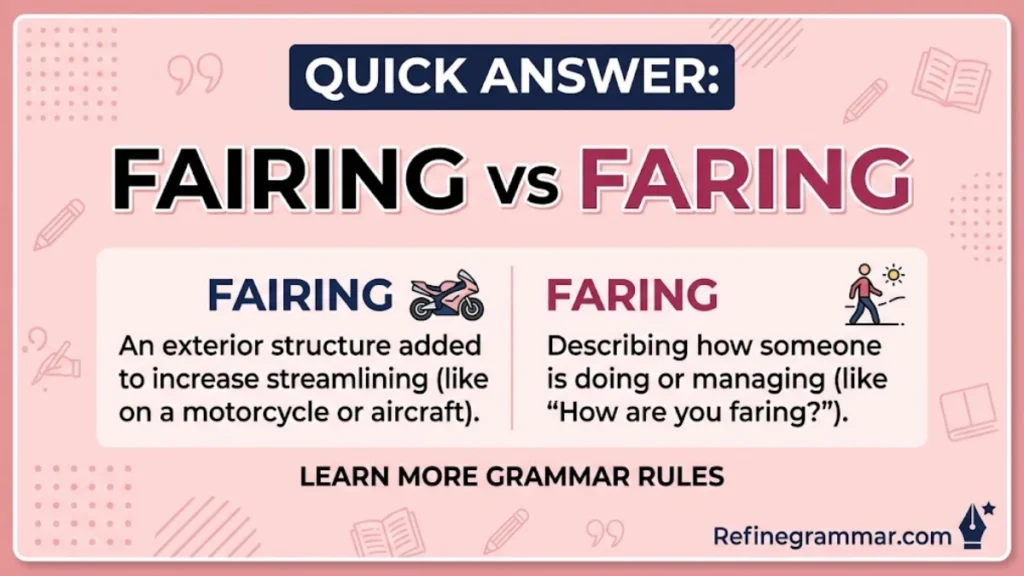
Here’s the short version of the fairing or faring answer before we go deeper:
- Fairing (noun) a smooth structural covering that reduces drag, most often seen on motorcycles, cars, aircraft, and boats.
- Faring (verb) the present participle of “to fare,” describing how someone or something is doing, progressing, or getting along.
A simple rule settles the fairing or faring question almost every time: if you can point to it, it’s a fairing; if you’re asking about someone’s condition or progress, it’s faring.
Meaning of “Fairing”
A fairing is a rigid or semi-rigid structure whose primary purpose is to smooth out a vehicle’s shape and cut down aerodynamic or hydrodynamic drag. It’s a physical, engineered part never an emotion, an action, or a state of being.
Common Uses of “Fairing”
- Motorcycles the plastic or fiberglass shell wrapped around the frame and engine
- Cars and race vehicles aerodynamic panels over wheels or the undercarriage
- Aircraft smooth covers filling the gap between wing and fuselage
- Boats and ships hull coverings that reduce water resistance
- Spacecraft the nose fairing that protects a satellite payload during launch
Because fairing names a physical object, it can be pluralized: fairings. Example: “The bike’s fairings cracked after the crash.” This is one of the clearest signals in the entire fairing or faring debate if a word can take an “-s” and still make sense, you’re dealing with the noun.
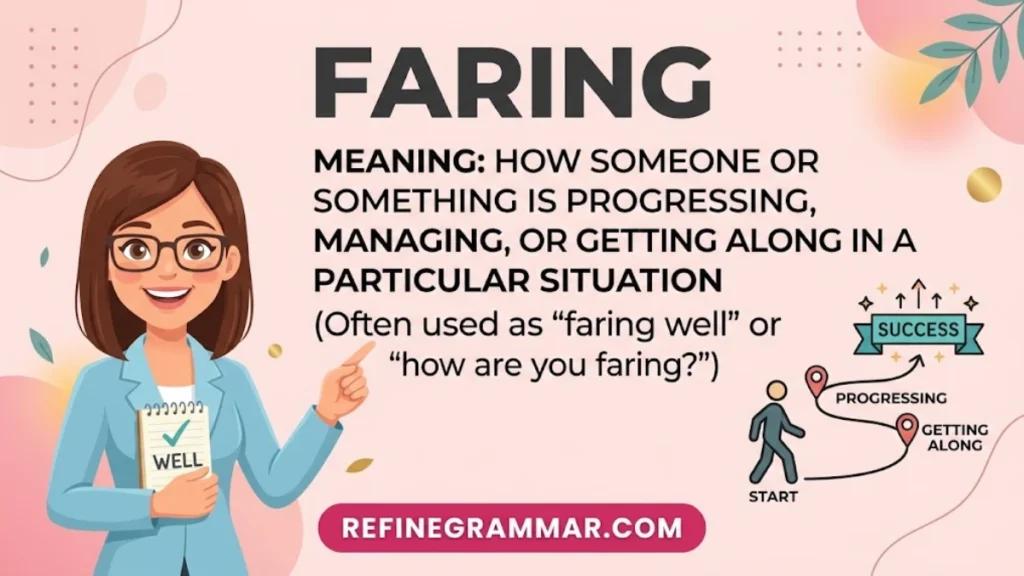
Meaning of “Faring”
Faring comes from the verb “to fare,” meaning to get along, progress, or experience a particular outcome. It’s almost always paired with a question word or an adverb describing quality well, badly, better, poorly.
Common Uses of “Faring”
- “How are you faring after the move?”
- “The company is faring well despite the market downturn.”
- “He’s faring better than expected after surgery.”
- “Local businesses are faring poorly this quarter.”
Unlike fairing, faring can never be turned into a plural noun it remains a verb form describing a state or condition, not a countable object.
Key Differences Between Fairing and Faring
The table below settles the fairing or faring comparison at a glance:
| Fairing | Faring | |
| Part of speech | Noun | Verb (present participle) |
| Refers to | A physical covering or shell | How someone/something is progressing |
| Can be plural? | Yes (fairings) | No |
| Typical subject | Vehicles, machines | People, businesses, situations |
| Example | “Replace the fairing.” | “How is she faring?” |
The easiest test: if you can point to it, it’s a fairing; if you’re describing progress or condition, it’s faring.
Common Mistakes People Make
1. Using “fairing” in place of “faring” writing “How are you fairing?” instead of “How are you faring?” This is the more common of the two fairing or faring mistakes, since faring appears less often in everyday reading.
2. Using “faring” for a motorcycle part writing “the faring is cracked” when it should read “the fairing is cracked.”
3. Assuming a spell-checker will catch it since both words are spelled correctly on their own, most tools miss the error entirely; the mistake is purely contextual.
This kind of contextual mix-up isn’t unique to fairing or faring English is full of similarly confusable pairs, from career or carrer to sponser vs sponsor, and the fix is always the same: learn the rule once, and the confusion disappears for good.
Memory Tricks to Never Confuse Them Again
- “Fairing” has “air” in it picture air flowing smoothly around a fairing to cut drag. Fairing = physical, aerodynamic.
- “Faring” rhymes with “sharing” and “caring” both are about people and how they’re doing.
- Swap test if you can replace the word with “covering” or “shell,” it’s fairing; if you can replace it with “doing” or “getting on,” it’s faring.
American vs British English Differences
The spelling and core meaning of both words are identical in American and British English there’s no regional variant here, unlike pairs such as colour/color. What differs is frequency of use:
- British English uses “How are you faring?” somewhat more often in everyday conversation, journalism, and formal correspondence.
- American English leans toward “How are you doing?” in casual speech, reserving faring for slightly more formal or written contexts such as news reports and business updates.
- Fairing as a technical term is used identically on both sides of the Atlantic, especially in motorsport, aerospace, and marine engineering writing.
When to Use “Fairing” in Technical Writing
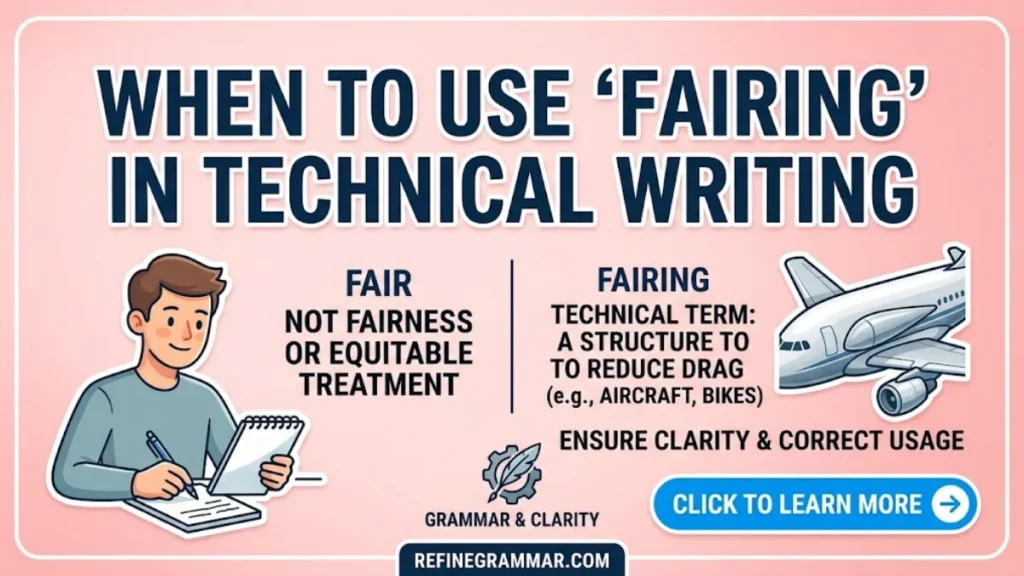
- Motorcycle or car body panels
- Aerodynamic covers on aircraft or spacecraft (e.g., a rocket’s “nose fairing”)
- Boat and ship hull coverings
- Engineering and product documentation describing drag-reducing components
Example: “The payload fairing separates from the rocket once the vehicle reaches the upper atmosphere.” In every one of these contexts, fairing or faring confusion simply isn’t an option only the noun fits.
When to Use “Faring” in Conversation or Writing
- “How is the new employee faring in her role?”
- “Local businesses are faring poorly this quarter.”
- “How are you faring, given everything that’s happened?”
- “The patient is faring well one week after treatment.”
If you can naturally ask “how is it going?” as a substitute, faring is the right word every time.
Why These Words Get Confused So Often
1. Identical pronunciation both are true homophones, so listeners can’t distinguish them by ear alone.
2. Low visibility of “faring” most people encounter “fairing” more often visually (motorcycles, cars), so it starts to feel like the default spelling.
3. No spell-check warning since both are correctly spelled real words, autocorrect tools rarely flag a context error.
This is a classic homophone trap, similar in nature to as well or aswell or meating vs meeting correct spelling alone never guarantees correct usage, and the fairing or faring mix-up is one of the more persistent examples in modern English.
Other Commonly Confused Word Pairs
If the fairing or faring mix-up caught you off guard, these related word pairs trip up writers just as often:
- cocoon or cacoon only one spelling is standard English.
- dysregulated vs disregulated a prefix mix-up that changes the word entirely.
- emersion vs immersion two real words with very different meanings.
- encorporate vs incorporate only one is a recognized business term.
- encode vs incode a common prefix error in technical writing.
- grately vs greatly a simple but frequent spelling slip.
- submission vs submittion the correct spelling trips up many writers.
- ladle vs ladel a kitchen-word spelling mix-up worth knowing.
Quick Practice Quiz
Test yourself on the fairing or faring rule is it fairing or faring?
1. The motorcycle’s ___ needs to be repainted.
2. How is your grandmother ___ after the surgery?
3. The rocket’s ___ protects the satellite during launch.
4. The startup is ___ well in its first year.
5. He replaced the cracked ___ on his sports bike.
Answers: 1. fairing 2. faring 3. fairing 4. faring 5. fairing
Frequently Asked Questions (FAQs)
1. Is fairing or faring correct?
Both are correct they’re just used in different contexts. Fairing is a physical covering on a vehicle or aircraft; faring describes how someone or something is progressing.
2. What does “faring well” mean?
It means doing well, progressing successfully, or getting along in good condition for example, “She’s faring well after the operation.”
3. What is the meaning of “fairing”?
A fairing is a structural shell or covering, most often on a motorcycle, car, aircraft, or boat, designed to reduce drag and protect internal components.
4. How are you faring?
This is a common way of asking how someone is doing or coping, similar to “How are you getting on?”
5. What does “I’m faring well” mean?
It means the speaker is doing fine or handling their current situation successfully.
6. Are you faring ok?
This is an informal way of asking whether someone is coping well with a situation, similar to “Are you doing okay?”
7. How do you use “faring” in a sentence?
Use it to describe progress or condition: “The team is faring better than last season” or “How is he faring in his new job?”
8. What is another word for “faring”?
Common synonyms include doing, coping, getting along, progressing, and managing.
9. What does it mean when someone says “How are you faring?”
It’s a way of checking in on someone’s wellbeing or how they’re coping with a specific circumstance, rather than a generic greeting.
10. How have you been faring?
This asks about someone’s overall wellbeing or progress over a period of time, often after a difficult event or change.
Conclusion
Mastering the fairing or faring distinction comes down to remembering one thing: fairing is a noun you can touch, faring is a verb describing how things are going. Whenever you’re unsure, run the swap test replace the word with “covering” or “doing” and the right choice for fairing or faring will be obvious. With the meanings, examples, and memory tricks in this guide, you’re now equipped to use both words correctly, every single time.
