
English is full of word pairs that sound almost identical but carry completely different meanings, and “staring” versus “starring” is a classic example. One extra letter changes a passive glance into a leading movie credit.
If you have ever paused midsentence wondering whether someone is staring at you or starring in a film, you are not alone this mixup ranks among the most searched grammar confusions online, right alongside similar mixups like career or carrer and emersion vs immersion.
This guide breaks down the staring or starring difference with clear definitions, real examples, a quick reference table, and answers to the questions people ask most. By the end, you will never secondguess staring or starring again.
Staring or Starring: Quick Answer
Main Difference
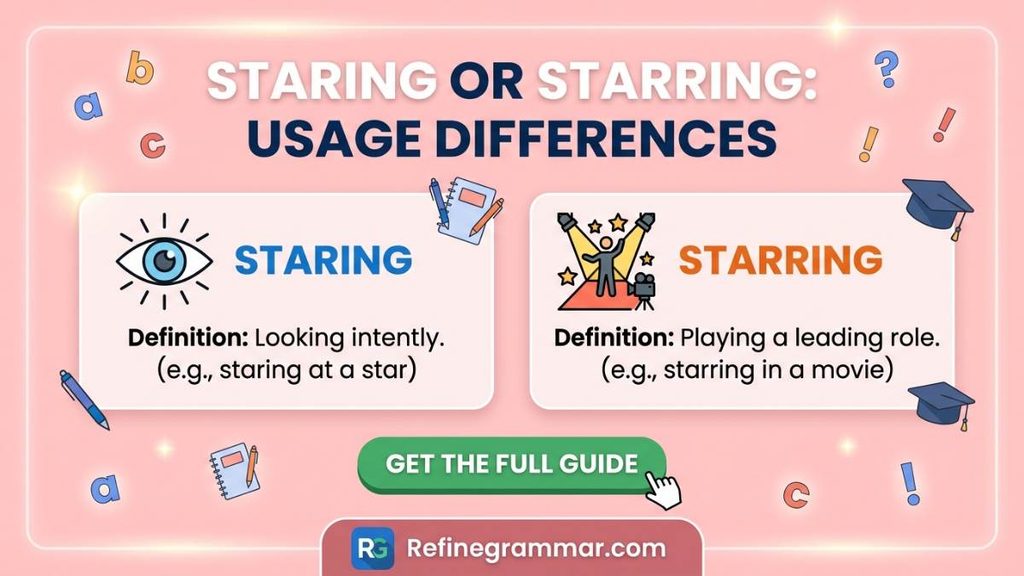
“Staring” comes from the verb stare, meaning to look at something fixedly for a long time. “Starring” comes from the noun star, meaning to feature as the lead performer in a movie, show, or event.
Examples
- She kept staring at the phone, waiting for a reply.
- The film is starring two award winning actors.
Notice the double “r” in starring that is the biggest visual clue separating the two words in the staring or starring debate.
FREE GRAMMAR CHIOCKER
Staring or Starring: Definitions with Examples
Starring (Definition)
“Starring” is the present participle of the verb star, used when someone plays the lead or a featured role in a film, series, or performance.
- The new thriller is starring an actor known for intense roles.
- Guest starring in the finale surprised longtime fans.
- Her breakout role came from starring in an indie drama.
Staring (Definition)
“Staring” is the present participle of the verb stare, meaning to look continuously at someone or something, often without blinking, out of curiosity, shock, or confusion.
- He was staring at the wall, lost in thought.
- Staring at someone for too long can feel uncomfortable.
- The kids were staring at the fireworks in awe.
Simple Meaning
If it is about looking, it is staring. If it is about acting or featuring in something, it is starring. That one line rule solves almost every staring or starring question.
What Does “Starring” Mean in Movies and Films?
In entertainment, “starring” always refers to top billing the lead cast members whose names appear first in the credits or on the poster. A movie “starring” someone means that actor carries the lead role. This word also appears in phrases like “starring role,” “guest starring,” and “costarring,” all pointing back to the same idea: featured performance, not a fixed gaze.
The Origin of Staring or Starring
Starring
Rooted in the Old English word steorra (star), the verb star evolved to describe someone who shines or stands out first on stage, later on screen. Add “ing” and double the final consonant, following standard English spelling rules, and you get “starring.”
Staring
“Staring” traces back to the Old English starian, meaning to gaze fixedly. Because the base word “stare” ends in a silent “e,” English spelling rules drop that letter before adding “ing,” giving us a single “r” in “staring.” This spelling logic is the same pattern behind other tricky pairs, such as confusing dysregulated vs disregulated or misspelling greatly as grately.
Staring or Starring: Usage Differences
Comparison Table
| Feature | Staring | Starring |
| Root word | Stare | Star |
| Meaning | Looking fixedly | Featuring as lead performer |
| Common context | Everyday behavior, emotions | Movies, TV, theatre |
| Spelling pattern | Single “r” | Double “r” |
| Example sentence | She was staring out the window. | The show is starring a rising talent. |
Which Word Should You Use?
Use “Starring” When
- Talking about a movie, TV show, or play’s lead cast
- Referring to a “starring role” or a “costarring” credit
- Describing someone’s big break into acting
Use “Staring” When
- Describing a fixed, prolonged look
- Talking about eye contact, curiosity, or shock
- Writing about someone lost in thought
Easy Memory Trick
Think: two R’s in “starring” for two names on a movie poster the lead and the colead. One R in “staring” for one steady eye. Whenever you are unsure about staring or starring, picture the poster versus the eye.
Common Mistakes with Staring or Staring
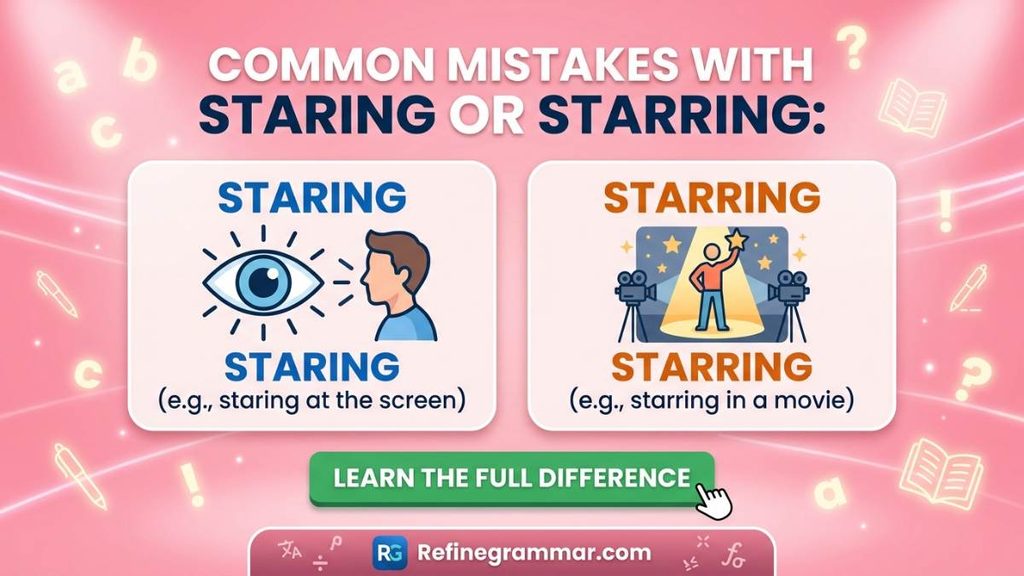
1. Mixing Both Words — Writing “staring role” instead of “starring role” is one of the most frequent slipups.
2. Wrong Context — Using “starring” to describe someone looking at another person, or vice versa.
3. Spelling Confusion — Forgetting the double “r” in starring, similar to how people misspell submission as submittion or ladle as ladel.
4. Ignoring Meaning — Assuming both words are interchangeable simply because they look alike, the way some readers mix up cocoon or cacoon.
Difference Between Staring and Starring
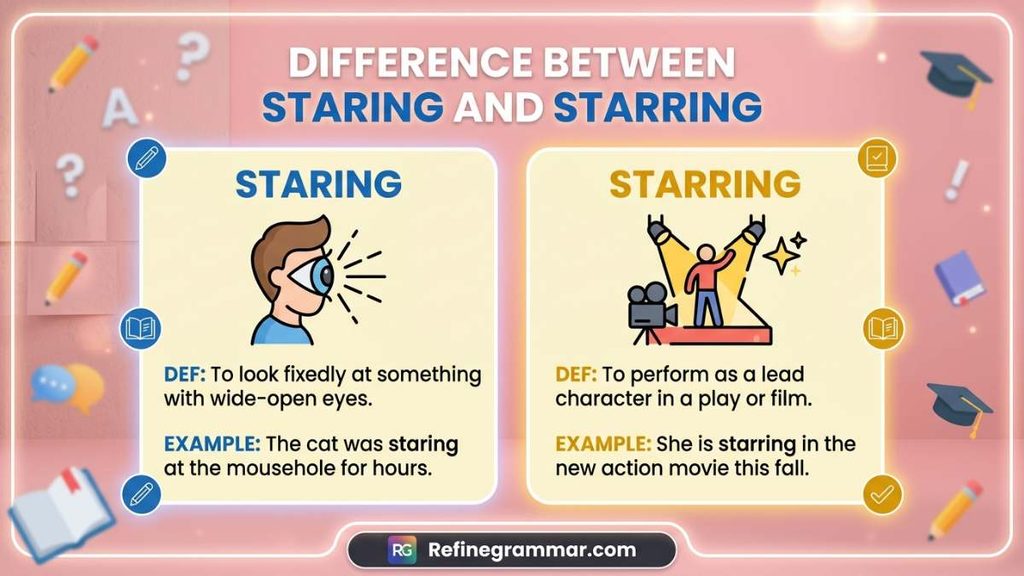
At its core, the difference is about action versus role. Staring is something anyone can do at any moment it is behavioral. Starring is a professional credit it is occupational, tied specifically to performance and media.
Staring or Starring in Everyday Examples
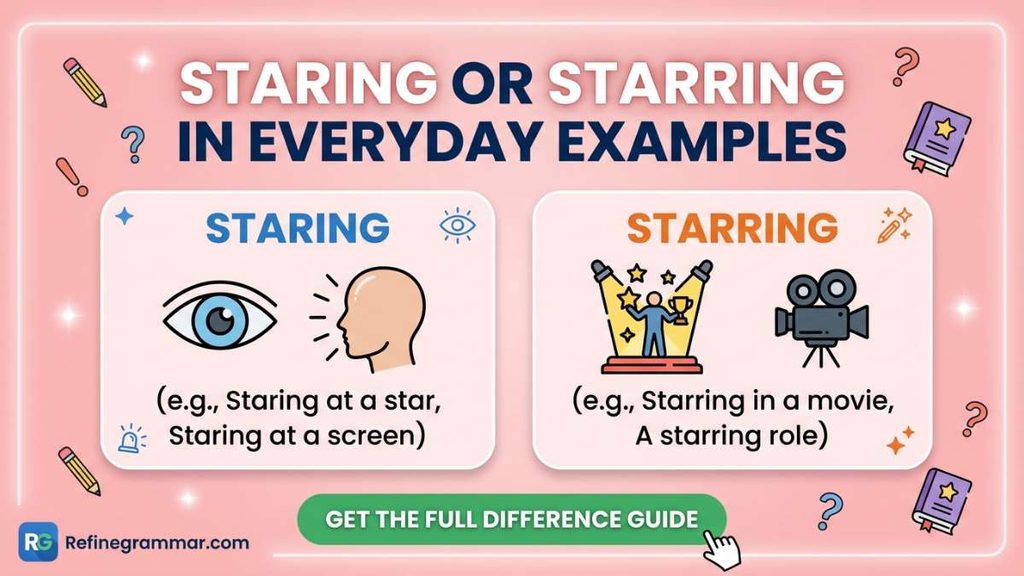
Daily Life
“Why are you staring at me like that?” is a common phrase in casual conversation always about the act of looking, not about a credit list. It is the kind of everyday slip that sits next to mishearing meating for meeting.
Social Media
Captions like “Guest starring in my best friend’s wedding video” show how “starring” has moved beyond film into everyday online content.
School
Students often confuse the two while writing essays about films, mistakenly writing “staring” when describing a movie’s lead cast much like other classroom spelling slips such as encode versus incode or as well versus aswell.
Professional Use
Marketing copy for films, ads, and press releases relies heavily on “starring” to highlight talent, in the same way brand copy must get word choice right when a company is a sponsor, not a sponser, of an event.
Staring or Starring: Usage Trends & Popularity
Search data consistently shows people typing “staring or starring” when writing about movies, credits, or captions, and typing “staring” alone far more often in everyday writing since it is simply a more commonly used verb. Interest tends to spike around major film releases and awards season, when “starring” appears heavily in press coverage.
Trend Insight
Search interest in “starring” consistently spikes whenever a major blockbuster or award season film is announced, while “staring” remains a steady, everyday search term year round.
Comparison Table
| Word | Part of Speech | Root | Meaning |
| Staring | Verb (participle) | Stare | Fixed, prolonged look |
| Starring | Verb (participle) | Star | Lead role in a production |
Common User Queries
People frequently search for phrases like “is it spelled staring or starring,” “starring or staring at someone,” and “staring vs starring pronunciation” all of which come back to the same core rule: one letter, two very different meanings.
FAQs
Which is correct, staring or starring?
Both are correct, but they mean different things staring is about looking, starring is about acting or featuring.
What is the difference between “staring” and “starring”?
Staring means gazing fixedly; starring means playing a lead role in a film or show.
Is it staring or starring in a movie?
It is “starring” as in, the movie is starring a well known actor.
What does it mean when a movie says “starring”?
It means those names hold the lead or featured roles in that production.
What does “staring” mean?
It means looking at something or someone continuously without looking away.
How do you spell when you’re staring at someone?
Spell it “staring,” with a single “r,” since it comes from “stare.”
Does stare mean look?
Yes, but specifically a long, fixed, unblinking look rather than a quick glance.
What’s another word for staring at someone?
Synonyms include gazing, gawking, and glaring, depending on the tone.
What does starring role mean?
It refers to the lead or most prominent character in a movie, show, or play.
What is another word for “starring”?
Featuring, headlining, and leading are common alternatives.
Final Thought
Staring and starring may look nearly identical, but their meanings could not be more different. Remember the double “r” for a movie’s leading role, and the single “r” for a fixed gaze. Get that one letter right the same way you would want to get incorporate, not encor porate right in a business document and you will never mix up staring or starring again.
