
If you have ever paused midsentence wondering whether to write “stopped” or “stoped,” you are not alone. The Stopped or Stoped question is one of the most common spelling doubts among English learners, students, and even professional writers. The good news is that there is a simple, memorable rule behind it, and once you understand it, you will never secondguess this word again.
In this guide, we will break down exactly why “stopped” is correct, why “stoped” is a mistake, and how a single spelling rule explains dozens of similar words in English. We will also look at realworld examples, a quickreference table, and answers to the most frequently asked questions about the Stopped or Stoped debate.
What Does “Stopped” Mean?
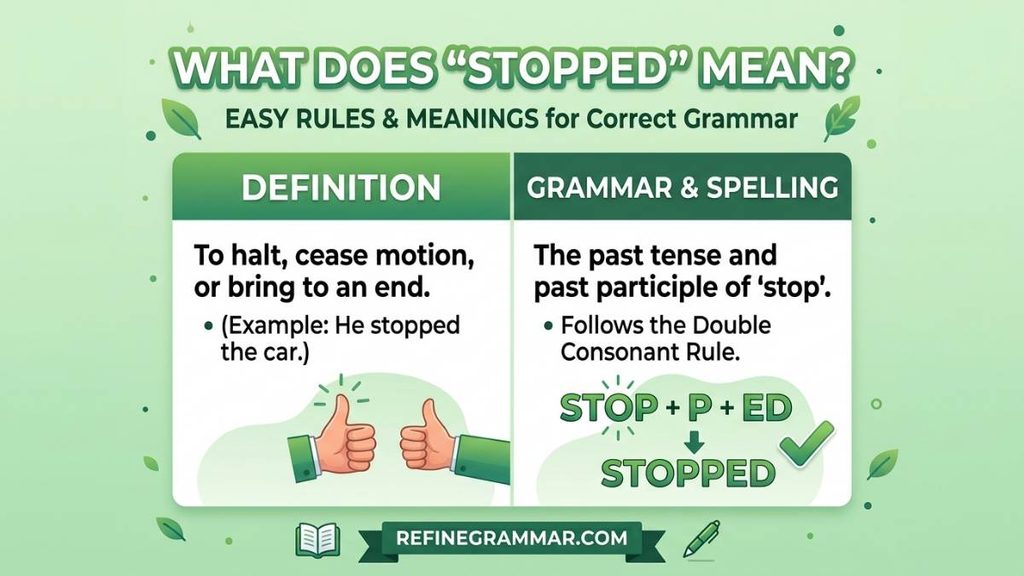
Simple Definition
“Stopped” is the past tense and past participle of the verb “stop.” It describes an action that has already ended, as in “The car stopped at the red light.”
Common Uses of “Stopped”
The word appears constantly in everyday English, from casual conversation to formal reports. Here are a few common contexts:
- Describing a completed action: “She stopped talking.”
- Describing a temporary pause: “The rain stopped for a while.”
- Describing a habit that ended: “He stopped smoking last year.”
- Describing machinery or systems: “The engine stopped suddenly.”
Why People Write “Stoped”
Most people who write “stoped” are simply applying a rule they learned for other words, where a single consonant is enough before adding “ed” (like “hoped” from “hope”). The problem is that “stop” and “hope” follow completely different spelling patterns, which is exactly what this article will clarify.
Why “Stopped” Has Double P
The doubling of the final consonant in “stopped” is not random. It follows a wellestablished grammar rule for how short, onesyllable verbs change when “ed” or “ing” is added, and understanding it resolves the Stopped or Stoped confusion for good.
Consonant Vowel Consonant Rule
The word “stop” ends in a single vowel followed by a single consonant: op. This consonantvowelconsonant (CVC) pattern signals that the final consonant should be doubled before adding a suffix that starts with a vowel, such as “ed” or “ing.” That is why “stop” becomes “stopped,” not “stoped.”
The Grammar Rule Behind “Stopped”
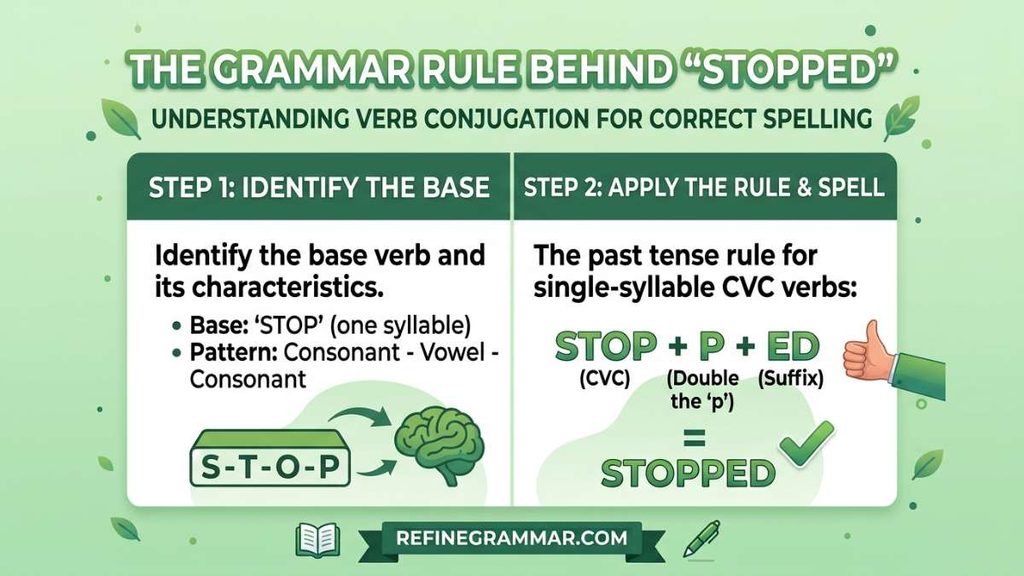
Doubling the final consonant keeps the short vowel sound intact. Without the extra “p,” the word “stoped” would visually suggest a long “o” sound, similar to “hoped” or “noped.” Doubling the consonant protects the original short vowel pronunciation of “stop.”
Why Doubling Matters
This is not just a spelling formality. Doubling the consonant preserves meaning and pronunciation at the same time. If English speakers ignored this rule, many words would become ambiguous or simply look wrong, which is why the Stopped or Stoped rule is taught early in grammar education.
When to Double the Final Consonant
English follows three conditions before doubling a final consonant. When a word meets all three, doubling is required.
The Word Has One Syllable
Short, onesyllable verbs like “stop,” “plan,” and “grab” typically double their final consonant.
The Word Ends in Consonant Vowel Consonant
The CVC pattern is the core trigger. If a word does not end this way, the doubling rule does not apply.
The Stress Falls on the Final Syllable
For longer words, the stressed syllable must be the final one. This is why “prefer” becomes “preferred,” but “visit” becomes “visited,” not “visitted.”
Examples of Similar Words
Once you understand the Stopped or Stoped rule, you can apply it confidently to other short verbs:
- Plan → Planned (not “planed”)
- Grab → Grabbed (not “grabed”)
- Drop → Dropped (not “droped”)
- Chat → Chatted (not “chated”)
- Shop → Shopped (not “shoped”)
Words That Do NOT Double the Final Consonant
Not every verb follows the doubling pattern. Recognizing the exceptions is just as important as knowing the rule itself.
Long Vowel Sounds
Words with a long vowel sound, or that end in a vowelvowelconsonant pattern, do not double the final letter. For example, “hope” becomes “hoped,” and “eat” becomes “ate” (irregular, but never doubled).
TwoSyllable Words Without Final Stress
When the stress falls on the first syllable, doubling is skipped. “Offer” becomes “offered,” not “offerred,” because the stress lands on “OFFer,” not the final syllable.
Stopped vs Stoped: Side by Side Comparison
| Feature | Stopped (Correct) | Stoped (Incorrect) |
| Part of speech | Verb (past tense/participle) | Not a standard English word |
| Spelling rule | Follows CVC doubling rule | Ignores doubling rule |
| Pronunciation match | Matches short vowel sound | Suggests a long vowel sound |
| Dictionary status | Listed in all major dictionaries | Not recognized as standard usage |
| Common context | Everyday and professional writing | Typing error or ESL mistake |
How “Stopped” Is Used in Everyday English
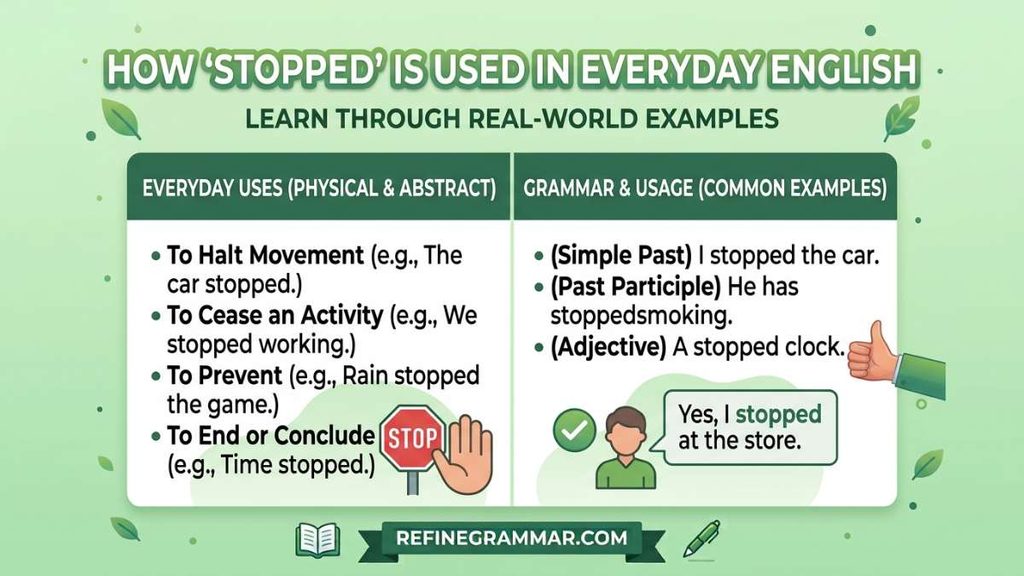
Because “stop” is one of the most frequently used verbs in English, getting the Stopped or Stoped spelling right matters across nearly every type of writing, from texting to technical documentation.
Everyday Conversation Examples
Examples
- “We stopped for coffee on the way home.”
- “The bus stopped right in front of the store.”
- “I stopped watching the show after season two.”
Correct Business Usage
In workplace communication, precision matters for credibility, so professionals should apply the doubling rule correctly in formal emails and reports:
- “Production was stopped due to a supply chain issue.”
- “The project was stopped pending client approval.”
Correct Academic Usage
Academic writing demands accuracy, so students should never confuse Stopped or Stoped in essays, theses, or research papers:
- “The experiment was stopped once the reaction stabilized.”
- “Researchers stopped the trial early due to conclusive results.”
Why People Misspell “Stopped”
The Stopped or Stoped mistake usually comes down to a handful of predictable causes.
Fast Typing and Autocorrect Dependence
Many people type quickly on mobile keyboards and rely on autocorrect, which does not always catch “stoped” since it resembles other valid words.
Free Grammar Chacker
English as a Second Language Challenges
For nonnative speakers, doubling rules are not intuitive because many languages do not double consonants for tense changes, making the Stopped or Stoped confusion common among ESL learners.
Pronunciation Confusion
Because “stop” and “stope” (a rare mining term) look visually similar once “ed” is added, writers sometimes default to the singleconsonant spelling without realizing the pronunciation changes.
Common Grammar Mistakes Similar to “Stoped”
The Stopped or Stoped issue is part of a much larger family of English spelling confusions. Writers who struggle with one usually struggle with several others.
Frequently Misspelled Words
English is full of tricky lookalike pairs. Some of the most searched examples include careerrelated spelling mistakes, the cocoon or cacoon spelling confusion, and the as well or aswell mixup. Health and psychology writers frequently run into the dysregulated vs disregulated debate, while students often mix up the emersion vs immersion confusion.
Typing errors are just as common. A rushed message can easily turn “meeting” into the meating vs meeting typo, or “sponsor” into the sponser vs sponsor spelling error. Business writers should also watch for the encorporate vs incorporate error and the encode vs incode mixup, while the grately vs greatly mistake, the submission vs submittion error, and the ladle vs ladel confusion round out the list of commonly searched spelling pairs.
American English vs British English Differences
Stopped
Unlike some verbs that change spelling between American and British English (such as “traveled” vs “travelled”), “stopped” is spelled the same way in both varieties. The Stopped or Stoped rule is universal across all major English dialects, which makes it one of the more reliable spelling rules to memorize.
Spelling Affects Search Rankings
For content creators and bloggers, spelling accuracy directly affects SEO. Search engines associate correctly spelled content with higher quality and trustworthiness, so resolving the Stopped or Stoped question properly can even influence how an article ranks.
Correct Spelling Improves Readability
Misspellings interrupt a reader’s flow and can undermine credibility, especially in resumes, business emails, and academic submissions. Getting “stopped” right signals attention to detail.
Easy Tricks to Remember “Stopped”
Think About the Short Vowel Sound
Compare
Say “stop” and “stope” out loud. Notice how different the vowel sounds are. Doubling the “p” keeps the short “o” sound from “stop” intact in “stopped.”
Remember the CVC Pattern
Quick Examples
- Stop (CVC) → Stopped
- Plan (CVC) → Planned
- Hope (CVCe) → Hoped (no doubling, silent e)
Read the Word Out Loud
If reading “stoped” out loud makes you want to rhyme it with “hoped” or “roped,” that is your cue that the spelling is wrong. Trust your ear as a backup to the rule.
Real World Case Study: Why One Letter Matters
A single missing letter can change meaning entirely. In mining terminology, “stope” refers to an excavated underground chamber, so “stoped” is only correct in that narrow technical context, not as the past tense of “stop.” Confusing the two risks sounding unintentionally technical in everyday writing.
Read More: Shute vs Chute: The Ultimate Guide to Correct Spelling
Popular Grammar Checkers
Most grammar checkers, including builtin browser spellcheckers, flag “stoped” and suggest “stopped.” Because “stoped” is a rare valid mining term, some tools may not always catch it, so writers should not rely on software alone.
The Psychology Behind Spelling Errors
Errors like Stopped or Stoped often happen because the brain processes familiar sound patterns faster than visual spelling rules, so writers default to writing a word the way it sounds.
Why English Spelling Feels So Inconsistent
English borrows heavily from Latin, French, and German, which is why spelling rules can feel contradictory. The consonantdoubling rule is one of the few consistent patterns learners can rely on.
Tips for Avoiding Spelling Mistakes in Writing
Slow Down During Editing
Rushed writing is the biggest cause of spelling slips. Reviewing a draft slowly, ideally out loud, catches errors like “stoped” before publishing.
Use Grammar Tools as Helpers, Not Replacements
Spell checkers are useful first filters, but should never replace a final human readthrough.
Build Pattern Recognition
The more short verbs you practice with the CVC rule, the more automatic correct spelling becomes.
Common Search Queries Related to “Stopped or Stoped”
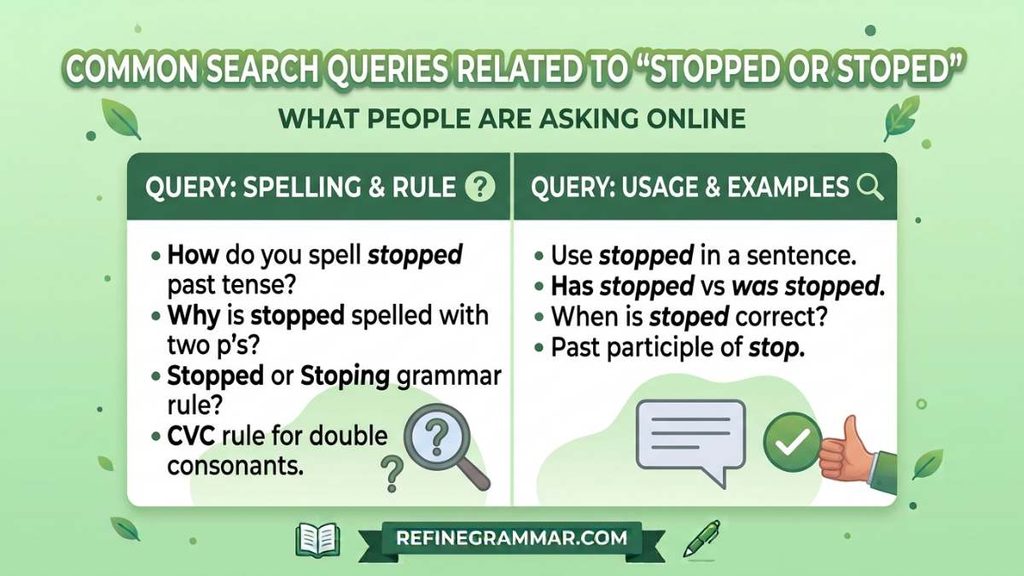
Popular Variations
- “is it stopped or stoped”
- “stopped or stoped correct spelling”
- “why is stopped spelled with two p’s”
- “stoped meaning”
Quick Reference Table for Consonant Doubling
| Base Word | Correct ed Form | Rule Applied |
| Stop | Stopped | CVC, one syllable |
| Plan | Planned | CVC, one syllable |
| Refer | Referred | CVC, final stress |
| Offer | Offered | No doubling, firstsyllable stress |
| Hope | Hoped | Silent e, no doubling |
The Final Verdict on Stopped or Stoped
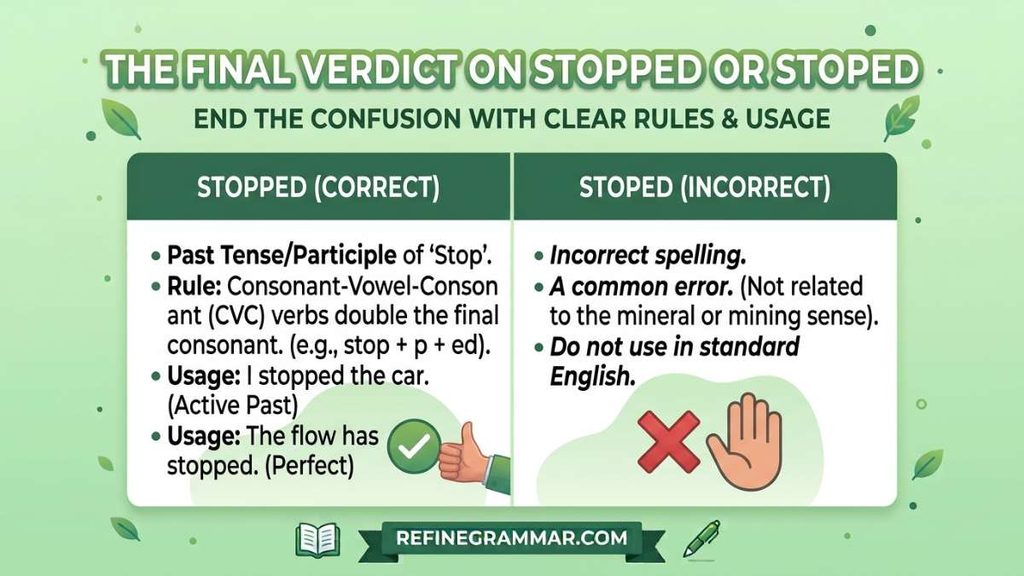
Correct Spelling
“Stopped” is the only correct way to write the past tense of “stop” in everyday English.
Incorrect Spelling
“Stoped” is incorrect in this context and should be avoided outside of specialized mining terminology.
FAQ
Is it spelled “stoped” or “stopped”?
It is spelled “stopped.” “Stoped” is not standard English outside of mining terminology.
Is “stopped” a real word?
Yes, “stopped” is a real, widely used word listed in every major English dictionary.
Is “stopped” correct grammar?
Yes, “stopped” is grammatically correct as the past tense and past participle of “stop.”
Which is correct — “I stop” or “I stopped”?
Both are correct, but “I stop” is present tense while “I stopped” describes a completed past action.
What’s the difference between “stop” and “stopped”?
“Stop” is the presenttense base verb, while “stopped” is its past tense and past participle form.
What is another word for “stopped”?
Synonyms include “halted,” “ceased,” “ended,” and “paused,” depending on context.
What does “stopped by” mean?
“Stopped by” means to visit briefly, as in “She stopped by the office on her way home.”
Which is correct — “stops” or “stopped”?
“Stops” is present tense for thirdperson singular, while “stopped” is the past tense form.
What does “Stope” mean?
“Stope” is a mining term referring to an underground excavation created to remove ore.
What is a better word for “stopped”?
“Halted” or “ceased” can work as more formal alternatives to “stopped” in professional writing.
Final Thought
The Stopped or Stoped debate comes down to one simple rule: double the final consonant after a short vowel before adding “ed.” Once you remember this pattern, “stopped” will never trip you up again. Keep this rule in mind, and your writing will stay accurate, professional, and easy to trust.
